Largest Comet to Date Approaching the Sun

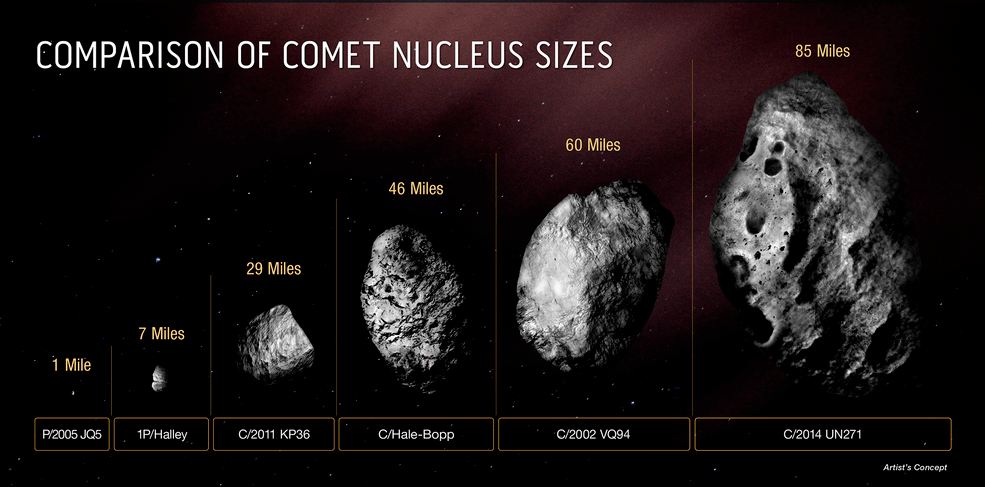
Image (Credit): Comparison of comet C/2014 UN271 (Bernardinelli-Bernstein) to several other comets. (NASA, ESA, Zena Levy (STScI))

A monster comet that takes 3 million years to circle the Sun is being closely analyzed by astronomers. The comet, C/2014 UN271 (Bernardinelli-Bernstein), will come closest to the Sun in 2031, but even then it will be about 1 billion miles away. At the most distant point in its orbit, the comet is about half a light year away from the Sun.

As shown in the graphic above, this is a large comet that could fully cover the state of Rhode Island. It was first detected by astronomers back in November 2010, when it was still 3 billion miles from the Sun. With the help of the Hubble Space Telescope, the astronomers were able to learn more about it this year.

The comet is believed to be a product of the Oort Cloud circling far outside our solar system. Of course, the Oort Cloud itself is a theory that has never been directly observed. But what about the Voyager spacecraft that left our solar system? Well, if you are willing to wait another 300 years, and the spacecraft are still working, you may have an answer.

You can read more about the comet at this NASA site.

A Day in Astronomy: The First Human in Outer Space

Image (Credit): Russian cosmonaut Yuri Gagarin before his first flight on April 12, 1961. (London Science Museum)

On this day in 1961, Russian cosmonaut Yuri Gagarin became the first human to go into outer space. He was launched into orbit aboard the Soviet Vostok 1 spacecraft. He orbited the Earth for 108 minutes before landing in Kazakstan. He did not come down in the capsule, but instead landed separately using a parachute.

Yuri Gagarin was later quoted as saying:

When I orbited the Earth in a spaceship, I saw for the first time how beautiful our planet is. Mankind, let us preserve and increase this beauty, and not destroy it!

It was his only flight into space. He died in 1968 in a training flight accident.

The following month, on May 5, 1961, Alan B. Shepard became the first American in space. He was aboard a Mercury capsule named Freedom 7. 

Image (Credit): Reentry capsule of the Vostok 1 with charring and its parachute on the ground after landing in Kazakhstan. (European Space Agency)

In Case You Missed It: Farming on Mars

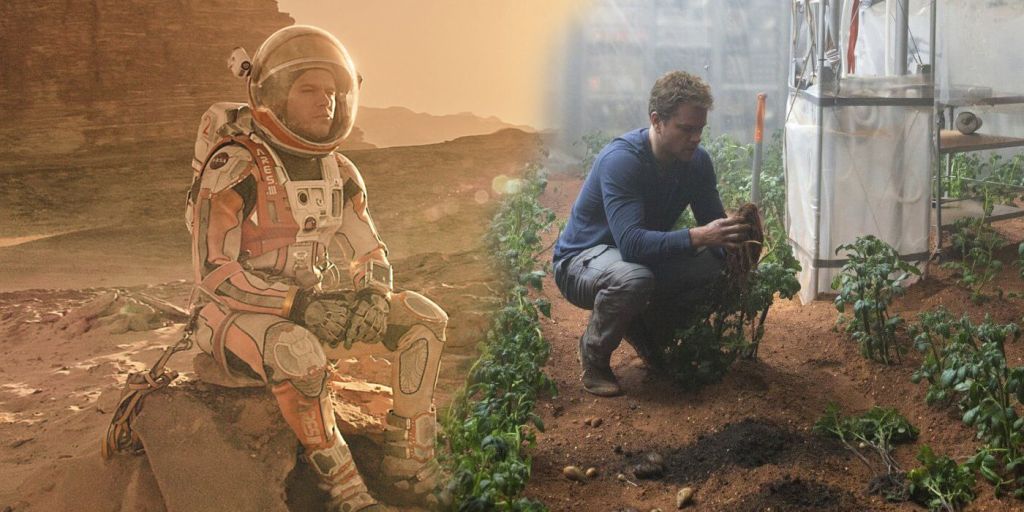
Image (Credit): Matt Damon on Mars in the film The Martian. (20th Century Fox)

Back in a November 2020 article, Science News discussed the difficulties of farming on Mars, noting it was not as easy as Matt Damon’s character made it seem in the film The Martian. In fact, toxins discovered in the Martian soil has proven that growing potatoes with a bit of man-made manure is not possible.

In the article, “Farming on Mars will be a Lot Harder Than ‘The Martian’ Made it Seem,” the author noted that researchers put together a variety of soil samples to match the surface of Mars and determined that the soil that most closely matched the Martian soil was unable to grow vegetation for any length of time. Once that soil was modified to include calcium perchlorate, which makes up about 2 percent of Martian soil, nothing could grow at all. In other words, Matt Damon would have starved if he only had a latrine to support him.

The researchers are testing other possible soil types using materials that can be found on Mars, so Martian potatoes (or at least legumes) may be possible. We will just need to send Mr. Damon back to Mars to test these new approaches.

Extra: The BBC’s Science Focus website posted a more hopeful article around the same time highlighting what can be grown on Mars, but it also outlined a number of problems that will impact Martian farming, including less sunlight, lower temperatures, thinner atmosphere, radiation, and extreme seasonal variations. We don’t always realize how good we have it back here on our home planet.

Space Quote: Space Cowboys or Space Tourists?

Image (Credit): SpaceX AX-1 mission to the International Space Station. (SpaceX)

“We are not space tourists.”

– Statement by Michael López-Alegría who traveled as a private citizen (and former NASA astronaut) to the International Space Station (ISS) on Friday as part of SpaceX’s AX-1 mission.

Why does this remind me of the statement “I am not a crook”? Mr. López-Alegría leads the mission carrying three wealthy passengers who spent about $55 million apiece to stay on the ISS for eight days and basically get in the way of working astronauts. I thought Bigelow was working on inflatable space hotels. Wouldn’t that be more appropriate? And maybe that $55 million could go towards STEM classes for students who want to go to space as a career rather than a joyride. Just an idea.

Image (Credit): Artist’s rendering of a Bigelow inflatable space station. (Bigelow Space Ops)

Most Distant Galaxy on Record

Image (Credit): This timeline illustrates the earliest galaxy candidates as well as the history of the universe.(Harikane et al., NASA, EST and P. Oesch/Yale)

Just recently I posted about the discovery of the farthest star. Well, now astronomers have spotted the farthest galaxy. The Harvard Gazette reports that a galaxy named HD1 appears to be about 13.5 billion light-years away and may contain the universe’s first stars or even the earliest black hole discovered to date. The contents of this galaxy is still being studied (and theorized).

The story quotes Fabio Pacucci, an astronomer at the Center for Astrophysics who was involved in the discovery, who stated:

Answering questions about the nature of a source so far away can be challenging… It’s like guessing the nationality of a ship from the flag it flies, while being faraway ashore, with the vessel in the middle of a gale and dense fog. One can maybe see some colors and shapes of the flag, but not in their entirety. It’s ultimately a long game of analysis and exclusion of implausible scenarios.

More review of the data as well as updated data from the James Webb Space Telescope at some point in the future should help to answer questions related to this galaxy.

You can read more about this discover in the Astrophysical Journal. You may also be interested in the accompanying paper published in the Monthly Notices of the Royal Astronomical Society Letters,