Pic of the Week: Interacting Galaxy Pair

Image (Credit): Hubble image of colliding galaxies – NGC 169 (bottom) and IC 1559 (top). (ESA/Hubble & NASA, J. Dalcanton, Dark Energy Survey, DOE, FNAL/DECam, CTIO/NOIRLab/NSF/AURA, SDSS)

This week’s image comes again from the Hubble Space Telescope, which is keeping us entertained as the James Webb Space Telescope cycles through its required observations and spins off images from time to time.

While an earlier image appeared to show colliding galaxies, though it was believed to be an optical illusion, the collision above is real. Below is more on the image from the European Space Agency’s (ESA) Hubble site:

Galaxies can merge, collide, or brush past one another — each of which has a significant impact on their shapes and structures. As common as these interactions are thought to be in the Universe, it is rare to capture an image of two galaxies interacting in such a visibly dynamic way. This image, from the NASA/ESA Hubble Space Telescope, feels incredibly three-dimensional for a piece of deep-space imagery. 

The subject of this image is named Arp 282, an interacting galaxy pair that is composed of the Seyfert galaxy NGC 169 (bottom) and the galaxy IC 1559 (top). If you’re interested in learning more about Seyfert galaxies, you can read about the Seyfert galaxy NGC 5728 here. Interestingly, both of the galaxies comprising Arp 282 have monumentally energetic cores, known as active galactic nuclei (AGN), although it is difficult to tell that from this image. This is actually rather fortunate, because if the full emission of two AGNs was visible in this image, then it would probably obscure the beautifully detailed tidal interactions occurring between NGC 169 and IC 1559. Tidal forces occur when an object’s gravity causes another object to distort or stretch. The direction of the tidal forces will be away from the lower-mass object and towards the higher mass object. When two galaxies interact, gas, dust and even entire solar systems will be drawn away from one galaxy towards the other by these tidal forces. This process can actually be seen in action in this image — delicate streams of matter have formed, visibly linking the two galaxies.

Soyuz Launch to Space Station a Success

Image (Credit): The Soyuz MS-22 rocket launch from earlier today. (NASA/Bill Ingalls)

Earlier today, the Russian Soyuz MS-22 rocket launched from Kazakhstan and successfully placed three new inhabitants on the International Space Station (ISS): NASA astronaut Frank Rubio and Russian cosmonauts Sergey Prokopyev and Dmitri Petelin. The three will stay on the ISS for the next six month, while three cosmonauts will be returning to Earth next week after completing their own six month tours.

Even with all of the Russian posturing back on the surface, it is great to see the ISS team is remaining above the fray. That is, if you ignore the flag-waving antics of the three returning cosmonauts. Sorry, I could not leave it alone.

Moon World Resort: Why Leave Earth?

Image (Credit): Artist’s rendition MOON Dubai, depicted close to the Palm Jumeriah and Burj Al Arab. (Moon World Resort)

It is quite the slogan to sell the Moon to the masses: “12 people have been there, 7 billion want to visit.” But this is not Elon Musk talking. This is a new real estate project aiming to bring the Moon to Earth in multiple locations in order to push shopping malls, spas, and condos. And maybe even conduct some space training, but I would not hold your breath (in your luxury pool).

On its Facebook page, Moon World Resort has a bold vision:

Moon World Resorts Inc. is proud to introduce the reinvention of the famed Las Vegas strip; unveiling MOON, the next giant leap for Hospitality, Entertainment, Technology and Attraction Tourism.

As a futuristic “building of global significance”, MOON will be heralded as an Architectural, Engineering and Design icon; delivering an additional 10 million annual tourists to Las Vegas, during its inaugural year!

So what is it exactly? Here are some details:

  • 735 feet (224 meters) high;
  • 5.5 million square feet (516 thousand square meters);
  • a lunar sphere 650 feet (198 meters) in diameter;
  • 4000 luxury hotel suites within the sphere;
  • various commercial endeavors, including a Convention Center, Event Center, Holistic Wellness Spa, Fitness Center, Arena, Beach Club, Night Club, Star Chef Restaurants, Boutique Plaza, E-Sports Center, Aquatic Center, Lagoon, Ballrooms, Meeting Space, Casino, Show Theater, Discovery Center, Amphitheater, Planetarium, Observatory and various Sports Facilities; and
  • a Lunar Colony attraction.

The cities targeted for this “shoot for the moon” project include one in North America (USA, with Las Vegas already named in the press release), South America (Brazil), Europe (Spain), MENA (UAE) and three in the Asia Pacific Region (China, Japan, India).

All the project needs now is investors to drop about $5 billion on this idea. Until this idea becomes a reality, you can spend your hard earned money on pretend Star Wars adventures in Florida. I guess it’s better than sending tourists to the International Space Station where they will only get in the way.

You can always find a customer for this stuff, and Las Vegas does seem like a logical place to start. Water is already in short supply in the Las Vegas desert, as it is on the Moon. Hence, this may be the perfect time to test lunar water recycling ideas with or without the lunar sphere.

Astronomy Ideas on Borrowed Time?

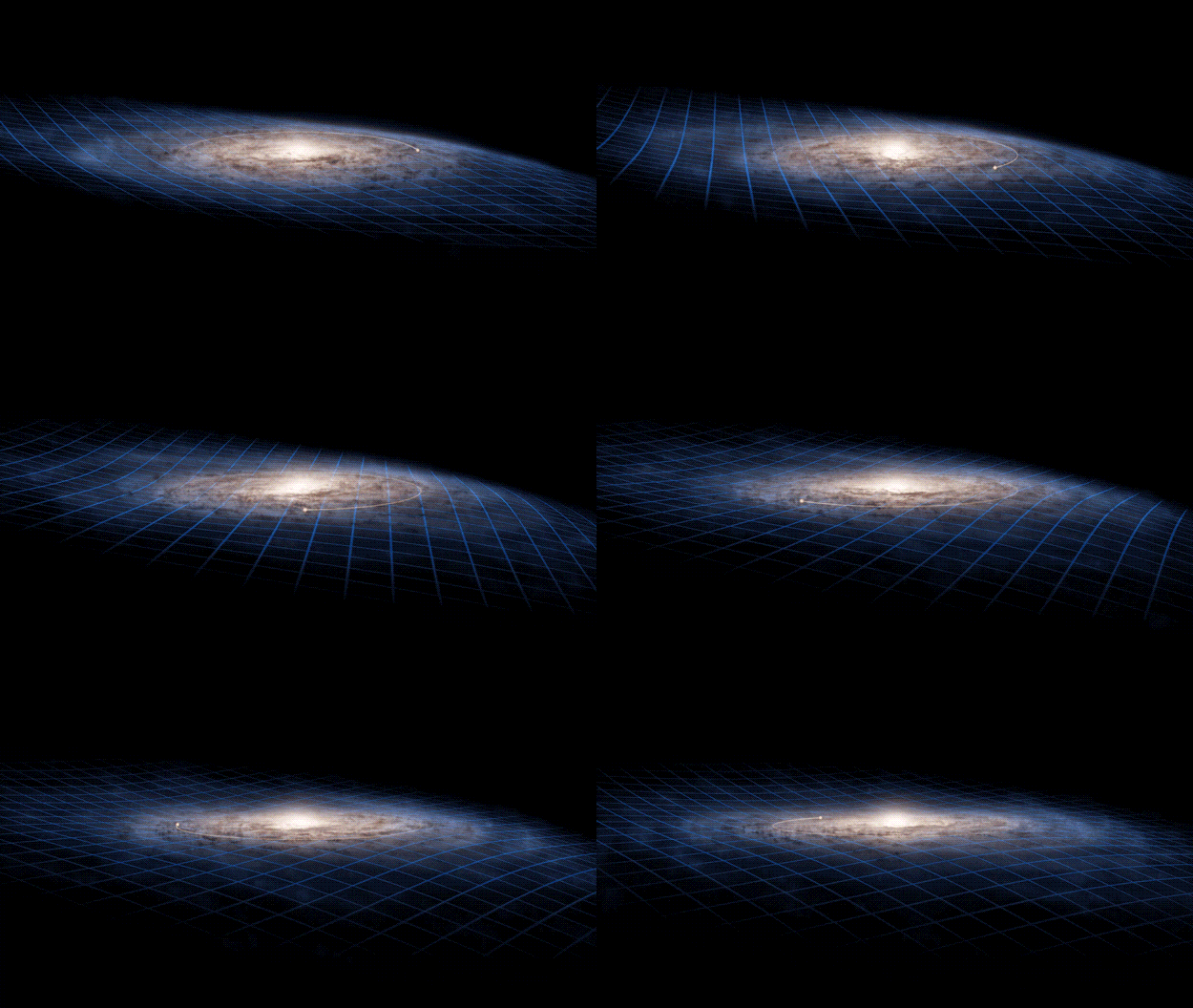
Image (Credit): The position of our Sun as it orbits the Milky Way’s center. (Stefan Payne-Wardenaar)

A recent Big Think story, “5 Consensus Ideas in Astronomy That Might Soon be Overturned,” comes as a good time as we reach further into space and back into time using the James Webb Space Telescope (JWST) and contemplate other telescopes that should come online shortly.

The story highlights these five ideas:

  • Dark energy is a cosmological constant;
  • Stars predate black holes;
  • Jovian planets protect terrestrial ones;
  • Most of the galaxy is uninhabitable; and
  • Globular clusters are planet-free.

For instance, regarding the uninhabitable areas of the galaxy, the Big Think story states:

Among its many discoveries, the ESA’s Gaia mission has found that the Milky Way galaxy not only has a warp to its galactic disk, but that the warp in the disk precesses and wobbles, completing a full rotation for roughly every three revolutions of the Sun [shown in yellow above] around the galactic center. Most astronomers assume that regions with too many stellar cataclysms in them, like the centers of galaxies, may be completely uninhabitable. But this picture is far from certain.

It is worth reading through the list and keeping these ideas in mind, and then following the JWST stories as they unfold. I bet you will be able to make a much longer list as old consensus ideas come apart and new ideas quickly follow.

More Space Travel Offers from China and NASA

Image (Credit): Artist’s impression of the Chinese Space Station. (China Manned Space Program)

The China Global Television Network recently reported that China is looking into offering space rides to commercial passengers by 2025, including suborbital flights, cargo flights, and trips to Chinese Space Station. For instance, suborbital flights are expected to be priced at 2 and 3 million yuan (or $287,200 to $430,800).

Given the growing U.S. space industry with its own range of space flight options, it was only a matter of time that China would enter this commercial space race. Russia has been in the game the longest, having sold seats to U.S. astronauts hoping to reach the International Space Station (ISS) following the demise of the space shuttle.

Not to be outdone, NASA has also announced plans to take commercial passengers to the ISS at $55 million per seat. According to Tech Times, NASA is seeking commercial partners for two such flights per year starting as early as 2023. We have already discussed the Axiom Mission 1 (or AX-1 mission) to the ISS earlier this year at about the same price, so this is not a new idea. I guess the Axiom Mission 1 went well enough for NASA to see this as a regular operation.

A variety of space travel options from a variety of countries and commercial suppliers shows that playing in space can be both fun and profitable. Just ask Captain Kirk.

That is fine, as long as the tourists do not get in the way of the real work that is being conducted. With the taxpayers still footing most of the space-faring bill, we do not want space travel to be seen as only a luxury for the wealthy (similar to electric vehicles in the U.S., up to now). Space and related space travel should be seen as something belonging to everyone.