
Here are some recent space-related stories of interest.
—Sky & Telescope: “Japan Launches the Martian Moons Exploration Mission“
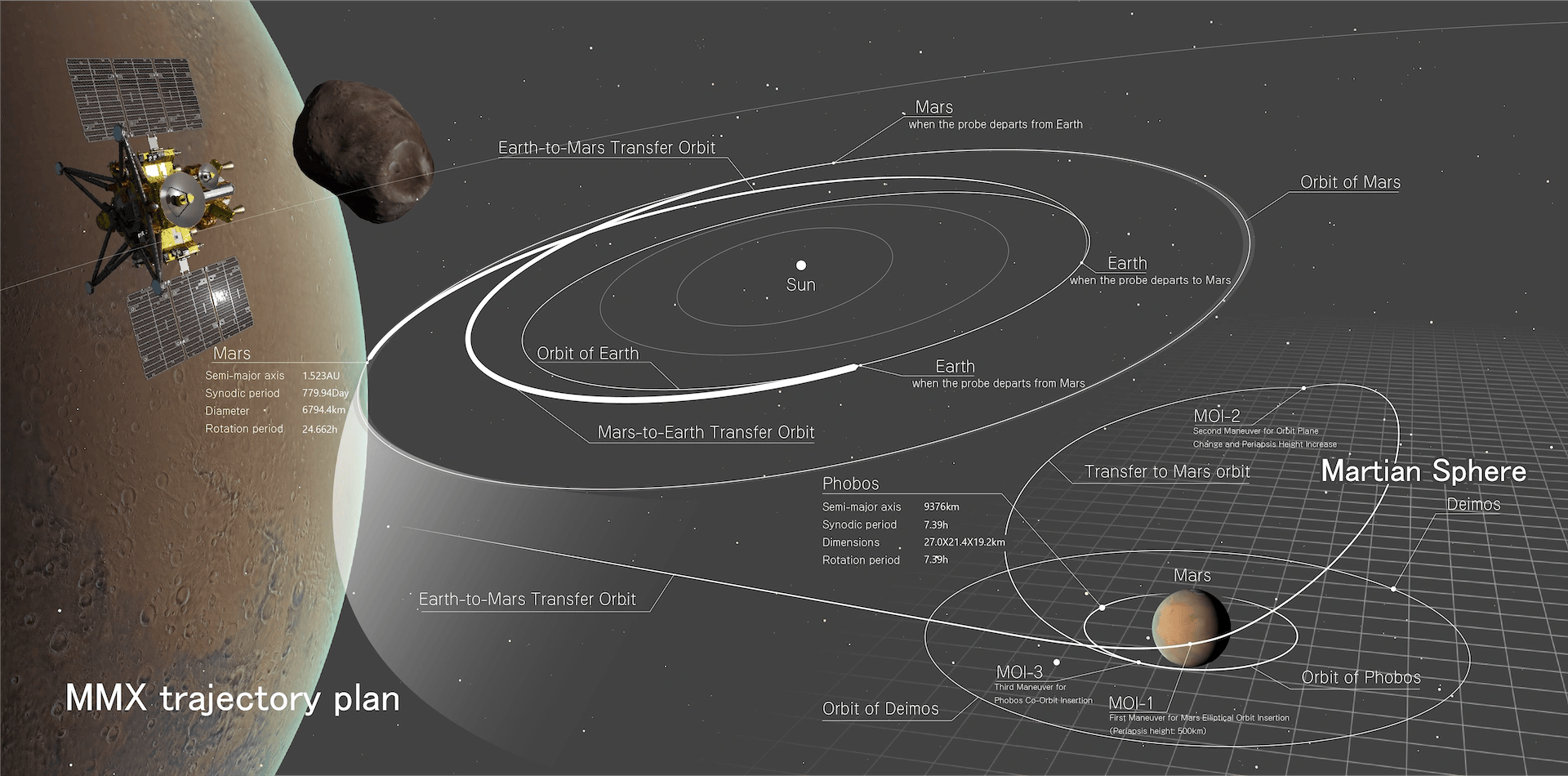
A two-stage, H3-24L rocket lit up the predawn skies over Tanegashima Space Center on the southern tip of Japan early on Tuesday, October 20th (3:41 p.m. EDT on October 19th), carrying a mission headed for the Red Planet: the Japan Aerospace Exploration Agency (JAXA) Martian Moons eXploration (MMX)…The mission is complex, set to explore the moons of Mars with a series of flybys past Deimos before rendezvous with and landing on Phobos. If all goes well, MMX will collect and return a sample from Phobos and return it to Earth. The agency’s goal is nothing less than to understand the potato-shaped moons’ origins.
—SciTechDaily: “NASA’s James Webb Telescope Reveals a Giant Alien Planet That’s Not Quite Round“
One side of WASP-17b’s atmosphere extends farther into space than the other, giving this intensely hot giant planet an uneven outline. Astronomers have now mapped that distortion with the James Webb Space Telescope (JWST), finding a pattern consistent with predictions of how heat and powerful winds shape a world with permanent day and night sides. WASP-17b is a hot Jupiter, a giant planet that orbits close to its star, about 1,300 light-years from Earth. The study, co-led by Cornell University in the United States and the University of Bristol in the United Kingdom, was published in Nature Astronomy. It marks the first application of a method called transmission strings, developed at Bristol by astrophysicists Dr. David Grant and Dr. Hannah Wakeford.
—ScienceDaily: “Astronomers Discover a Ghostly Green Star Unlike Any Known Before“
Astronomers at the University of Warwick have discovered that white dwarf stars can display a surprising variety of colors, including green, pink, purple, yellow, and cyan. Among their findings is the first known star that would appear genuinely green to the human eye. For most stars, color is closely tied to temperature. Cooler stars appear orange, stars like our Sun look white, and the hottest stars shine pale blue. The relationship is similar to heating a piece of iron, which changes from red to orange and eventually white as its temperature rises.

