
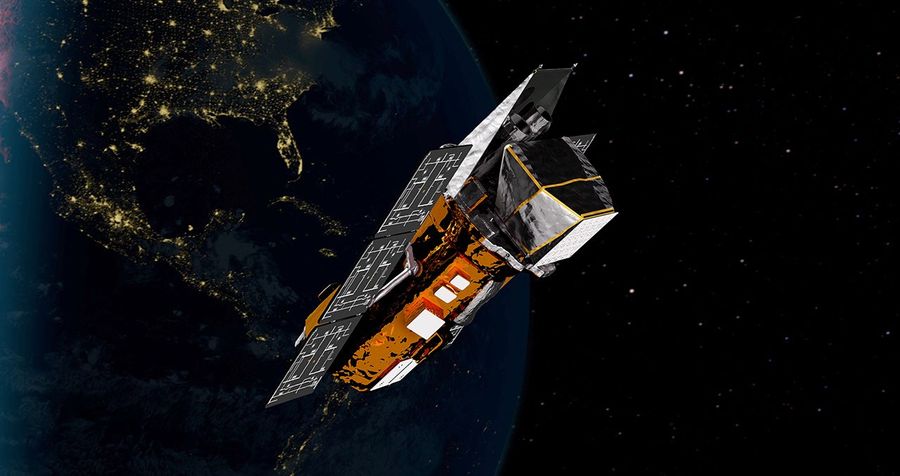
Here are some recent space-related stories of interest.
—LiveScience: “NASA’s Swift Observatory Ends 22-year Mission to Study the Most Powerful Explosions Since the Big Bang“
A pioneering NASA space telescope is no more. In sad news for Swifties everywhere, the Neil Gehrels Swift Observatory has officially ended its mission after more than 20 years of tracking the most powerful explosions in the universe since the Big Bang. According to a NASA announcement, the Swift team shut down the telescope’s science operations Tuesday (Oct. 20) after the observatory fell too low in its orbit to continue taking reliable measurements of the cosmos. In the coming weeks, Swift will drop even further, eventually passing a point of no return and taking a fiery plunge through Earth’s atmosphere.
—EuroNews: “Europe Weighs €10bn Plan to Launch Its Own Astronauts Ahead of Rome Space Summit“
Europe wants to stop depending on others to send its own astronauts into space. The next key date for deciding how to do that is 15 December in Rome, when the member countries of the European Space Agency (ESA) will meet to discuss the future of space exploration. On the table are multi-billion-euro investments, new technologies and one strategic issue: ensuring that Europe can reach Earth orbit with its own means, without relying exclusively on services provided by foreign companies. The summit, officially the Intermediate Ministerial Meeting 2026, comes at a time of transformation in the sector. Member states will have to assess proposals to strengthen Europe’s role in low Earth orbit, prepare for the post-International Space Station era and build the continent’s presence on the Moon, while also looking towards Mars. The aim is not to abandon international cooperation, but to take part in it with greater autonomy
—South China Morning Post: “Chinese Astronomers Find Real 3-body System. It Is Not What Liu Cixin Thinks“
In author and computer engineer Liu Cixin’s science fiction hit The Three-Body Problem, three suns throw a doomed world into chaos. Chinese astronomers say they have found a real three-star system that is far better behaved. Using FAST, the world’s biggest single-dish radio telescope in southwestern China, the researchers found two dead stars and a “living” one locked in a steady cosmic dance about 7,000 light years from Earth. One of the dead stars is a pulsar that spins more than 300 times a second, about as fast as the blades of a kitchen blender. It whirls around its partner, a white dwarf – the dim, burnt-out core of a smaller star – every eight days.
Note: Here is the podcast version of this post.

