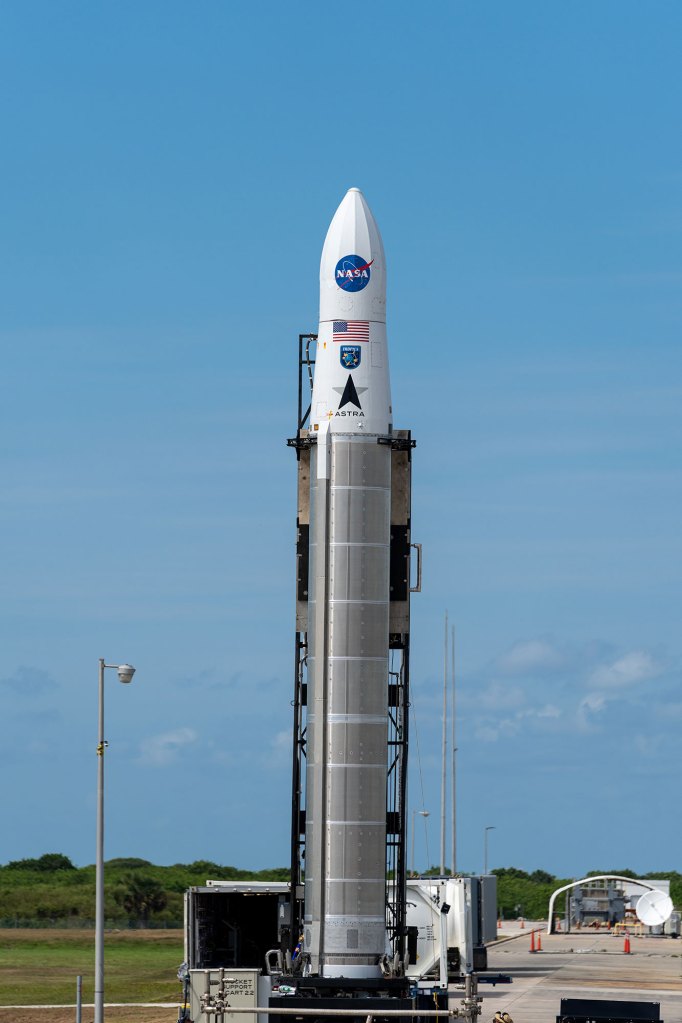
Source/Credit: Guiana Space Center launch pads from the ESA.
Be prepared. With the ongoing Russian invasion of Ukraine and the related U.S. and European sanctions, we can expect some delays and cancellations in upcoming space missions. The latest news story is Russia’s pull out of the Guiana Space Center in Kourou, French Guiana, leading to the delayed launch of two European Space Agency (ESA) Galileo navigation satellites that were to be sent into orbit on Soyuz rockets.
Director General of Russia’s Roscosmos tweeted:
In response to EU sanctions against our enterprises, Roscosmos is suspending cooperation with European partners in organizing space launches from the Kourou cosmodrome and withdrawing its technical personnel, including the consolidated launch crew, from French Guiana.
Luckily, the world is becoming less and less reliant on Russian rockets. Nonetheless, it would be better for Russia to focus on scientific missions again rather than military missions. Rockets should be aimed at the stars instead of the Ukrainian people.
Source/Credit: Gaia spacecraft map of the Milky Way from ESA.
The European Space Agency (ESA) reported scientists found the remnants of another galaxy that collides with our galaxy 8-10 billion years ago. This would be the sixth such grouping or galaxy to be found within the Milky Way. We commonly hear about merging planets in the early stages of our solar system, but that is small stuff by comparison. Observations from ESA’s Gaia spacecraft led to this discovery. This merged galaxy is called “Pontus,” the name of one of the first children of Gaia, the Greek goddess of the Earth.
An earlier ESA release discussed the number of galaxies that arrived more recently and may pass us by or be caught by the Milky Way and pulled apart like Pontus and the others:
François Hammer, Observatoire de Paris – Université Paris Sciences et Lettres, France, and colleagues from across Europe and China, used the Gaia data to calculate the movements of 40 dwarf galaxies around the Milky Way. They did this by computing a set of quantities known as the three-dimensional velocities for each galaxy, and then using those to calculate the galaxy’s orbital energy and the angular (rotational) momentum.
They found that these galaxies are moving much faster than the giant stars and star clusters that are known to be orbiting the Milky Way. So fast, that they couldn’t be in orbit yet around the Milky Way, where interactions with our galaxy and its contents would have sapped their orbital energy and angular momentum…
So will these newcomers settle into orbit or simply pass us by? “Some of them will be captured by the Milky Way and will become satellites,” says François.
I wonder what is would be like sitting in one of those smaller galaxies awaiting your fate. Of course, it will be a very long wait.
Source/Credit: Dwarf galaxies around the Milky Way from ESA.
Source/credit: Gaia spacecraft from the ESA/- C. Carreau.
Source/Credit: International Space Station (ISS) from NASA.
“If you block cooperation with us, who will save the ISS from uncontrolled deorbiting and falling on US or European territory?”
–Dmitry Olegovich Rogozin, Director General of Roscosmos, commenting on US sanctions against Russia’s aerospace industry resulting from that country’s invasion of Ukraine this week. The ISS is expected to stay aloft until 2031, assuming everyone cooperates.
The giant star…is waging a tug-of-war between gravity and radiation to avoid self-destruction. The star, called AG Carinae, is surrounded by an expanding shell of gas and dust — a nebula — that is shaped by the powerful winds of the star. The nebula is about five light-years wide, which equals the distance from here to our nearest star, Alpha Centauri.
The huge structure was created from one or more giant eruptions several thousand years ago. The star’s outer layers were blown into space, the expelled material amounting to roughly 10 times the mass of our Sun. These outbursts are typical in the life of a rare breed of star called a Luminous Blue Variable (LBV), a brief unstable phase in the short life of an ultra-bright, glamorous star that lives fast and dies young. These stars are among the most massive and brightest stars known. They live for only a few million years, compared to the roughly 10-billion-year lifetime of our own Sun. AG Carinae is a few million years old and resides 20,000 light-years away inside our Milky Way galaxy. The star’s expected lifetime is between 5 million and 6 million years.
Source/Credit: A NASA composite image of Uranus taken from Voyager 2 and the Hubble Space Telescope.
In an earlier posting, I highlighted some scientific papers calling for a return to Neptune rather than Uranus, in part because of Neptune’s moon Triton. But what is the argument for a mission to Uranus? Below I highlight one of the papers submitted to the Planetary Science and Astrobiology Decadal Survey 2023-2032 arguing the merits of a NASA mission to Uranus.
The large moons of Uranus are possible ocean worlds that exhibit a variety of surface features, hinting at endogenic geologic activity in the recent past. These moons are rich in water ice, as well as carbon-bearing and likely nitrogen-bearing constituents, which represent some of the key components for life as we know it. However, our understanding of Uranus and its moons is severely limited by the absence of data collected by an orbiting spacecraft…
An orbiter would vastly improve our understanding of these possible ocean worlds and allow us to assess the nature of water and organics in the Uranian system, thereby improving our knowledge of these moons’ astrobiological potential. A Flagship mission to Uranus can be carried out with existing chemical propulsion technology by making use of a Jupiter gravity assist in the 2030 – 2034 timeframe, leading to a flight time of only ~11 years, arriving in the early to mid 2040’s (outlined in the Ice Giants Pre-Decadal Survey Mission Study Report: https://www.lpi.usra.edu/icegiants/mission_study/Full-Report.pdf).
The five large moons discussed in the paper are Miranda, Ariel, Umbriel, Titania, and Oberon. Titania and Oberon where the first to be discovered back in 1787, followed by the later discoveries of Ariel, Umbriel, and Miranda (in that order). Unlike the moons of other planets, the moons of Uranus are named after magical spirits in English literature.
All of these ocean worlds have gained greater interest as we learn about the dynamics of life on of our own planet. As noted in an article in the MIT Technology Review:
It was once thought the solar system was probably a barren wasteland apart from Earth. Rocky neighbors were too dry and cold like Mars, or too hot and hellish like Venus. The other planets were gas giants, and life on those worlds or their satellite moons was basically inconceivable. Earth seemed to be a miracle of a miracle.
But life isn’t that simple. We now know that life on Earth is able to thrive in even the harshest, most brutal environments, in super cold and super dry conditions, depths of unimaginable pressures, and without the need to use sunlight as a source of energy. At the same time, our cursory understanding of these obscure worlds has expanded tremendously.
We have plenty of worlds to explore in our own solar system as other scientists continue their search for exoplanets and exomoons. The only question now is which local worlds will we visit in our next round of space missions.