Pic of the Week: The Flame Nebula

Source/Credit: NASA, ESA, and N. Da Rio (University of Virginia); Processing: Gladys Kober (NASA/Catholic University of America).

This week’s image from the Hubble Space Telescope shows the Flame Nebula in the constellation Orion, as explained by NASA:

The Flame Nebula, also called NGC 2024, is a large star-forming region in the constellation Orion that lies about 1,400 light-years from Earth. It’s a portion of the Orion Molecular Cloud Complex, which includes such famous nebulae as the Horsehead Nebula and Orion Nebula. This image focuses on the dark, dusty heart of the nebula, where a star cluster resides, mostly hidden from view. Nearby (but not visible in this image) is the bright star Alnitak, the easternmost star in the Belt of Orion. Radiation from Alnitak ionizes the Flame Nebula’s hydrogen gas. As the gas begins to cool from its higher-energy state to a lower-energy state, it emits energy in the form of light, causing the visible glow behind the swirled wisps of dust.

Television: Space Force, the TV Show

Source/Credit: Netflix.

It did not take long for the newly-created U.S. Space Force to be the butt of jokes, but its mission is critical, as has already been noted in earlier postings on this site. Even so, a little bit of humor goes a long way, and the Netflix series Space Force has plenty of humor to go around. Season two starts Friday, February 18th. Here are trailers for season one and two.

Steve Carell is perfect as the leader of U.S. Space Force as it bungles along and eventually faces an international crisis on the moon. Mimicking reality, the U.S. and China have designs on the Moon and it may not be big enough for both nations. Given the accompanying cast, such as John Malkovich, Lisa Kudrow, and Ben Schwartz, you know this will be one strange space ride. Patton Oswalt will join the cast in season two as a bumbling astronaut, so things can only get more insane. Think of it as a combination of The Office and The Right Stuff giving birth to “The Wrong Stuff.”

We all need a laugh at the moment, so tune in and lighten up. After that, you can look into the work of the official U.S. Space Force and start worrying again.

Note: Here is the mission statement of the real U.S. Space Force (that word “Guardians” is really in there):

The USSF is responsible for organizing, training, and equipping Guardians to conduct global space operations that enhance the way our joint and coalition forces fight, while also offering decision makers military options to achieve national objectives.

Source/Credit: Official flag of the official U.S. Space Force.

Note: The real Space Force is protecting our satellites rather than running missions to the Moon, Mars, and Europa. TV shows have more latitude on such things.

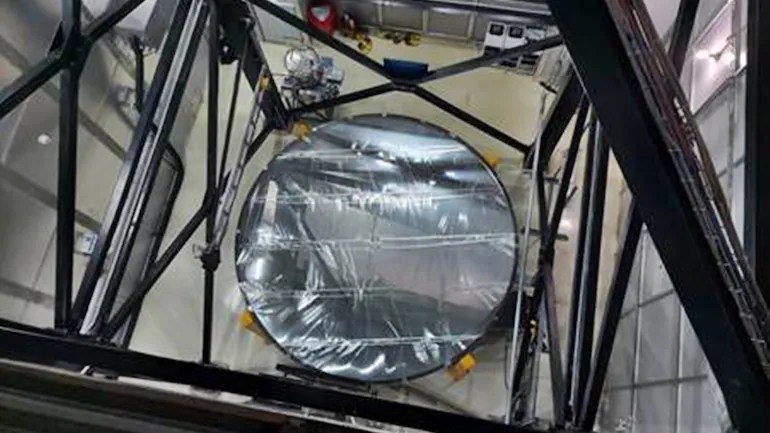
James Webb Space Telescope Selfie

Source/Credit: NASA.

NASA has shared the first images from the James Webb Space Telescope (JWST), which includes the selfie of the 18-part mirror shown above. The space telescope is still aligning these mirror segments before prime time, so we will probably see more selfies and related shots for the time being, such as the images below (one labeled) showing the 18 segment views of one star that will eventually become one view of one star.

Keep these raw images in mind once we start to see mind-blowing images from the JWST. This amazing device is just getting started. The first of these images should start to appear this summer.

Source/Credit: NASA.

Podcast: Joe Rogan and Brian Cox

Source/Credit: The Joe Rogan Experience on YouTube.

While Joe Rogan has been in some hot water recently, I think we can agree that many of his broadcasts were less controversial and simply fun. He is a good host with plenty of though-provoking questions. I do not want to get into politics, but rather focus on science. And in that case, his two-and-a-half hour discussion on January 28, 2019 with Professor Brian Cox, English physicist and Professor of Particle Physics in the School of Physics and Astronomy at the University of Manchester in the UK, was a terrific way to go over both astronomy and physics.

Some of the topics covered during their talk included the size and complexity of the universe, black holes, wormholes, time travel, the Fermi Paradox, unknown objects at the edge of our solar system, space travel, lasers in space, and the role of artificial intelligence in society. The forum provided plenty of time to cover a large range of topics. It is well worth dropping in and listening.

Some other discussions worth watching include Joe Rogan’s August 22, 2018 discussion with Neil deGrasse Tyson and his May 7, 2020 discussion with Elon Musk.

Television: The Silent Sea

Source/Credit: Netflix.

Netflix’s new series from South Korea, The Silent Sea, was released right before Christmas and did not get a lot of attention. It may not deserve a lot of attention, and would have probably been better as a short film (which is how it started) rather than an 8-part series, but it was passable as entertainment.

The year is 2075 and Earth has become a dust bowl where water is rationed and civilization is dying. We seem to have the ability to maintain manned stations on the Moon and Mars, but water conservation is beyond our abilities. It seems we did not have a Planet B ready to go. With this background, the series is about a special team sent back to the Moon to visit a failed station and retrieve critical scientific samples. I will not give you too many hints, but it relates back to the water shortage on Earth.

The trip to the Moon seemed more like a Southwest flight than a space mission, and the Moon base itself is a ridiculously gigantic facility at the edge of a chasm, yet the action mainly takes place within the Moon base at a good pace. Throughout the series there are mysterious deaths, unknown figures running around the station, and corporate espionage, so it does not lack a fair amount of drama. Sadly, the last episode unravels quickly with a somewhat dumb (and certainly unbelievable) ending.

I cannot recommend it after seeing much better series, such as The Expanse and National Geographic’s Mars. However, if you need to satisfy your science fiction fix before other space series are available, give it a try. You have been warned.

Source/Credit: Scene from The Silent Sea from Netflix.