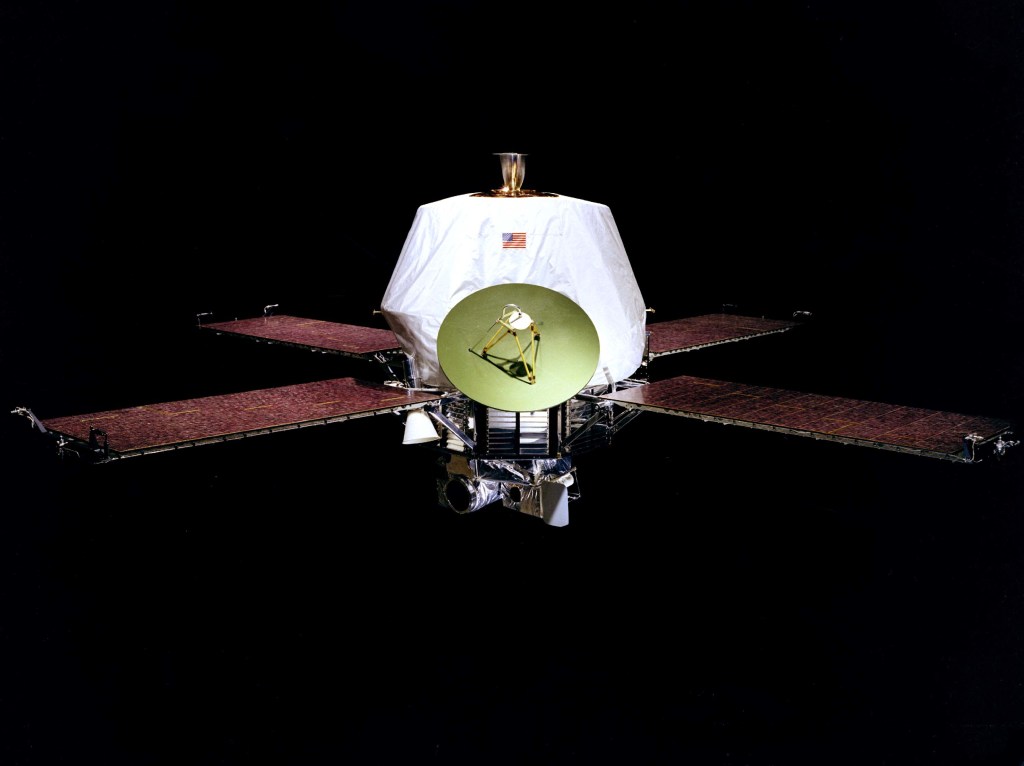
On this day in 1971, the Mariner 9 spacecraft was launched from Cape Canaveral Air Force Station, Florida. It would become the first spacecraft from Earth to orbit Mars (or any other planet). It arrived at Mars on November 14, 1971. The Soviets were also working on their own program, launching their two Mars-bound spacecraft even earlier in May, but both arrived at Mars after Mariner 9.
The Mariner 9 spacecraft successfully mapped 85 percent of the Martian surface and also sent back thousands of images detailing the Martian surface as well as the two Martian moon, Deimos and Phobos. NASA’s last contact with the spacecraft was on October 27, 1972. The spacecraft was expected to remain in orbit until 2020, when it would crash onto the Martian surface.
You can read more about the Mariner 9 mission here.
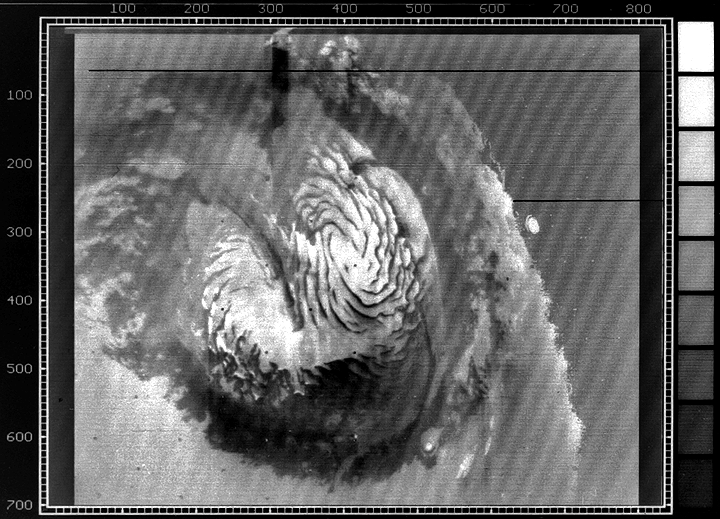
Image (Credit): Mariner 9 image of the north polar cap of Mars. The image was taken on 12 October 1972, about one-half Martian month after summer solstice, at which time the cap had reached its minimal extent. The cap is about 1000 kilometers across. (NASA)
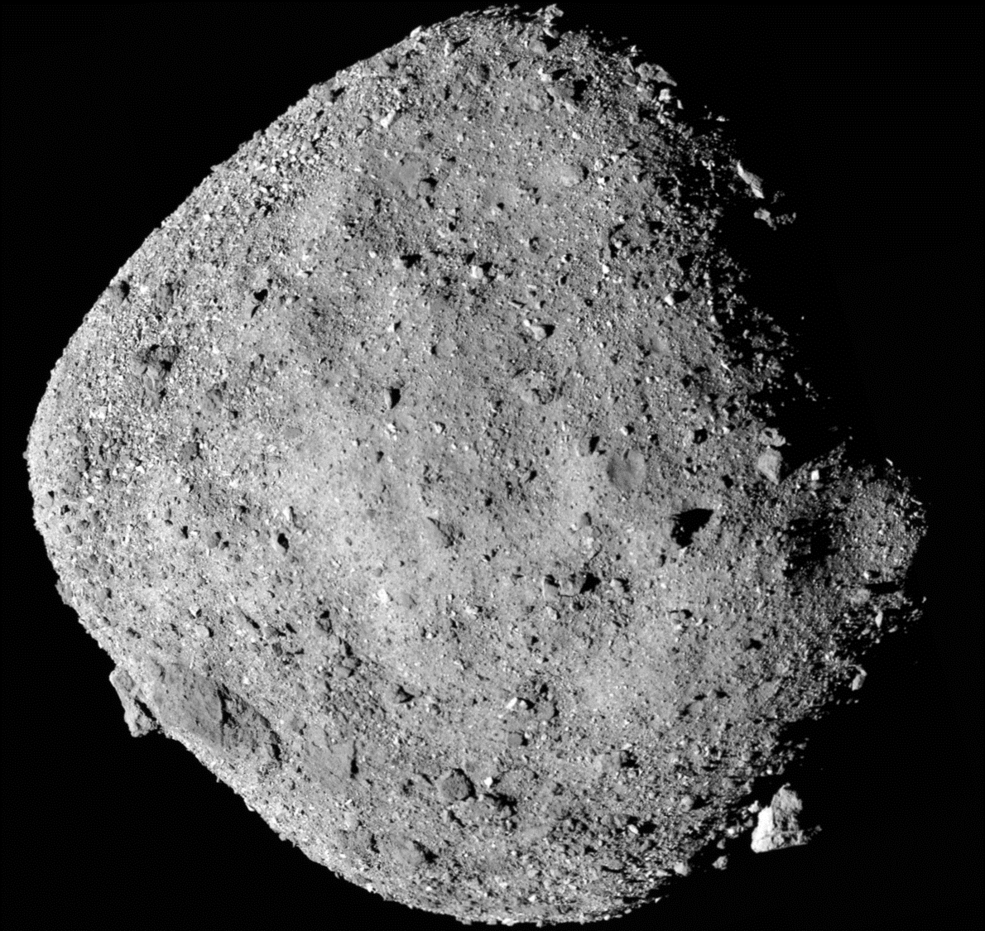
Image (Credit): Mosaic image of asteroid Bennu composed of 12 PolyCam images collected on Dec. 2, 2018 by the OSIRIS-REx spacecraft from a range of 15 miles. (NASA/Goddard/University of Arizona)
Back in 2020, NASA’s OSIRIS-REx spacecraft collected samples from asteroid Bennu, named after the ancient Egyptian mythological bird associated with the Sun, creation, and rebirth. These samples are scheduled to return to Earth until next year, but in the meantime there is already a lot that NASA knows about this asteroid. Some of the key points are listed below:
Bennu is over 4.5 billion years old.
Bennu is a “rubble-pile” asteroid, meaning it is rocky debris compressed by gravity.
Bennu is likely to be rich in platinum and gold compared to the average crust on Earth.
Between the years 2175 and 2199, the chance that Bennu will impact Earth is only 1-in-2,700.
You can tour the surface of Bennu by viewing a video produced by NASA’s Goddard Space Flight Center in Greenbelt, Maryland. Titled “Tour of Asteroid Bennu,” the film was featured in the SIGGRAPH Computer Animation Festival Electronic Theater. While it did not win any awards, it was still a great opportunity to share the mission with a wider audience.
Missions to planets and moons tend to get most of the attention, but asteroids can reveal plenty about the origins of our solar system. You can learn more about the OSIRIS-REx mission to Bennu here.
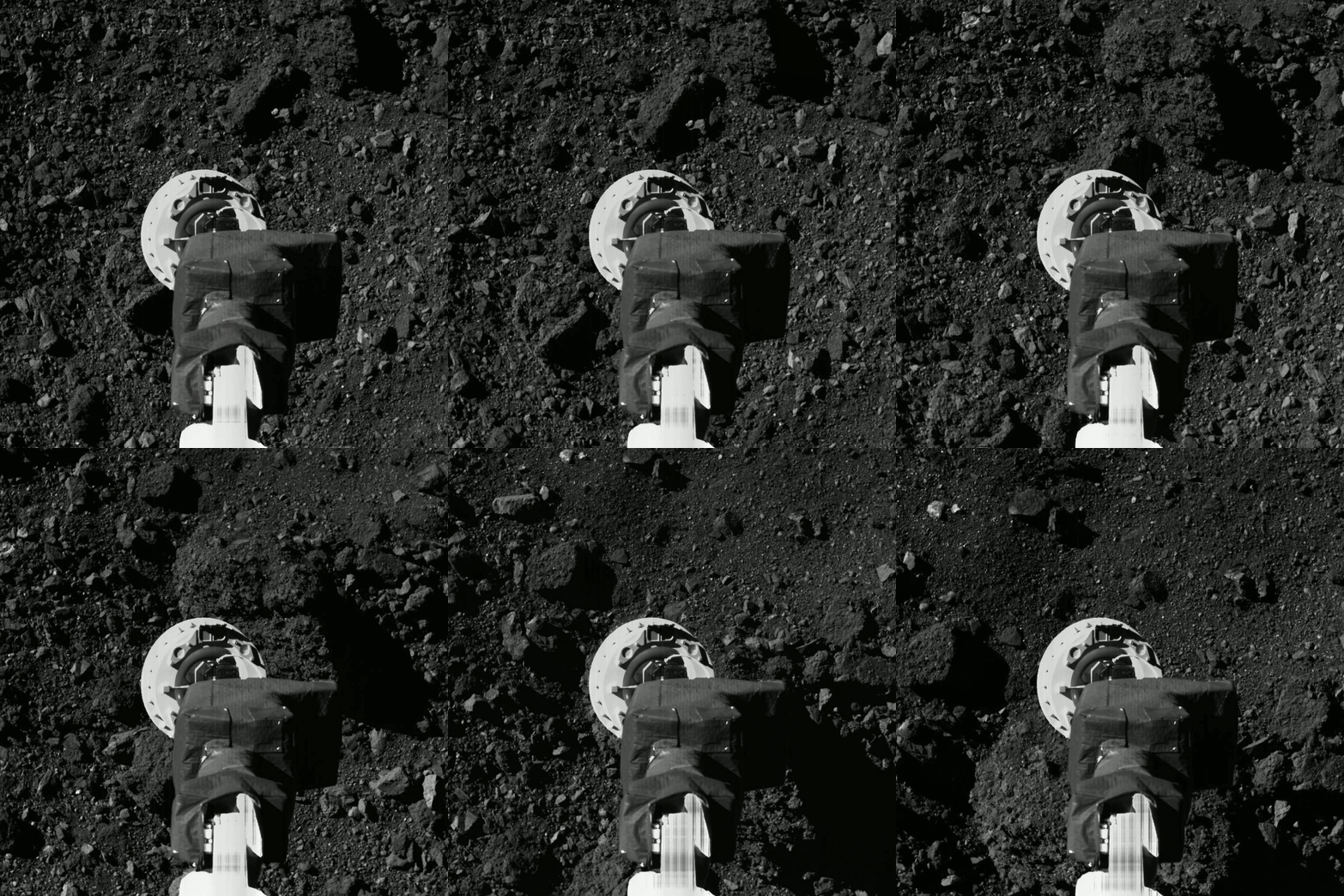
Image (Credit): Captured on Aug. 11, 2020 during the second rehearsal of the OSIRIS-REx mission’s sample collection event, this series of images shows the SamCam imager’s field of view as the NASA spacecraft approaches asteroid Bennu’s surface. (NASA/Goddard/University of Arizona)
While Star Trek is generally a better fit for an astronomy site, I did not want to ignore the release this week of Disney+’s Obi-Wan Kenobi. As with the other similar releases in the last few years, including The Mandalorian and The Book of Boba Fett, Disney is mining the Star Wars stories for new angles. Of course, Paramount has also been doing the same with Star Trek.
Disney has been spending quite a bit of time on the planet of Tatooine in all three new series, be it bounty hunting in The Mandalorian, taking over Jabba the Hutt’s old business in The Book of Boba Fett, and now Obi-Wan watching over young Luke Skywalker’s formative years in Obi-Wan Kenobi. I hope you don’t mind sand. Here is a preview of what you can expect with this latest series.
So far I have enjoyed The Mandalorian and suffered through The Book of Boba Fett. Too often Star Wars seems to be mostly a vehicle to sell toys (think of Baby Yoda), and yet the creators kept it fun in The Mandalorian. Adding Amy Sedaris to the mix of characters was brilliant.
Maybe The Mandalorian worked because the main character said so little and Baby Yoda said basically nothing. I know Mr. Lucas is gone, but dialogue has not been the strongest part of the Star Wars universe. We can only hope the creators have finally learned how to use the talents of Ewan McGregor and Hayden Christensen in the latest series.
And yes, there’s more. Stay tuned for the next Star Wars series, Andor, coming out on August 31st. Season two of this new series is already in the works. It takes place 28 years after the film Star Wars: Revenge of the Sith and five years before the events of the film Rogue One. I think this one will stay away from Tatooine, thankfully. Diego Luna will be playing the role of Cassian Andor. Here is a teaser for Andor.
Image (Credit): An artist’s drawing a stellar black hole named Cygnus X-1. (NASA/CXC/M.Weiss)
We already knew a supermassive black hole sits at the center of our galaxy and others like it, but what about dwarf galaxies? SciTechDaily reports that astronomers in the University of North Carolina-Chapel Hill’s Department of Physics & Astronomy have found that large black holes are also more common than previously thought in dwarf galaxies.
The astronomers developed a new way to identify such black holes and found that about 80 percent of all black holes found in dwarf galaxies could be found in this way. These smaller black holes may help to create the supermassive black holes we see in larger galaxies as the dwarf galaxies collide and combine to make the larger galaxies.
Professor Sheila Kannappan, Polimera’s Ph.D. advisor in the Department of Physics & Astronomy and coauthor of the study, stated:
We’re still pinching ourselves…We’re excited to pursue a zillion follow-up ideas. The black holes we’ve found are the basic building blocks of supermassive black holes like the one in our own Milky Way. There’s so much we want to learn about them.
While even Albert Einstein had doubts that his theoretical black hole could exist in reality, astronomers continue to find they are a larger part of the universe than anyone expected. When you consider smaller stellar black holes, the figure is enormous. As NASA noted:
Judging from the number of stars large enough to produce such black holes, however, scientists estimate that there are as many as ten million to a billion such black holes in the Milky Way alone.
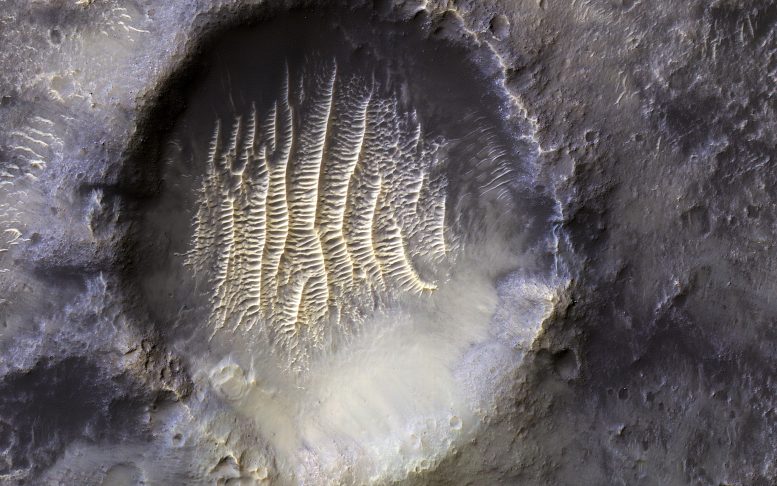
Image (Credit): Martian crater Airy-0. (NASA/JPL-Caltech/University of Arizona)
This week’s pic is an eerie crater within the Airy Crater on Mars that marks an important spot – 0° longitude on Mars. You can see this position of this smaller crater, Airy-0, within the larger crater below. NASA posted this image on Instagram with a few more details:
The larger crater that sits within this crater, called the Airy Crater, originally defined zero longitude for Mars, but as higher resolution photos became available, a smaller feature was needed. This crater, called Airy-0 (zero) was selected because it did not need to adjust existing maps.
This image was captured by the High-Resolution Imaging Science Experiment (HiRISE), on the Mars Reconnaissance Orbiter. The map is projected here at a scale of 50 centimeters (19.7 inches) per pixel.
The Airy Crater is names after Sir George Biddell Airy, the 7th Astronomer Royal, in 1850.