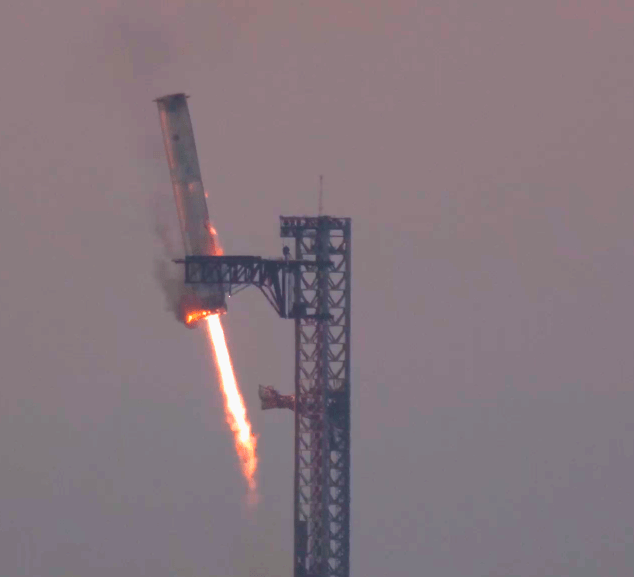
Image (Credit): An image showing SpaceX’s Super Heavy booster being grabbed midair after the fifth flight test from Boca Chica, Texas. (Taken from a SpaceX video)
Earlier today, SpaceX conducted its fifth Starship test earlier today. It appears it was an overall success, with a new twist. This time the rocket’s Super Heavy booster returned to the launch pad to be captured midair by two metal arms. It seemed like an unnecessary risk to the landing site, but the stunt was successful.
The rocket itself “landed” without incident off Australia’s coast before falling into the sea and exploding.
All in all it went according to plan, which is a good sign for NASA and its future plans for the rocket.
While all the attention today related to the booster bravado, I just want to see a Starship that is ready for the upcoming Artemis mission. After all, all the fancy tricks related to the Starship will look pretty useless should the Chinese be the first to return to the Moon.
Image (Credit): Image of Apollo 17 astronaut Eugene Cernan on the Moon’s surface. (NASA)
“As the U.S. has flailed, China and its partners have marched forward, notching one success after another. There is no reason to believe they will not be first to send a crewed mission to the lunar south pole, where only a half dozen or so promising regions exist to safely land. Depending on how the currently vague noninterference rules are interpreted and enforced by the Chinese (and others), significant parts of the moon might end up off-limits for anyone else to explore or mine. We do not know for certain how China might behave on the lunar surface—this is part of the conundrum—but terrestrial conflicts in the South China Sea and China’s regular infractions of sovereign airspace give scant rationale for optimism.”
Image (Credit): The Starship rocket launching on its fourth flight test in Boca Chica, TX. (SpaceX)
The other week, Elon Musk said he was planning to send five uncrewed Starship rockets to Mars in two years, followed by manned flights after that. Why the sudden announcement? It was not clear, but he does have money to burn and also a desire for attention.
SpaceX plans to launch about five uncrewed Starships to Mars in two years.
If those all land safely, then crewed missions are possible in four years. If we encounter challenges, then the crewed missions will be postponed another two years.
Of course, he has yet to prove that the Starship is ready for assist NASA with the Artemis mission to place astronauts on the Moon. The rocket is getting better with every test, but the Starship problems are likely to delay the entire lunar mission. Yet he is already eyeing Mars?
If you read the full post, it appears he is using the Starship announcement to poke at California and Kamala Harris. He also seems to be ready to blame everyone but himself if he cannot meet his self-imposed Mars timetable.
One might ask if Mr. Musk has any idea where his Starship astronauts will be staying under this timetable. I have not heard of any great plans to build the necessary infrastructure to host a colony on the surface of Mars. Does he have a plan?
Mr. Musk had enormous problems meeting his proposed deadline for a Tesla pickup truck here on Earth, and the truck he eventually rolled out has has been less than a stellar vehicle given the hype. So any timetable on a Mars mission seems like mere fantasy at this point.
By the way, if Mr. Musk is so interested in protecting Earthlings from a dangerous future, he already has the ability to tamp down the rage and hate on Twitter/X and cease his calls for civil wars.
It is already in his power to make the Earth a better place to live while we plan for Mars. He just doesn’t seem to be all that interested.
Image (Credit): Shackleton crater at the Moon’s south pole. (NASA/GSFC/Arizona State University)
With NASA planning to return to the Moon shortly as part of the Artemis mission, it is tying up loose end and figuring out what else it may need. It seems that one of the needed items is a better way to conduct its work at the lunar south pole. This comes down to two challenges, both of which have a payout to the winner.
Challenge 1: NASA is seeking an orienteering aid that will help the astronauts navigate on traverses away from the lunar lander and return back. While there were similar devices available to the Apollo astronauts, NASA is looking for new and unique solutions. Among other considerations, devices must be accurate, easy to use, able to be used on the moon’s surface by an astronaut wearing pressurized gloves. If your solution is one of the best, you could be eligible for a share of the $15,000 prize purse.
Challenge 2: NASA is looking for assistance in getting to and mapping the bottom of Shackleton Crater. The design must work in the extreme conditions of the lunar south pole and Shackleton Crater, map the crater, characterize and quantify what is in the crater, and send the data back to be used for future missions. If you can solve this challenge by describing your design concept in detail, you could be eligible for a share of the $30,000 prize purse.
You might wonder why NASA is only thinking of these needs now. I am hoping NASA has some less refined solutions and is only seeking for a better way.
If you have an idea or two, be sure to share it with NASA by November 25, 2024.
Axiom Space is facing significant financial headwinds as the company attempts to deliver on two key commercial programs for NASA—the development of a private space station in low-Earth orbit and spacesuits that could one day be worn by astronauts on the Moon. Forbes reports that Axiom Space, which was founded by billionaire Kam Ghaffarian and NASA executive Mike Suffredini in 2016, has been struggling to raise money to keep its doors open and has had difficulties meeting its payroll dating back to at least early 2023. In addition, the Houston-based company has fallen behind on payments to key suppliers, including Thales Alenia Space for its space station and SpaceX for crewed launches.
Intuitive Machines said on Tuesday it has bagged a navigation and communication services contract of up to $4.82 billion from NASA for missions in the near space region. As part of the contract, which has a base period of five years with an additional five-year option period, Intuitive will deploy lunar relay satellites and provide communication and navigation services to aid NASA’s Artemis campaign.
A new analysis of maps of the near and far sides of the Moon shows that there are multiple sources of water and hydroxyl in the sunlit rocks and soils, including water-rich rocks excavated by meteor impacts at all latitudes. “Future astronauts may be able to find water even near the equator by exploiting these water-rich areas. Previously, it was thought that only the polar region, and in particular, the deeply shadowed craters at the poles were where water could be found in abundance,” said Roger Clark, Senior Scientist at the Planetary Science Institute and lead author of “The Global Distribution of Water and Hydroxyl on the Moon as Seen by the Moon Mineralogy Mapper (M3)” that appears in the Planetary Science Journal. “