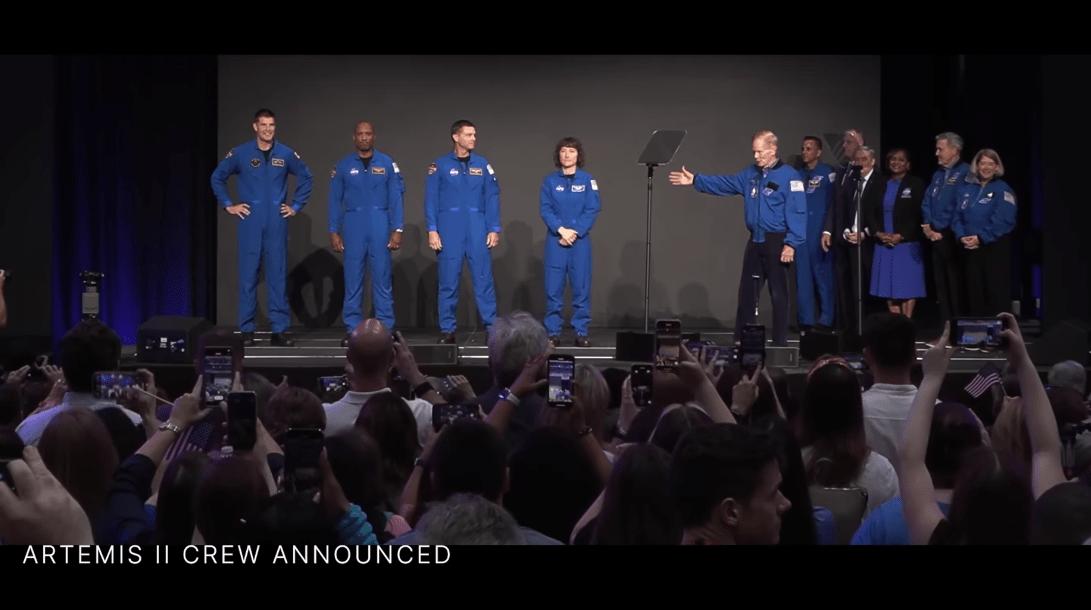
Space Stories: Fancy Space Suits, Giant Blinding Satellites, and More Russian Space Station Leaks

Credit: Dezeen

Here are some recent stories of interest.

Dezeen: “Prada Designing Lunar Spacesuits for NASA Moon Mission

Fashion house Prada has teamed up with commercial space company Axiom Space to create lunar spacesuits for NASA’s Artemis III mission, which will be the first crewed moon landing since 1972. Called Axiom Extravehicular Mobility Unit (AxEMU), the suits will be designed to give astronauts “advanced capabilities for space exploration,” Prada said. They are an evolution of NASA’s Exploration Extravehicular Mobility Unit (xEMU) spacesuit design and will use “innovative technologies and design” to be more flexible and provide more protection against the harsh lunar environment, according to the brand.

Scientific American: “Giant Satellite Outshines Most Stars in the Sky

On some nights, one of the brightest objects in the sky is neither a planet nor a star. It is a telecommunications satellite called BlueWalker 3, and at times it outshines 99% of the stars visible from a dark location on Earth, according to observations reported today in Nature. BlueWalker 3 is the most brilliant recent addition to a sky that is already swarming with satellites. The spaceflight company SpaceX alone has launched more than 5,000 satellites into orbit, and companies around the globe have collectively proposed launching more than half a million satellites in the coming years — a scenario that astronomers fear could hamper scientific observations of the Universe.

The Guardian: “Third Space Station Leak in a Year Prompts Doubts About Russia’s Programme

The Russian segment of the International Space Station (ISS) has sprung its third coolant leak in under a year, raising new questions about the reliability of the country’s space programme even as officials said crew members were not in danger. Flakes of frozen coolant spraying into space were seen in an official live feed of the orbital lab provided by Nasa on Monday, and confirmed in radio chatter between US mission control and astronauts. “The Nauka module of the Russian segment of the ISS has suffered a coolant leak from the external (backup) radiator circuit, which was delivered to the station in 2012,” Russian space agency Roscosmos said on Telegram, adding temperatures remained normal in the affected unit.

Audit Results: SLS Program is Unaffordable

Image (Credit): Artist’s rendering of the SLS. (NASA)

The Government Accountability Office (GAO) recently completed a review of NASA’s Space Launch System (SLS), which is the cornerstone of the Artemis program. GAO assessed the extent to which (1) NASA has established plans to measure the SLS program costs post-Artemis I, and (2) the program has made progress with its plans to reduce projected SLS costs.

The GAO report, Space Launch System: Cost Transparency Needed to Monitor Program Affordability, highlights a number of continuing issues related to project costs and budgeting.

So what is the bottom line? This quote is most concerning: “Senior NASA officials told GAO that at current cost levels, the SLS program is unaffordable.”

The SLS is the vehicle that is supposed to demonstrate our ability to return to the Moon as well as our readiness for a Mars mission. But all of this is contingent on continued funding from Congress, and the congressional auditors have raised a red flag.

I expect you could find similar audit issues with the earlier Apollo missions as well as other space missions, yet NASA does not need to give Congress a reason to put money elsewhere. Let’s hope NASA’s leaders take the audit seriously and show some progress to keep all of the parties happy and the funding alive.

Space Quote: If You Build It…Don’t Forget to Maintain It

Image (Credit): The Vehicle Assembly Building at NASA’s Kennedy Space Center in Florida. (NASA/Kim Shiflett)

“On average we have a $250 to $260 million dollar annual maintenance gap…Unplanned failures can have mission impacts, and the last thing we want to do is affect Artemis or some other significant mission.”

-Statement by NASA Facilities and Real Estate Division Director Eric Weiser regarding the maintenance of NASA’s infrastructure, as reported in The Register. He went on to say, “What that means is, on average, we’re renewing our infrastructure around every 200 years… A better number would be 60 to 80 years, and to do that we simply need more funding.” I know maintenance expenditures are boring, but this is no different than defense or highways. You get what you pay for, and also what you maintain.

Space Quote: What’s the Launch Date for Artemis III?

Credit: NASA

“We really are trying to get in the details of that schedule because when we come up with a date, December of 2025, or whatever that date might be, we want to have confidence for our teams, that we all have a realistic path to get there.” 

-Statement by Jim Free, NASA associate administrator of Exploration Systems Development, regarding the launch date of the Artemis III mission, as reported in Florida Today. The story highlights the potential delays related to SpaceX’s Starship and Axiom’s space suits.

Space Stories: Fast-Spinning Martians, Artemis 3 Mission Issues, and an Ancient Star Cluster

Image (Credit): Image of Mars taken by the United Arab Emirates’ “Amal,” or “Hope,” probe. (Mohammed bin Rashid Space Center/UAE Space Agency, via AP)

Here are some recent stories of interest.

Space.com : “Mars is Spinning Faster and its Days are Getting Shorter. Scientists Aren’t Sure Why

The length of Mars’ day is shortening by three-quarters of a millisecond each year as the planet’s rotation spins up, according to new results from NASA’s InSight lander…Planetary scientists are not entirely sure why this is happening, but it is likely related to the redistribution of Mars’ mass, which can have an effect on the planet’s rotation like an ice skater pulling in their arms to spin faster. This redistribution might be caused by the accumulation of ice on Mars’ polar caps, experts believe, or by the surface itself slowly rebounding from residing under the weight of immense glaciers that existed at equatorial latitudes during the world’s most recent ice ages, which ended about 400,000 years ago.

SpaceNews.com : “NASA Weighs Changes to Artemis 3 if Key Elements are Delayed

NASA has left the door open for changing the scope of Artemis 3, currently set to be the first crewed lunar landing of the program, if key elements suffer major delays. Speaking at an Aug. 8 briefing at the Kennedy Space Center, Jim Free, NASA associate administrator for exploration systems development, said the Artemis 3 mission still has a formal launch date of December 2025 but that he was monitoring potential delays in hardware needed for the mission. “We may end up flying a different mission if that’s the case,” he said. “If we have these big slips out, we’ve looked at if can we do other missions.” Artemis 3 could also change based on the outcome of Artemis 2, he added.

ScienceNews.com : “A Star Cluster in the Milky Way Appears to be as Old as the Universe

One of the oldest known objects in the universe is wandering around the Milky Way. Star cluster M92, a densely packed ball of stars roughly 27,000 light-years from Earth, is about 13.8 billion years old, researchers report in a paper submitted June 3 to arXiv.org. The newly refined age estimate makes this clump of stars nearly the same age as the universe. Refining the ages of clusters like M92 can help put limits on the age of the universe itself. It can also help solve cosmic conundrums about how the universe evolved.