Gift Ideas: Lego Lunar Research Base

Image (Credit): Lego Lunar Research Base playset. (Lego)

While we await the Artemis III crew landing on the Moon and related lunar base, you might want to create your own mission with the Lego Lunar Research Base (shown above), which has “NASA-inspired” details. The playset has almost 800 Lego pieces, so you can build it yourself (to NASA specs, of course).

The playset comes with a “… lunar lander, VIPER rover and a domed accommodation module with laboratories, garage and air lock, plus 6 astronaut minifigures. I’m assuming the rocket that gets the astronaut minifigures to the Moon is sold separately.

And below is the Lego International Space Station is you are looking for something more traditional (and less expensive).

It’s great to see that Lego is allowing kids to build their own space missions at home.

Image (Credit): Lego International Space Station playset. (Lego)

Some of you may have played with Star Wars and Star Trek sets as kids, but at least these latest Lego set have a ring of credibility. Star Wars helped you destroy the galaxy, whereas Star Trek seemed more interest in exploration and at least had the veneer of Artemis CXXV.

I checked on whether Chinese and Russian kids with have their own space playsets and found the Russian Roscosmos Soyuz MS spacecraft (still a concept) and China’s Jiuquan Satellite Launch Center (made by a Lego copycat), both shown below.

Image (Credit): Lego version of the Russian Roscosmos Soyuz MS spacecraft. (Lego Ideas)
Image (Credit): Sembo Blocks version of the Jiuquan Satellite Launch Center. (http://www.whatsonweibo.com)

The Jiuquan Satellite Launch Center playset comes with a Long March 2F rocket and an authentic warning sign stating, “Those stealing secrets will be caught, once they’re caught they will be killed [decapitated].”

Maybe even reality is not always the best model for play.

Extra: You can find more Lego space models at the NASA gift shop.

The National Air and Space Museum is Open for Business

Image (Credit): The “Destination Moon” exibition at the refurbished National Air and Space Museum. (Smithsonian Museum)

If you have been awaiting the refurbishing of the Smithsonian’s National Air and Space Museum, then you will be happy to know that the museum reopened on October 14th. Only now you cannot simply stroll into the museum. Instead, you need to obtain a free timed-entry pass. Unfortunately, this seems to be the current system used by numerous museums to control traffic as well as capture all of your personal information so they can swamp you with junk mail and offers. Anyway…

Here are the a few of the new exhibits the museum is highlighting (go here for the full list):

  1. “Walking On Other Worlds”: Experience what it’s like in distant parts of our solar system in the “Walking on Other Worlds” interactive experience in the Kenneth C. Griffin Exploring the Planets Gallery. This immersive media exhibit presents visitors with a seven-minute “tour” of seven different worlds: Venus, Earth’s Moon, Mars, Jupiter, Saturn’s moon Titan, asteroid Ryugu, and comet 67P.
  2. Science Fiction Artifacts: New to display is a full-sized T-70 X-wing Starfighter “flown” by Poe Dameron (Oscar Isaac) in Star Wars: The Rise of Skywalker (2019). The screen-used vehicle is on long-term loan from Lucasfilm and is displayed hanging outside the planetarium. Star Trek is also represented in the new exhibitions. 
  3. ISS Cupola: In the One World Connected gallery, put yourself in the shoes of astronauts on the International Space Station (ISS) with the ISS Cupola interactive. Every 90 minutes, astronauts on board the ISS can see the Sun rise from the station’s Cupola, a European Space Agency-built observatory module. 

Given that NASA’s Artemis 1 mission is shooting for the Moon again, the timing is perfect. Of course, in December 2022 it will have been 50 years since the last human walk on the Moon’s surface, so we have a lot to celebrate as well as a lot of time to make up. Let’s hope a future update to the National Air and Space Museum includes models of spacecraft used to get humans to Mars.

And remember, you can also visit the Steven F. Udvar-Hazy Center outside the Washington Beltway that contains large planes, jets, and spacecraft that cannot fit in the DC museum, including the Space Shuttle Discovery. Last time I went there I could walk right in without using a timed-entry pass.

Image (Credit): Space Shuttle Discovery at the Steven F. Udvar-Hazy Center. (Smithsonian Museum)

Artemis I: If at First You Don’t Succeed…

NASA is ready to try the uncrewed Artemis I mission again next month. The planned date is November 14, with November 16 and 19 as back up dates.

Should you need it, here is a quick summary of the Artemis I mission again:

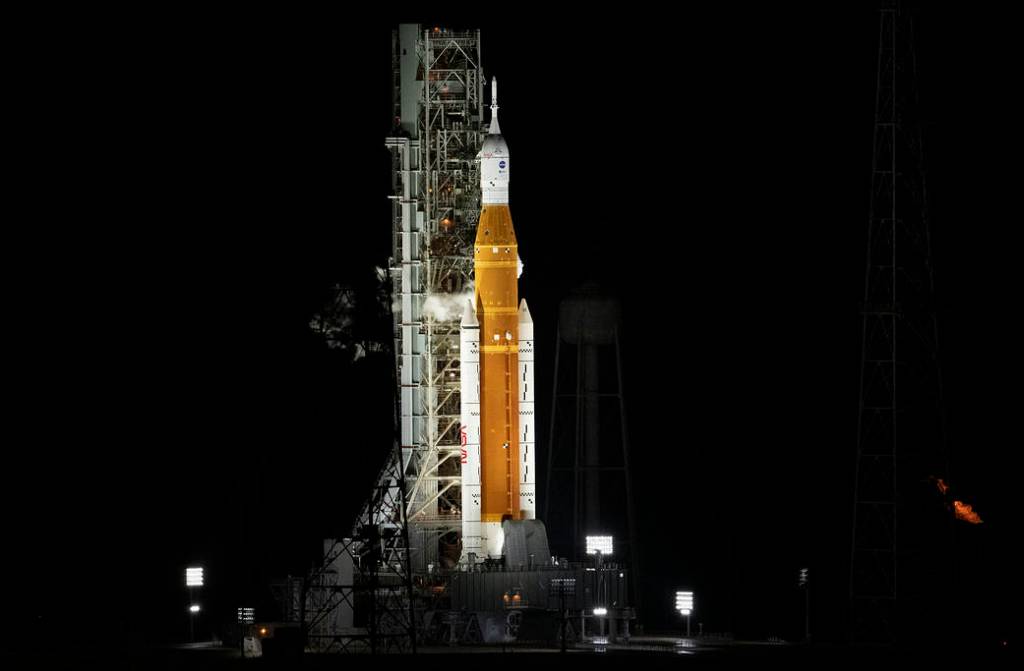
Artemis I will be the first integrated flight test of NASA’s deep space exploration system: the Orion spacecraft, Space Launch System (SLS) rocket and the ground systems at Kennedy Space Center in Cape Canaveral, Florida. The first in a series of increasingly complex missions, Artemis I will be an uncrewed flight that will provide a foundation for human deep space exploration, and demonstrate our commitment and capability to extend human existence to the Moon and beyond. During this flight, the uncrewed Orion spacecraft will launch on the most powerful rocket in the world and travel thousands of miles beyond the Moon, farther than any spacecraft built for humans has ever flown, over the course of about a three-week mission. 

I am tired of crossing my fingers, so let’s just hope these launch dates work.

Image (Credit): Artemis I mission map. (NASA)

Artemis I Launch Set for September 27th

Image (Credit): Artemis I mission patch. (NASA)

This time of year the weather tends to be troublesome in the Florida region, but NASA still hopes to try again with its Artemis I uncrewed launch to the Moon on September 27th.

Here are the updated mission facts:

  • Launch date: Sept. 27, 2022
  • Mission duration: 38 days, 23 hours, 49 minutes
  • Total distance traveled: 1.3 million miles
  • Re-entry speed: 24,500 mph (Mach 32)
  • Splashdown: Nov. 05, 2022

CNN reports that “Concerns over the weather system forming in the Caribbean put the weather conditions at only 20% favorable for a launch.” So don’t get your hopes too high, but at least NASA has resolved the hydrogen leak.

Fingers crossed.

Update: You can uncross those fingers. The launch is being delayed due to weather.

Artemis I: Still Looking for a Window

Credit: The Plain Dealer

According to Artemis blog, NASA is looking at a new Artemis I launch date of either September 23 or September 27. The blog states NASA has requested the following launch periods: 

  • Sept 23: Two-hour launch window opens at 6:47 a.m. EDT; landing on Oct. 18 
  • Sept. 27: 70-minute launch window opens at 11:37 a.m.; landing on Nov. 5 

Someone needs to update NASA’s Artemis I web-page, which as of today still shows a September 3, 2022 launch date.

Success is key for NASA to keep the momentum. Before the planned September 3rd launch, The Economist magazine (paper version) had an article titled “A Flying Turkey,” with the subtitle “The Space Launch System is yesterday’s rocket, powered by yesterday’s technology and brought about by yesterday’s thinking.” In addition to listing the Frankenstein approach used to cobble together a mission that makes reusable components non-reusable, it highlighted the ugly politics out of Alabama under Senator Shelby, calling the rocket system the “Senate Launch System.” The only endearing qualities of the Artemis missions appeared to be the commercial components under the last Artemis phase utilizing commercial partners.

This criticism is not new, but it will continue while NASA struggles to get Artemis I underway. We have already skipped out on the Moon for the last 50 years. Let’s get our heads back in the game!