“We should not have publicly funded programmes to send people to the moon, still less to Mars…It’s hugely risky, hugely expensive, and there’s no practical or scientific benefit to sending humans. It’s a pretty bad bargain for the taxpayer.”
-Statement by Lord Martin Rees, co-author of the book The End of Astronauts, speaking to the The Guardian. He argues that private sector humans and government robots are the future of space exploration. In other words, let billionaires die space, while the government avoids this risk. Harvard University Press states:
In The End of Astronauts, Goldsmith and Rees weigh the benefits and risks of human exploration across the solar system. In space humans require air, food, and water, along with protection from potentially deadly radiation and high-energy particles, at a cost of more than ten times that of robotic exploration. Meanwhile, automated explorers have demonstrated the ability to investigate planetary surfaces efficiently and effectively, operating autonomously or under direction from Earth. Although Goldsmith and Rees are alert to the limits of artificial intelligence, they know that our robots steadily improve, while our bodies do not. Today a robot cannot equal a geologist’s expertise, but by the time we land a geologist on Mars, this advantage will diminish significantly.
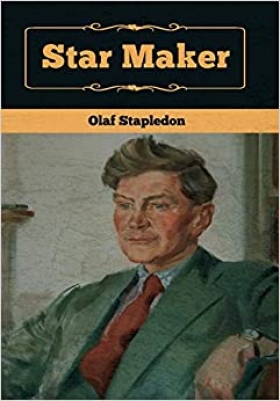
I was reading the 1937 science fiction classic Star Maker by British writer Olaf Stapledon when I came across this statement:
I perceived that I was on a little round grain or rock and metal, filmed with water and with air, whirling in sunlight and darkness. And on the skin of that little grain all the swarms of men, generation by generation, had lived in labor and blindness, with intermittent joy and intermittent lucidity of spirit. And all their history, with its folk-wanderings, its empires, its philosophies, its proud sciences, its social revolutions, its increasing hunger for community, was but a flicker in one day of the lives of stars.
It reminded me of Carl Sagan’s famous statement from his book Pale Blue Dot:
From this distant vantage point, the Earth might not seem of any particular interest. But for us, it’s different. Consider again that dot. That’s here. That’s home. That’s us. On it everyone you love, everyone you know, everyone you ever heard of, every human being who ever was, lived out their lives. The aggregate of our joy and suffering, thousands of confident religions, ideologies, and economic doctrines, every hunter and forager, every hero and coward, every creator and destroyer of civilization, every king and peasant, every young couple in love, every mother and father, hopeful child, inventor and explorer, every teacher of morals, every corrupt politician, every “superstar,” every “supreme leader,” every saint and sinner in the history of our species lived there–on a mote of dust suspended in a sunbeam.
Mr. Stapledon had only his imagination at hand when he pondered the role of humans. His book has been praised by numerous science fiction writers, including H. G. Wells, Stanisław Lem, and Arthur C. Clarke.
Mr. Sagan was fortunate to have an image from Voyager I that clearly made this same point. We need the combined powers of dreamers and scientists as we face this awesome universe.
Image (Credit): This narrow-angle color image of the Earth, dubbed ‘Pale Blue Dot’, is a part of the first ever ‘portrait’ of the solar system taken by Voyager 1. (NASA JP)
Alan Alda recently interviewed Canadian astronaut Chris Hadfield to discuss his space work, singing career, and recent book. You can catch all of it on Mr. Alda’s podcast Clear+Vivid. For instance, Mr. Hadfield notes that he used duct tape on the International Space Station (ISS) to cover over bullet-sized holes in the station’s exterior handrails torn up by space debris. This is not exactly a high-tech solution, but it works and prevents the rough edges of the damaged rails from tearing into this space suit.
Mr. Hadfield also shares his story about the time he was blinded during an ISS space walk. Amazingly, he continued with the eight-hour space walk after a quick fix bled air from his suit and restored his vision.
You can also learn about the work that went into his now famous space-based version of David Bowie’s “Space Oddity” (see below). He notes that he had plenty of time on the ISS to write his own songs as well.
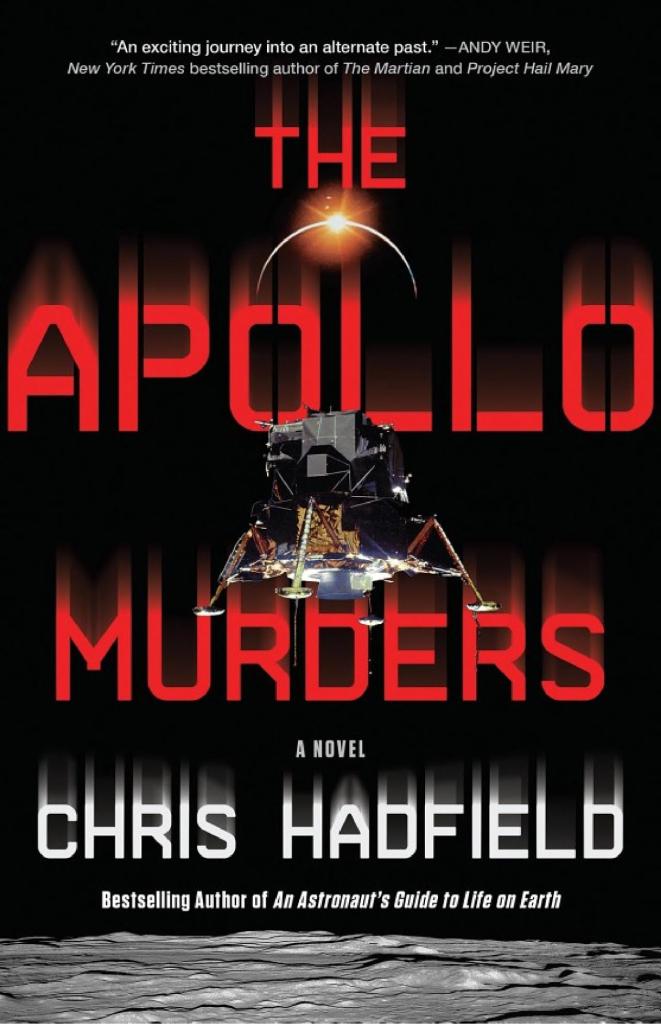
And should you be looking for a good adventure book, Mr. Hadfield book The Apollo Murdersmay solve that craving. It has enough real space stories intertwined within this thriller to keep it interesting. Here is the blurb for the book:
1973: a final, top-secret mission to the Moon. Three astronauts in a tiny spaceship, a quarter million miles from home. A quarter million miles from help.
NASA is about to launch Apollo 18. While the mission has been billed as a scientific one, flight controller Kazimieras “Kaz” Zemeckis knows there is a darker objective. Intelligence has discovered a secret Soviet space station spying on America, and Apollo 18 may be the only chance to stop it.
But even as Kaz races to keep the NASA crew one step ahead of their Russian rivals, a deadly accident reveals that not everyone involved is quite who they were thought to be. With political stakes stretched to the breaking point, the White House and the Kremlin can only watch as their astronauts collide on the lunar surface, far beyond the reach of law or rescue.
Full of the fascinating technical detail that fans of The Martian loved, and reminiscent of the thrilling claustrophobia, twists, and tension of The Hunt for Red October, The Apollo Murders is a high-stakes thriller unlike any other. Chris Hadfield captures the fierce G-forces of launch, the frozen loneliness of space, and the fear of holding on to the outside of a spacecraft orbiting the Earth at 17,000 miles per hour as only someone who has experienced all of these things in real life can.
Strap in and count down for the ride of a lifetime.
Alan Alda calls Mr. Hadfield a great communicator for space programs. Given all of his efforts and talents, it is hard to disagree.
Image (Credit): Chris Hadfield’s video singing “Space Oddity” on the ISS. (Canadian Space Agency)
Image (Credit): Chris Hadfield’s latest book. (Mulholland Books)
Image (Credit): An artist’s rendering of ‘Oumuamua. (European Southern Observatory / Science Photo Library)
“Human history is very often driven by a group of people feeling superior to another group of people. If we find that we are not the smartest kid on the cosmic block, it will give us a different perspective. All the differences between humans will become irrelevant.”
-Harvard University Professor Avi Loeb quoted in the Independent discussing his search for extraterrestrial life and his new effort called The Galileo Project. His book, Extraterrestrial: The First Sign of Intelligent Life Beyond Earth, on the the mysterious object ‘Oumuamua that visited our solar system has caused quite a stir.
The January 31st edition of The New Yorkerhas an article written by Joshua Rothman where he interviews Kim Stanley Robinson they hike through the Sierra mountains. The article,”Best-Case Scenario,” covers a lot of ground and has its ups and downs (sorry, I could not help myself). The Sierras offer a nice setting for experiencing the beauty of this strange planet while also scaring the reader about what may be lost as the hikers deal with the smoke of distant forest fires.
The two most prominent books discussed in the article are Mr. Stanley’s recent The Ministry for the Future and his 2015 novel Aurora, allowing the reader to appreciate both the uniqueness of this world as well as attempts by his characters to reach more distant worlds. I enjoyed reading both Aurora and Mr. Stanley’s Mars trilogy, but I should probably spend some time reading his works focusing on planet Earth. Mr. Stanley has made it clear that we need to preserve the one place in the universe that we know can host us. As he stated in BoingBoing back in 2015, “…there is no Planet B. Earth is our only home.”
With regard to expanding into our galaxy, in the same article he stated:
I’m not saying we shouldn’t go into space; we should. We should send people to the moon, and Mars, and the asteroids, and every place we can in the solar system, putting up stations and swapping humans in and out of them. This is not only a beautiful thing to do, but useful in helping us to design a long-term relationship with Earth itself. Space science is an Earth science. The solar system is our neighborhood. But the stars are too far away.
Mr. Stanley has spoken far and wide for some time about his novels, his views on space travel, and his concerns regarding our future. For more on all of this, you can try his Facebook page or this unofficial site. And you may want to check out some other articles in The New Yorker as well, such as this May 2021 piece, “Is Mars Ours?“