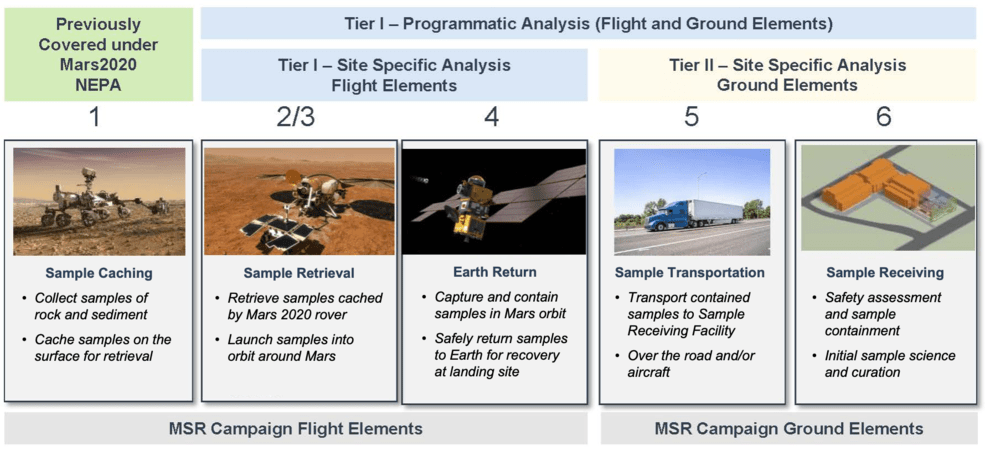
Image (Credit): Mars Sample Return campaign poster. (NASA)
NASA and the European Space Agency are still looking for comments on the process to return Martian rock samples to Earth. Of the six steps needed to collect and return the samples (see graphic above), only the first step is currently underway with the Perseverance Rover exploring Mars. Now we need to get those samples home. You have until May 15th to get comments back to NASA on this.
And what is the time frame for getting these samples back to Earth? The current goal is 2033, assuming all goes well. You may recall that China also wants to collect and return Martian samples by 2030. I expect more delays on both sides. When you add this to the race back to the Moon, the space race is getting more interesting every day.
Image (Credit): USSR’s Luna 2 spacecraft. (Worldhistoryproject.org)
So who owned the rocket stage that hit the Moon earlier this month? I had earlier noted the speculation pertaining to both SpaceX and then the Chinese rockets. Surprisingly, it is still is not clear who owned that rocket stage and maybe we will never know. That is not a good answer for the European Space Agency’s Space Safety Programme, which stated:
The upcoming lunar impact illustrates well the need for a comprehensive regulatory regime in space, not only for the economically crucial orbits around Earth but also applying to the Moon.
While that case has yet to be solved, we are pretty certain about the first Earth-launched rocked to hit the Moon. We can blame the Soviets for that strike back in 1959 with its Luna 2 (nicknamed the Lunik 2). At least the goal in that case was to hit the Moon.
Launched on September 12, 1959, it took 35 hours to travel the distance between the Earth and Moon. Luna 1, launched by the Soviets earlier that year, was supposed to hit the Moon but it missed by about 3,700 miles. You can see more about Luna 2 via this dated news clip.
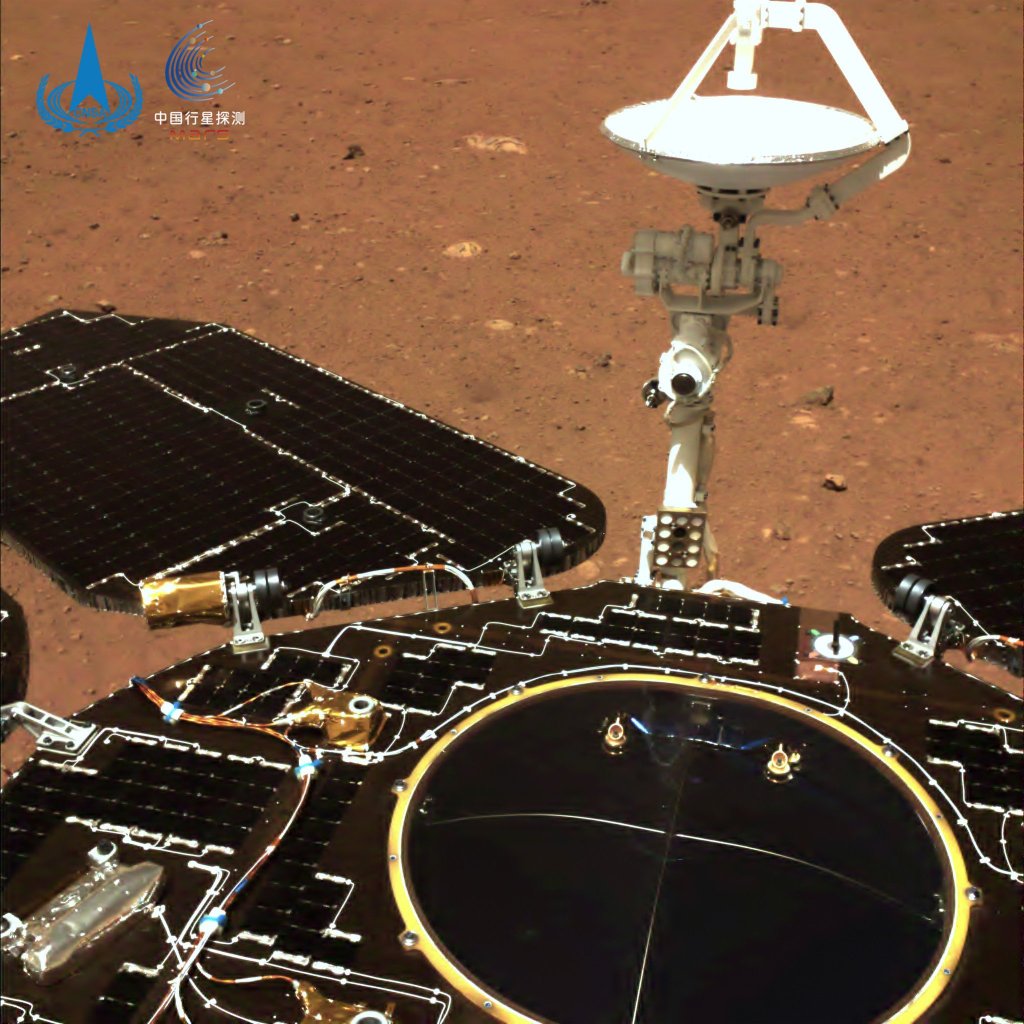
Image (Credit): Two images from China’s Martian Rover Zhurong. (CNCA)
The China National Space Administration (CNSA) Watcher site posted the above before and after selfies taken by the Zhurong Mars Rover. The top shot was taken on May 19, 2021 and the bottom shot on January 22, 2022. You can see the dust that has accumulated in less than a year on the rover’s panels. The site notes that the rover has the ability to vibrate and loosen the accumulated dust.
China launched Tianwen-1, which carried the rover, on July 23, 2020. It went into orbit around Mars in February 2021, with the Zhurong Rover landing on the Martian surface on May 14, 2021. China sent the rover to the Red Planet to find evidence of water. If all goes well, China hopes to bring a Martian samples back to Earth in a subsequent mission. The Planetary Society has some helpful information here on the Chinese mission.
Image (Credit): China’s Mars Rover Zhurong next to its landing platform on the surface of the red planet. (CNSA)
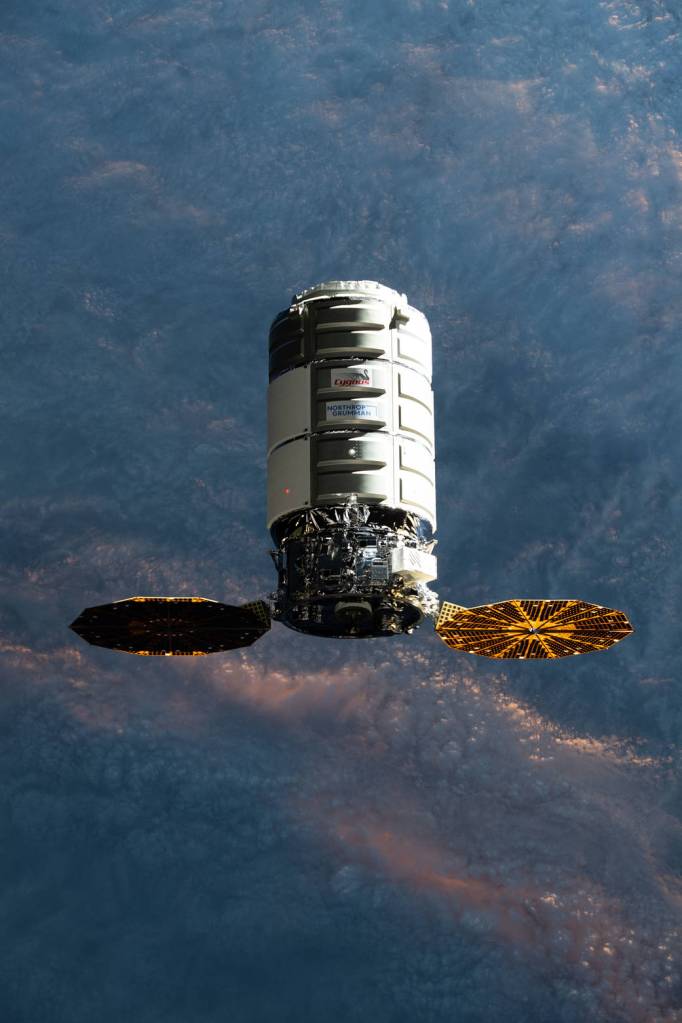
Image(Credit): Northrop Grumman’s Cygnus space freighter approaching the International Space Station (NASA).
Over the weekend, the Washington Post published an editorial by Homer Hickam, former NASA engineer and advisor to the National Space Council, titled, “Our space partnership with Russia can’t go on.” In the piece, Mr. Hickam argues that the International Space Station (ISS) has accomplished its goals and the US can now move onto other projects without the Russians:
With our flourishing commercial space companies, who are already cutting metal on their own future space stations, plus our federal government’s Artemis moon program, the United States is entering a new golden age of space exploration. The Russians, meanwhile, are stuck in the past with antiquated spacecraft and nowhere to go except the ISS.
Mr. Hickam appears to believe pushing out the Russians may mean the end of the ISS. Of course, this is just one man’s view, and whatever we do we need to do it in conjunction with our other ISS partners.
We could continue to maintain the ISS through 2030, as planned, and schedule more useful science even without the Russians as partners. This may make sense until we have another viable station that we can use, such as NASA’s planned lunar Gateway. Russia will not be part of the Gateway given that it is working with China on other lunar plans, so we do not need to worry about another breakup.
It would be better if Russia had focused on its space accomplishments rather than territorial ambitions as it prepares for the future. Joint space programs are a great way to use rockets for peaceful missions. I am not against a space race that pushes us even farther into space, yet I would prefer it be fueled by scientific achievement rather than nationalist angst.
Image(Credit): Artist rendering of the Artemis lunar Gateway (NASA).
Source/Credit: Yutu 2 rover on the dark side of the moon from the China National Space Administration.
As much as we talk about cooperation in space, it is always nice to be the first nation to pass a milestone, be it the first man on the Moon or the first probe of Pluto. The U.S. has plenty of great stories about space travel, as do the Russians, and now the Chinese are creating their own stories. For instance, China’s Yutu 2 rover was the first rover to explore the dark side of the Moon.
A linchpin of the NASA moon effort is the Space Launch System, the Boeing-built mega-rocket that has been beset by years of delay and cost overruns that is finally set to make its maiden test flight in 2022.
The U.S., Russia, and China all have designs on the moon:
The U.S. moon program has been enlisting international partners in the form of the Artemis Accords, which now includes more than a dozen countries. But Russia and China, which are pursuing a lunar research station, are also seeking partners.
We already know that the U.S. hopes to have astronauts on the Moon in 2024, so what are the Russian and Chinese schedules for their projects? It appears the two nations are working on a joint lunar research base scheduled for the 2030s. However, not everyone is convinced this will happen. A Foreign Policy article, “A Chinese-Russian Moon Base? Not So Fast,”voiced skepticism that the two nations can generate sufficient funding, technological know-how, and political unity to pull off such a mission, citing earlier joint attempts, including a Martian mission:
In 2007, China and Russia signed an agreement for “joint Chinese-Russian exploration of Mars,” culminating in a 2011 launch of a Mars orbiter and landing craft. However, the Russian rocket malfunctioned, causing Russian and Chinese spacecraft to come crashing back down to Earth, an embarrassing conclusion to bothcountries’ first attempt to reach the red planet.
The two nations seems to be even more unified against the U.S. since this Foreign Policy article was published, so anything is possible. However, the U.S. did pretty well in the 1960s and 1970s after initially trailing the Russians, so my money is still on the U.S. in this latest race.