If you are trying to learn more about the space programs at NASA, you can download the recently updated NASA+ app, which has a variety of videos and astronomy series to please anyone’s curiosity. For instance, check out the videos under “Scientific Wonders” to learn more about the James Webb Space Telescope, the New Horizons mission to Pluto, the Hubble Space Telescope, the Kepler Space Telescope, the OSIRIS-REx asteroid sample return, and much more.
This free app can bring you up to speed on the earlier space programs as well as provide updates on the latest missions. For example, you can watch the video showing yesterday’s docking of the SpaceX CRS-29 Cargo Dragon Resupply Craft with the International Space Program.
You cannot go wrong with this free app. You can read more about the updated NASA+ app here.
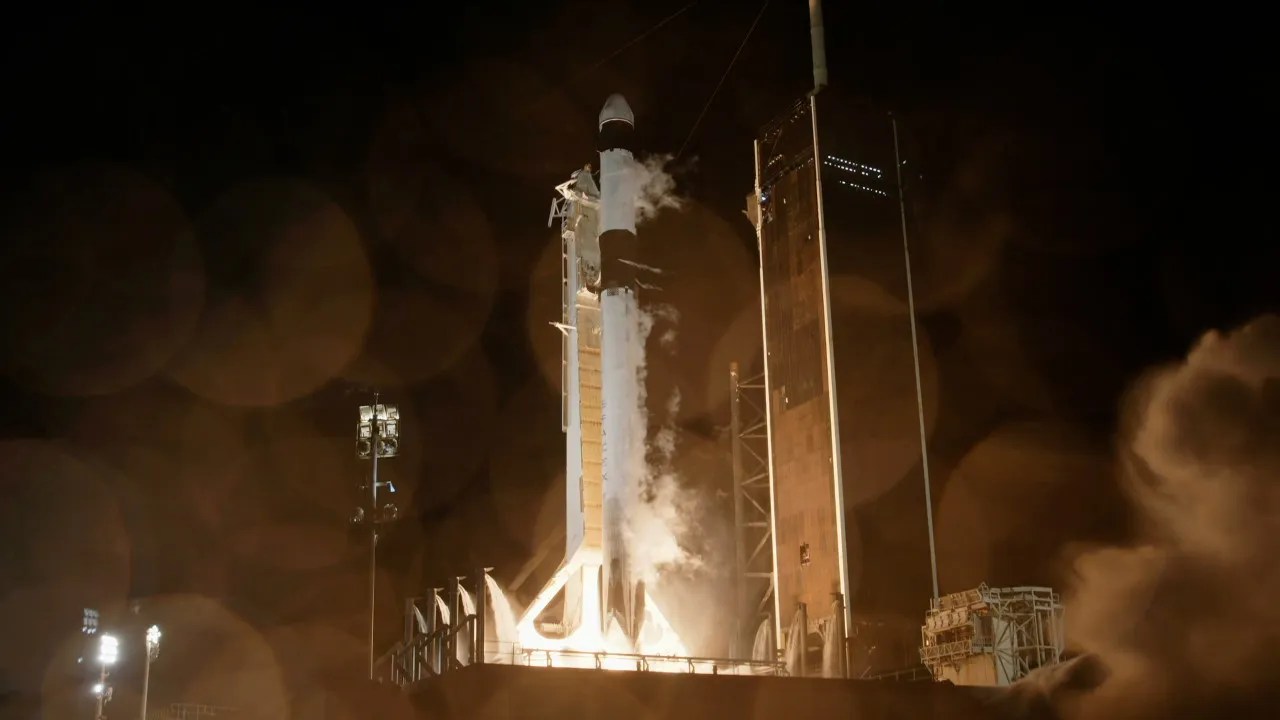
Image (Credit): The launch of the CRS-19 resupply mission to the ISS on Thursday, November 9. (NASA)
Yesterday, NASA sent another resupply mission to the International Space Station (ISS) aboard a SpaceX Dragon spacecraft. It will not rendezvous with the ISS until early Saturday morning (no sleeping in for the crew).
This mission, CRS-29, will be SpaceX’s 29th supply mission to the ISS. The next most frequent resupplier is Northrop Grumman, which has sent 19 resupply missions to the ISS.
If you are interested in the material being brought to the station, NASA discusses some of the contents here.
You can also follow the progress of the latest mission here.
Image (Credit): Sierra Space employees in front of the new Dream Chaser. (Sierra Nevada)
“I am reminded of a comment made by Steve Jobs that every once in a while, a revolutionary product comes along that changes everything. I think Dream Chaser is that product. This breakthrough shifts paradigms and redefines space travel. The Dream Chaser is not just a product; it’s a testament to human spirit, determination and the relentless pursuit of what lies beyond.”
-Statement by Sierra Space CEO Tom Vice in a company press release announcing the completion of the first Dream Chaser, said to be the “world’s sole commercial runway-capable spaceplane.” Its next stop is NASA’s Neil A. Armstrong Test Facility in Ohio for environmental testing. It is basically an advanced version of the earlier space shuttles that will be launched on a rocket and return by landing on a runway. NASA plans to use the spaceplane to bring cargo to the ISS. As with the initial space shuttle, the reusable craft makes a lot of sense and should help with overall costs. Of course, it is not clear why we had to go without a shuttle for 12 years.
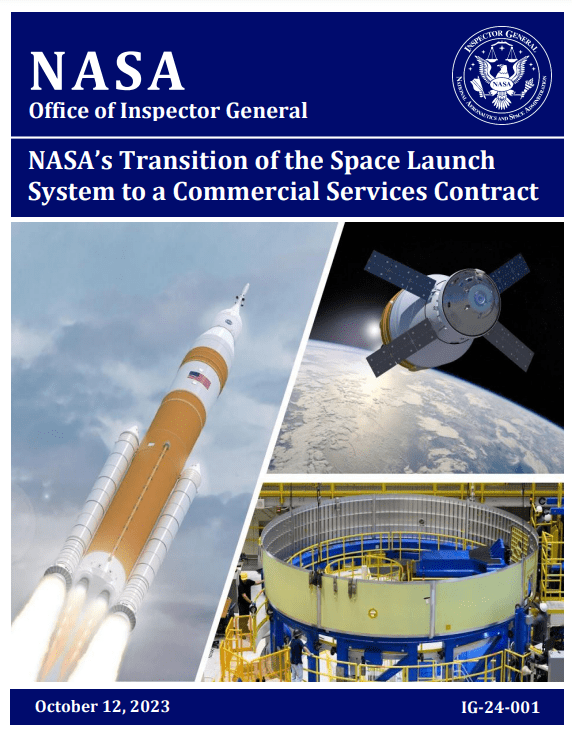
First, the US Government Accountability Office reported that NASA’s Space Launch System (SLS) is unaffordable, and now NASA’s Office of Inspector General (OIG) doubles down on that earlier finding, reporting that the SLS, a key component of the Artemis program, has costs that are spinning out of control.
Our analysis shows a single SLS Block 1B will cost at least $2.5 billion to produce—not including Systems Engineering and Integration costs—and NASA’s aspirational goal to achieve a cost savings of 50 percent is highly unrealistic. Specifically, our review determined that cost saving initiatives in several SLS production contracts such as reducing workforce within Boeing’s Stages contract and gaining manufacturing efficiencies with Aerojet Rocketdyne’s RS-25 Restart and Production Contract were not significant and, as a result, a single SLS will cost more than $2 billion through the first 10 SLS rockets produced under [the Exploration Production and Operations Contract].
NASA OIG concludes that maybe other contractors needs to be considered, stating:
Although Congress directed NASA in 2010 to build a heavy-lift rocket and crew capsule using existing contracts from the canceled Constellation effort to meet its space exploration goals, the Agency may soon have more affordable commercial options to carry humans to the Moon and beyond. In our judgment, the Agency should continue to monitor the commercial development of heavy-lift space flight systems and begin discussions of whether it makes financial and strategic sense to consider these options as part of the Agency’s longer-term plans to support its ambitious space exploration goals.
Where are these “more affordable commercial options”? Could it be SpaceX? Blue Origin? If so, let’s start the transition ASAP so that the Moon and Mars remain a realistic goal in the near future. We have plenty of talent in this country and a race to the top is what we need, not a space agency stuck with an Edsel rocket system.
Image (Credit): Launch of the Amazon Project Kuiper prototypes from Cape Canaveral. (Amazon)
If you were worried about satellite traffic and its impact on astronomy, then you have one more thing to worry about. Yesterday, two prototype satellites were launched aboard an Atlas V rocket from the Cape Canaveral Space Force Station. They are part of Amazon’s Project Kuiper, which may lead to 3,200 additional satellites orbiting the Earth.
Project Kuiper is an initiative to increase global broadband access through a constellation of 3,236 satellites in low Earth orbit (LEO). Its mission is to bring fast, affordable broadband to unserved and underserved communities around the world.
Sounds a lot like SpaceX’s Starlink, doesn’t it? And plenty more similar projects are being planned by the Chinese and others.
It does make you wonder whether there is a better way. I understand the nationals security complications with satellites, but thousands upon thousands of satellites circling the Earth to provide similar Internet services to customers sounds wasteful, dangerous, and bothersome to astronomy. I liked it better when the wires were running under the seas or underground. This new approach will be a mess.
The Government Accountability Office issued a report last year highlighting some of the risks and mitigation ideas:
Increase in orbital debris. Debris in space can damage or destroy satellites, affecting commercial services, scientific observation, and national security. Better characterizing debris, increasing adherence to operational guidelines, and removing debris are among the possible mitigations, but achieving these is challenging.
Emissions into the upper atmosphere. Rocket launches and satellite reentries produce particles and gases that can affect atmospheric temperatures and deplete the ozone layer. Limiting use of rocket engines that produce certain harmful emissions could mitigate the effects. However, the size and significance of these effects are poorly understood due to a lack of observational data, and it is not yet clear if mitigation is warranted.
Disruption of astronomy. Satellites can reflect sunlight and transmit radio signals that obstruct observations of natural phenomena. Satellite operators and astronomers are beginning to explore ways of mitigating these effects with technologies to darken satellites, and with tools to help astronomers avoid or filter out light reflections or radio transmissions. However, the efficacy of these techniques remains in question, and astronomers need more data about the satellites to improve mitigations.
The report has a lot of good information, but I am not sure Amazon, SpaceX, or the Chinese will be paying any attention until a world body gets involved. National regulation will not be enough.
More likely than not, as with many of these areas in need of regulation, we are just one major accident away from new rules.