A New Suit for the Moon Mission

Image (Credit): Space suits in the television series Lost in Space. (Netflix)

U.S. companies Axiom Space and Collins Aerospace have been tasked to build new suits for NASA’s astronauts. The suits will be worn as part of the Artemis Program returning astronauts to the Moon. First, the new suits will be tested and used on the International Space Station (ISS).

While both companies are still in the early stages of developing the next space suite, the $3.5 billion Extravehicular Activity Services (xEVAS) Contract will support this development and production.

In a press release, Mark Kirasich, deputy associate administrator of NASA’s Artemis Campaign Development Division, stated:

Our commercial partnerships will help realize our human exploration goals…We look forward to using these services for NASA’s continued presence in low-Earth orbit and our upcoming achievement of returning American astronauts to the Moon’s surface. We are confident our collaboration with industry and leveraging NASA’s expertise gained through over 60 years of space exploration will enable us to achieve these goals together.

You may recognize the name Axiom Space. It was the company that worked with SpaceX to put private citizens on the ISS with its Axiom Mission 1 (Ax-1). It is also developing the world’s first commercial space station, the Axiom Station.

Collins Aerospace, part of Raytheon Technologies, has plenty of experience with space suits. The company designed the spacesuit used by the Apollo mission astronauts who landed on the moon. It also designed the space suits currently in use for missions outside the ISS.

In Case You Missed It: Public Views on the Space Program

Image (Credit): Size of the Earth compared to Mars and the Moon. (hyperphysics.phy-astr.gsu.edu/)

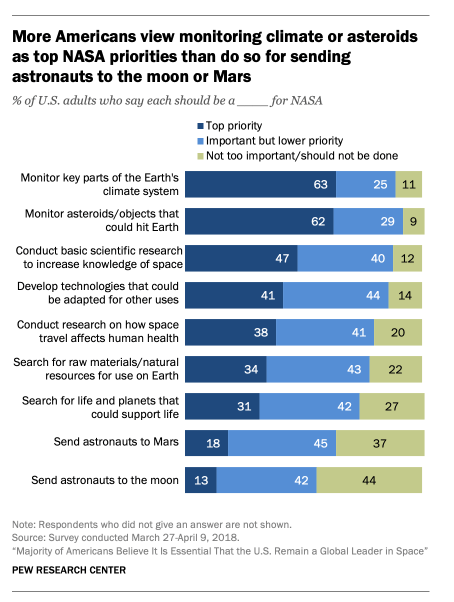
Back in July 2019, the Pew Research Institute issued the results of earlier surveys about the US space program. Let’s look at the answers to six of the questions:

  1. Most Americans think sending astronauts to Mars or the Moon should be a lower priority for NASA – or say it should not be done at all (see graphic below).
  2. Americans see priorities other than a Moon or Mars landing as more pressing for NASA.
  3. Half of Americans think space travel will become routine during the next 50 years of space exploration.
  4. A majority of Americans say the U.S. must remain a global leader in space exploration, and that NASA’s continued involvement is essential.
  5. Americans have little confidence that private space companies will minimize space debris. 
  6. Americans are not enthusiastic about the idea of creating a military Space Force.

NASA may not be listening given that a trip back to the Moon was the lowest priority of Americans and yet is it the largest program currently in the U.S. space program, with a Moon satellite and trip to Mars as part of future plans. As far as minimizing space debris, the public seemed right on the mark regarding private space companies. If Elon Musk is any indicator, the commercial sector will not be deterred as it adds thousands of new satellites and related debris. And the ship has sailed on the Space Force question with the creation of the US Space Force in December 2019.

This would not be the first time Washington, DC goes down its own path regardless of public sentiment.

Image (Credit): Second question on the Pew survey on the space program. (Pew Research Institute)

Starliner: Third Time’s the Charm

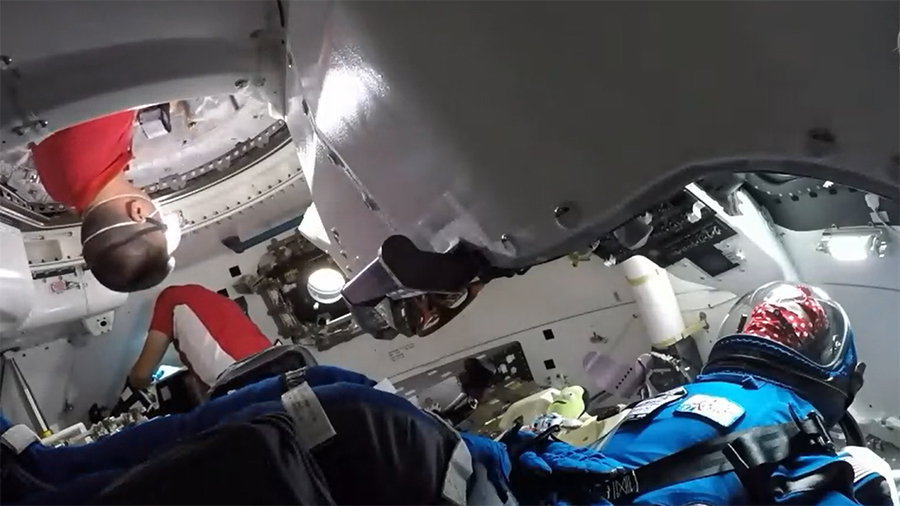
Image (Credit): NASA astronauts Bob Hines and Kjell Lindgren greet “Rosie the Rocketeer” inside the Boeing Starliner spacecraft shortly after opening its hatch. (NASA)

Finally, we have another spacecraft that appears capable of bringing astronauts into orbit. After two earlier tries, Boeing’s Starliner was successfully launched on Thursday and then connected with the International Spaced Stations (ISS) today. Now we just need it to undock on Wednesday and safely return.

In a press release, Jim Chilton, Boeing’s senior vice president for Space and Launch, stated:

Starliner has proven safe, autonomous rendezvous and docking capability…We’re honored to join the fleet of commercial spacecraft capable of conducting transportation services to the space station for NASA.

We needed this redundancy in our ISS program and now we have it.

You can read more about the mission here.

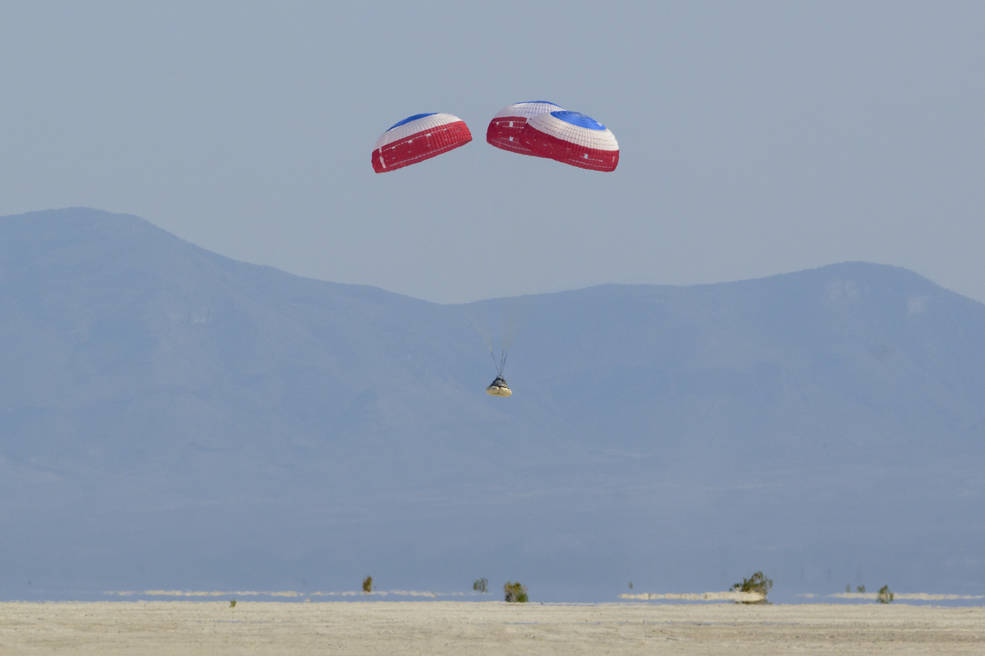
Update: The Starliner spacecraft safely returned to Earth on Wednesday, May 22nd. Joel Montalbano, manager of NASA’s International Space Station Program, stated:

Congratulations to the NASA and Boeing teams…I am excited to see the completion of a critical step in bringing another system online to transport long-duration crew members to and from the International Space Station. Soon, we hope to see crews arrive to the space station on Starliner to continue the important microgravity scientific research and discovery made possible by the orbiting laboratory.

Image (Credit): Boeing’s CST-100 Starliner spacecraft lands at White Sands Missile Range’s Space Harbor, Wednesday, May 25, 2022, in New Mexico. (NASA/Bill Ingalls)

KSC: Upcoming Launch Schedule & More

Image (Credit): The John F. Kennedy Space Center in Florida. (NASA)

If you are interested in what is being launched from the Kennedy Space Center (KSC), you can easily view this information at this website. For example, on May 19th, the Boeing CST-100 Starliner will be tested in orbit as it becomes another candidate to resupply the International Space Station. The site also highlights other interesting events and anniversaries, such as the December 7th 50th anniversary of the Apollo 17th launch.

One place holder on the KSC schedule with no clear date is the inaugural launch of NASA’s Space Launch System (SLS) rocket, the first phase of the Artemis Program. In a recent press release, NASA outlined the parameters for such a launch as well as the remaining days in 2022 that would satisfy these parameters. The four parameters are:

  1. The Moon’s position in its lunar cycle;
  2. A trajectory so Orion is not in darkness for more than 90 minutes at a time so that the solar array wings can receive and convert sunlight to electricity and the spacecraft can maintain an optimal temperature range;
  3. A trajectory that allows for the skip entry technique planned during Orion’s return to Earth; and
  4. Daylight conditions for Orion’s splashdown to initially assist recovery personnel when they locate, secure, and retrieve the spacecraft from the Pacific Ocean.  

The calendar still has plenty of possible dates. The question now is whether NASA can get all of the pieces together in time to make this happen in 2022.

Credit: NASA

Space Quote: A Mature Rocket Market?

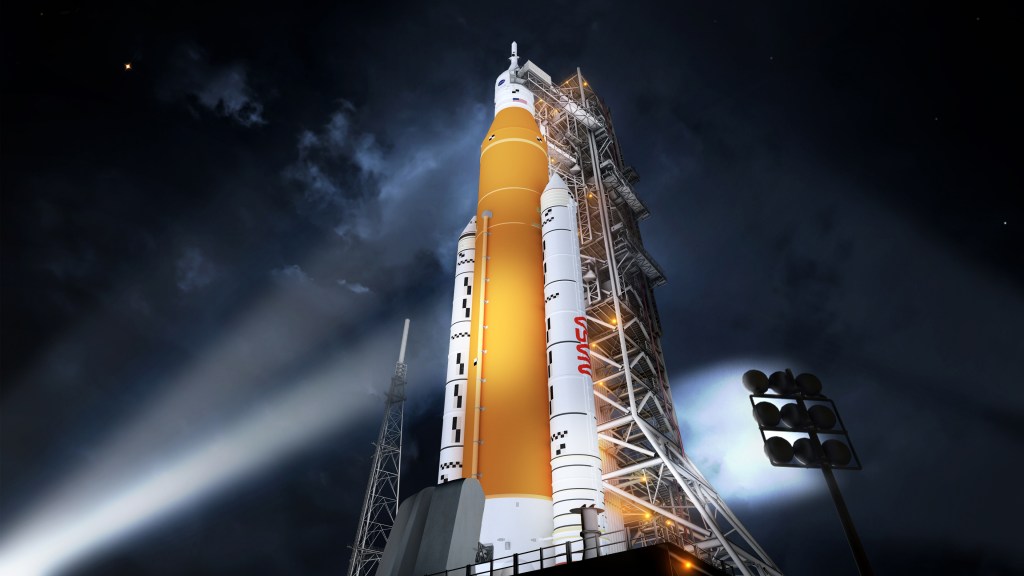
Image (Credit): Space Launch System rocket. (NASA)

“The launch industry is at a point where the technology is so mature that it may not be necessary to have the U.S. government invest in it… It may be we’re at a tipping point with this rocket.”

-Statement by Dan Goldin, a former NASA administrator, regarding NASA’s expenditures on the Space Launch System (SLS) in a Wall Street Journal article, “NASA Is Building Moon Rockets, Maybe for the Last Time.” The SLS and Orion spacecraft are part of NASA’s Artemis Program to return astronauts to the Moon.