Image (Credit): Test run of the Starship Booster on May 5, 2022. (SpaceX)
Earlier this week, SpaceX conducted another test of its Starship. However, the booster was damaged by an explosion during a pre-launch test and will now need to be inspected to determine whether it can be used in the inaugural launch of the Starship later this summer.
For more on the Starship, check out the Cool Worlds video titled “Why Starship Could Transform Astronomy.” It argues that reduced launch costs, reduced complexity, and heavier payloads would allow NASA to launch a fleet of telescopes within current budgets. For instance, the larger Starship payload would have allowed NASA to avoid all of the contortions necessary to fold the James Webb Space Telescope into a smaller rocket. The video also argues that SpaceX’s willingness to take risks is something NASA may want to emulate.
These are interesting times with NASA and SpaceX testing new rockets to place astronauts on distant objects. Even if Russia wants to sit this one out, we have a full blown space race underway domestically.
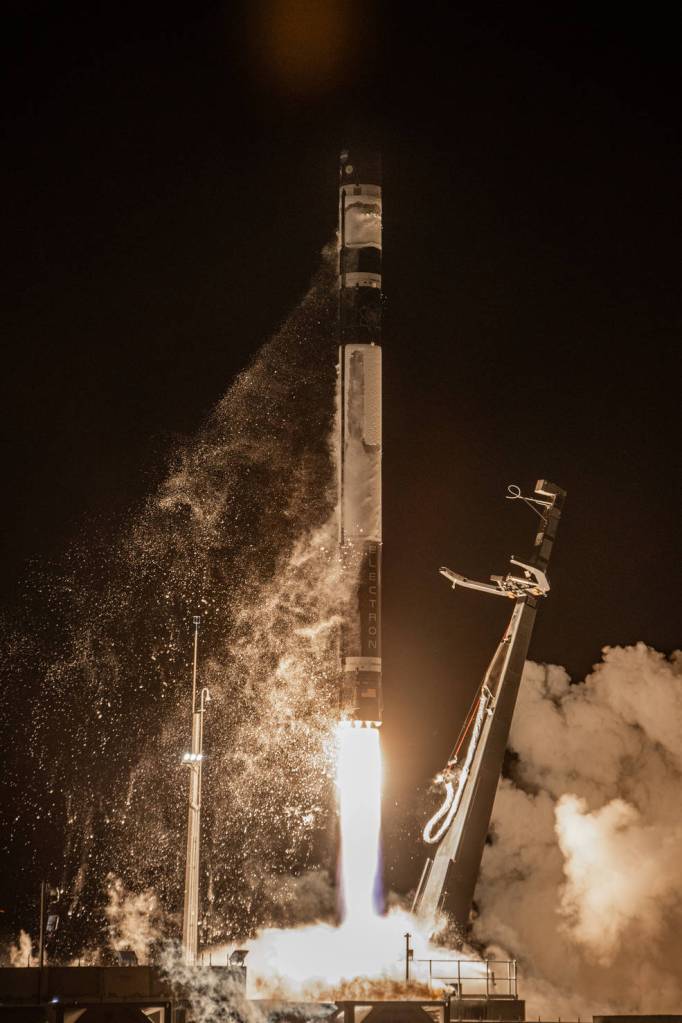
Image (Credit): June 28th launch of CAPSTONE aboard Rocket Lab’s Electron rocket from the Rocket Lab Launch Complex 1 on the Mahia Peninsula of New Zealand. (Rocket Lab)
While we are awaiting the launch of the uncrewed Artemis phase-one rocket later this summer to test the waters for a crewed mission, other related missions are ongoing. NASA’s Cislunar Autonomous Positioning System Technology Operations and Navigation Experiment (CAPSTONE) was launched earlier in the week from New Zealand and will take about four months before it orbits the Moon for another six months. The miniaturized satellite, or CubeSat, is designed to test the future lunar orbit of Gateway, a lunar space station being planned by NASA and its commercial and international partners to support NASA’s Artemis program, including astronaut missions.
Here are CAPSTONE’s mission objectives:
Verify the characteristics of a cis-lunar near rectilinear halo orbit for future spacecraft;
Demonstrate entering and maintaining this unique orbit that provides a highly-efficient path to the Moon’s surface and back;
Demonstrate spacecraft-to-spacecraft navigation services that allow future spacecraft to determine their location relative to the Moon without relying exclusively on tracking from Earth;
Lay a foundation for commercial support of future lunar operations; and
Gain experience with small dedicated launches of CubeSats beyond low-Earth orbit, to the Moon, and beyond.
In a press release, Elwood Agasid, project manager for CAPSTONE at NASA’s Ames Research Center in California’s Silicon Valley, stated:
CAPSTONE is a pathfinder in many ways, and it will demonstrate several technology capabilities during its mission timeframe while navigating a never-before-flown orbit around the Moon…CAPSTONE is laying a foundation for Artemis, Gateway, and commercial support for future lunar operations.
We forget about all of the smaller missions (literally, in this case) that make the full mission possible. CAPSTONE is a key mission to test some ideas and reduce risk for future astronauts.
Image (Credit): Artist’s impression of CAPSTONE in orbit near the Moon. (Illustration by NASA/Daniel Rutter)
In addition to the dialog about her time with NASA and the growing role of commercial space providers, the dialogue also gets into specific projects, including potential plans to mine asteroids. One asteroid in particular, Psyche (located in the asteroid belt), was cited as an asteroid of special interest because it contains what some believe to be the core of a failed planet, which means plenty of expensive metals.
NASA currently has plans to launch a spacecraft later this year to visit Psyche. The objectives are to:
Determine whether Psyche is a core, or if it is unmelted material.
Determine the relative ages of regions of Psyche’s surface.
Determine whether small metal bodies incorporate the same light elements as are expected in the Earth’s high-pressure core.
Determine whether Psyche was formed under conditions more oxidizing or more reducing than Earth’s core.
Characterize Psyche’s topography.
I recommend you listen to the full podcast story and also stayed tuned for the upcoming asteroid adventure.
Update: The Psyche mission has been delayed. NASA noted:
Due to the late delivery of the spacecraft’s flight software and testing equipment, NASA does not have sufficient time to complete the testing needed ahead of its remaining launch period this year, which ends on Oct. 11.
A launch is possible as early as next year, but NASA is now going over all the options.
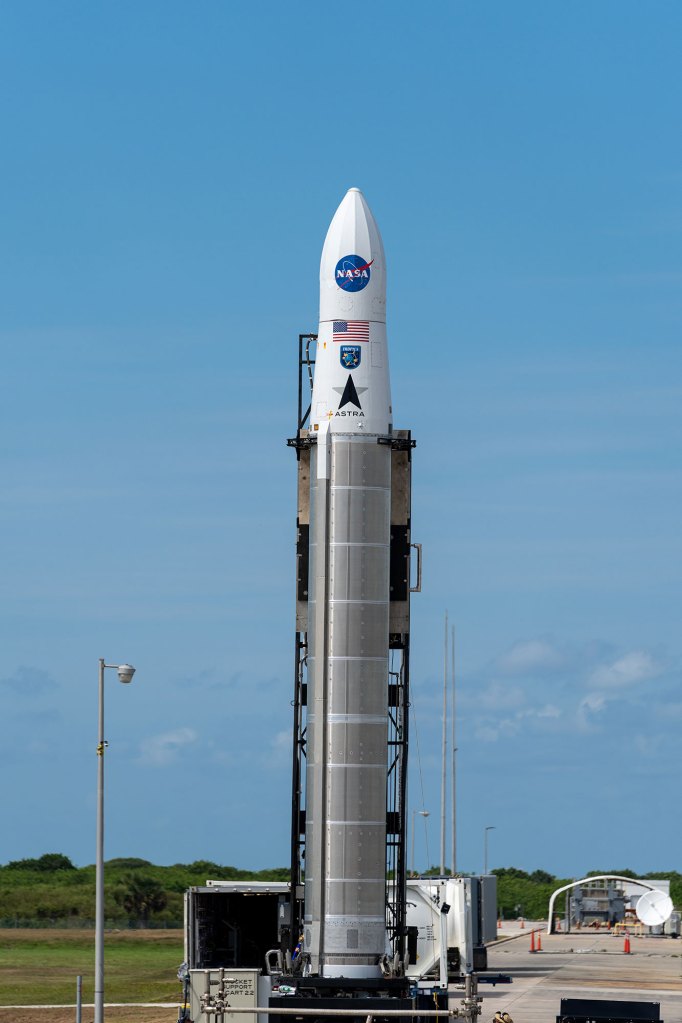
Image (Credit): Astra rocket for the TROPICS satellites. (Astra)
This weekend we witnessed another example that space operations are risky. On Sunday, Astra’s Rocket LV0010 launched from Cape Canaveral but was unable to place two satellites into orbit. The satellites were part of NASA’s TROPICS-1 mission. The main issue was the engine on the upper portion of the rocket.
As described by Astra on its website, the launch of the Time-Resolved Observations of Precipitation structure and storm Intensity with a Constellation of Smallsats (TROPICS) mission was awarded to Astra in February of this year and “consists of a constellation of six small satellites that will observe tropical cyclones, aiming to improve the scientific community’s understanding of these dangerous weather events.” This was the first of three such launches, leaving four satellites untouched and ready to go once Astra, NASA, and the Federal Aviation Administration figure out what happened this weekend.
This is not the first NASA mishap. Back in February, Rocket LV0008 (also launched from Cape Canaveral) suffered an in-flight anomaly during stage separation. As a result, NASA’s Educational Launch of Nanosatellites (ELaNa 41) mission to place CubeSats into orbit failed. CubeSats are miniature satellites designed to provide a low-cost platform for NASA missions.
Astra is a relatively new entrant to in the commercial space industry having been founded in 2016. Let’s hope the lessons learned from this mishap and persistence will allow the company to thrive in this competitive and risky industry.
Have you read about the Chinese car company with space ambitions? In a June 2 press release, we learn that a unit of the Chinese automaker Geely (owner of Volvo, Polestar, and Group Lotus) already sent 9 communications satellites into orbit this year, with plans for a total of 240 such satellites in a constellation that will assist car drivers with autonomous driving.
Of course, automaker Elon Musk is also launching satellites into space as part of the Starlink program, but that is about the end of the similarities for now. In addition to planning to launch fewer satellites with a more restricted mission, Geely will depend upon Chinese government rockets to launch these satellites. Mr. Musk has his own SpaceX rockets to assist Starlink.
That does not mean Geely lacks in ambition elsewhere. In the same press release, Geely stated:
With the successful launch and operation of Geespace’s first satellites, the company will become one of the world’s first providers of combined commercial Precise Point Positioning and Real-Time Kinematic services (PPP-RTK)…
Tony Wang, CEO and Chief Scientist of Geespace said: “Many favourable factors such as policy support and market demand is accelerating the growth of the commercial aerospace sector...new opportunities to develop have been opened in various sectors including smart mobility, consumer electronics, unmanned systems, smart cities, and environmental protection.”
And while Geely is not building rockets at this time, it is building satellites:
Early in September 2021, Geely’s Intelligent Satellite Production and Testing Centre began mass production of commercial satellites with an annual production capacity of 500 units. Through intelligent modular manufacturing, Geespace is able to produce high-quality, easily customizable satellites to meet the growing global demand for commercial satellites. The GeeSAT-1 is only the first of many new satellite models from Geespace and its successful launch into orbit is just the first of many to come.