Space Stories: Mars Ascent Vehicle, Dark Matter Stars, and a New Russian Space Station

Image (Credit): Artist’s rendering of the Mars Ascent Vehicle. (NASA)

Here are some recent stories of interest.

NASA/JPJ.com : “NASA Mars Ascent Vehicle Continues Progress Toward Mars Sample Return

NASA’s Mars Ascent Vehicle (MAV) recently reached some major milestones in support of the Mars Sample Return program. The Mars Ascent Vehicle would be the first launch of a rocket from the surface of another planet. The team developing MAV conducted successful tests of the first and second stage solid rocket motors needed for the launch. Mars Sample Return will bring scientifically selected samples to Earth for study using the most sophisticated instrumentation around the world. This strategic partnership with ESA (European Space Agency) features the first mission to return samples from another planet. The samples currently being collected by NASA’s Perseverance Rover during its exploration of an ancient river delta have the potential to reveal the early evolution of Mars, including the potential for ancient life.

ScienceNews : “The James Webb Telescope May Have Spotted Stars Powered by Dark Matter

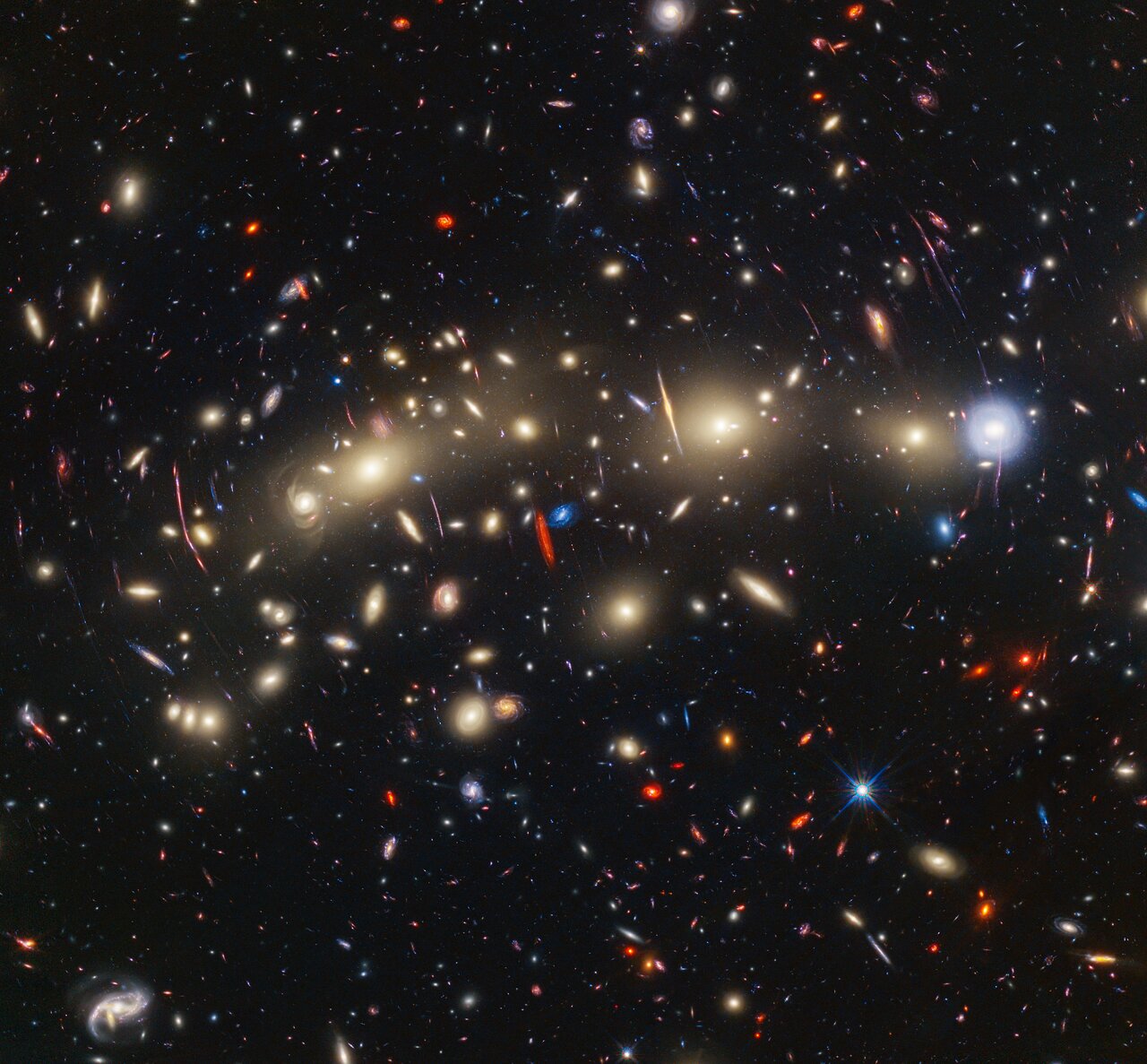
The James Webb Space Telescope has spotted objects in the early universe that might be a new kind of star — one powered by dark matter. These “dark stars” are still hypothetical. Their identification in JWST images is far from certain. But if any of the three candidates — reported in the July 25 Proceedings of the National Academy of Sciences — turn out to be this new type of star, they could offer a glimpse of star formation in the early universe, hint at the nature of dark matter and possibly explain the origins of supermassive black holes.

CNN : “Russia Proposes Joint Research Module on Space Station for China, India, Brazil and South Africa

The head of Russia’s space agency has extended an offer to Moscow’s partners in the BRICS group – Brazil, IndiaChina and South Africa – to participate in the construction of a joint module for its planned orbital space station, state media reported Monday. Construction of the planned space station follows Moscow’s decision last year to end its decades-long partnership with NASA and withdraw from the aging International Space Station – one of the last remaining channels of cooperation between Russia and the United States.

What Do Frozen Worms Say About Space Travel?

Image (Credit): Hibernation pods for space travel as shown in the movie Aliens. (20th Century Fox)

Earlier this week we learned about worms taken from Siberian permafrost that have been revived after being frozen for 46,000 years. In the Scientific American, the co-author of the study with these finding, cell biologist Teymuras Kurzchalia, stated, “The radiocarbon dating is absolutely precise, and we now know that they really survived 46,000 years.”

So what does this mean for life that is somewhat more complex than a worm? Given that the findings are still being challenged, maybe nothing. Yet, if true, it may say something about life on this planet, life on other planets, and human life spans should we want to travel to distant locations. While such hibernation is a staple of science fiction, it seems to be a bit closer to reality with this study out there.

The European Space Agency (ESA) and others are already looking into human hibernation for space travel. In one ESA press article from 2019 regarding hibernation for travel to Mars, we read how one study concluded the following:

Not only does hibernation have positive psychological effects, it also allows for a complete mission and system re-design, optimised for human hibernation, which could minimise both mass and cost.

I think the “cost” point may be the key decider on this distant travel matter. Besides, how long can you play “I see a red star” before you go mad?

Russia is also Heading to the Moon

Image (Credit): Russia’s Luna-Glob-Lander. (https://www.russianspaceweb.com/)

As noted in an earlier post, India left for the moon’s south pole last week, but it won’t be alone for long. Russia is planning to launch its Luna-25 spacecraft, also called the Luna-Glob-Lander, next month. According to NASA, the mission has two primary scientific objectives at the Moon’s south pole:

  • to study composition of the polar regolith, and
  • to study the plasma and dust components of the lunar polar exosphere.

The last Luna mission was Luna-24 back in 1976 and involved the return of lunar samples to Earth.

The European Space Agency was planning to be part of this latest mission until the invasion of Ukraine, so Russia is on its own now.

I imagine simpler missions like this will be necessary if Russia plans to eventually build a moon base, though finding a partner may be tough. It is clear that the US and Russia are no longer in a neck-to-neck race back to the Moon. Only China seems to have the stamina to compete with NASA’s Artemis program, though the US is still in the lead for now.

The Luna-25 launch is planned for August 10 if all goes well.

ESA’s Euclid Space Telescope Safely Launched

Credit: ESA

Earier today, the European Space Agency’s (ESA) Euclid Space Telescope was safely launched from Cape Canaveral on a Space X Falcon 9 rocket (though the original plan was to use a Russian Soyuz rocket until the invasion nixed that idea). The space telescope is destined for the Sun-Earth Lagrange point 2 (L2), which is an average distance of 1 million miles beyond Earth’s orbit. It will join the James Webb Space Telescope.

In addition to the 1.2 meter diameter telescope, the mission includes two scientific instruments: a visible-wavelength camera (the VISible instrument, VIS) and a near-infrared camera/spectrometer (the Near-Infrared Spectrometer and Photometer, NISP). 

The focus of the new space telescope will be to create a 3D map of the universe to better understand dark matter and dark energy. As noted on the ESA’s website, Euclid hopes to answer these questions:

  • What is the structure and history of the cosmic web?
  • What is the nature of dark matter?
  • How has the expansion of the Universe changed over time?
  • What is the nature of dark energy?
  • Is our understanding of gravity complete?

It is a tall order for this new telescope. Astronomer Isobel Hook from the UK’s Lancaster University put it this way to BBC News:

It will be like setting off on a ship before people knew where land was in different directions. We’ll be mapping out the Universe to try to understand where we fit into it and how we’ve got here – how the whole Universe got from the point of the Big Bang to the beautiful galaxies we see around us, the Solar System and to life.

Space Stories: Launch of the Euclid Space Telescope, Mercury Flyby, and a Super Hot Brown Dwarf

Image (Credit): Artist’s rendering of the ESA’s Euclid Space Telescope. (ESA, CC BY-SA 3.0 IGO)

Here are some recent stories of interest.

NASA/JPL: “NASA to Provide Coverage for Launch of ESA ‘Dark Universe’ Mission

The ESA (European Space Agency) and SpaceX are targeting no earlier than 11:11 a.m. EDT (8:11 a.m. PDT) Saturday, July 1, to launch the Euclid spacecraft. Euclid is an ESA mission with contributions from NASA that will shed light on the nature of dark matter and dark energy, two of the biggest modern mysteries about the universe.

Sky&Telescope: “BepiColombo Mission Makes Third Mercury Flyby

An intrepid space mission had another brief glimpse of its final destination this week, as the European Space Agency’s BepiColombo flew past Mercury for a third time. The team confirms that the spacecraft is in good health post flyby, and that all instruments performed as planned. “Everything went very smoothly with the flyby and the images from the monitoring cameras taken during the close-approach phase of the flyby have been transmitted to the ground,” said Ignacio Clerigo (ESA) in a recent press release. “While the next Mercury flyby isn’t until September 2024, there are still challenges to tackle in the intervening time.”

Phys.org: “Discovery of a Brown Dwarf Hotter than the Sun

An international team of astronomers has discovered a planet-like object that is hotter than the sun. Their report has been accepted for publication in the journal Nature Astronomy and is currently available on the arXiv pre-print server. Brown dwarfs are sometimes called failed stars and do not qualify for the category of either a planet or a star. In this new effort, the researchers have identified one that orbits a star so closely that its temperature is hotter than our sun.