Image (Credit): Artist’s rendering of SpaceX’s Starship HLS on the Moon. (SpaceX)
“The HLS schedule is significantly challenged and, in our estimation, could be years late for a 2027 Artemis 3 moon landing.”
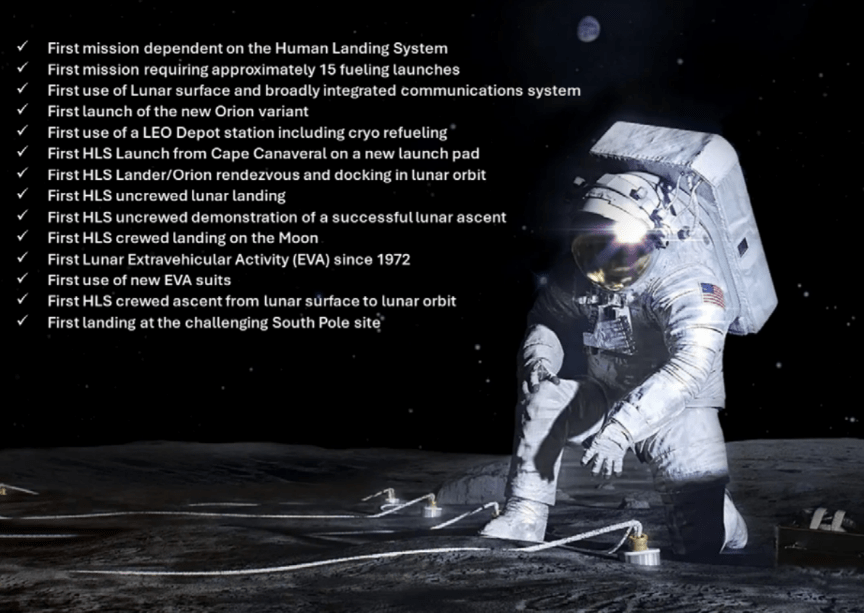
-Statement by Aerospace Safety Advisory Panel (ASAP) member Paul Sean Hill, as quoted by Space News. NASA contracted with SpaceX to develop the Human Landing System (HLS) for the astronauts landing on the Moon as part of Artemis III and later missions. While Blue Origin has also been tapped by NASA to assist with later missions, SpaceX was expected to provide the initial HLS. Maybe NASA should have picked two companies to provide the initial HLS, with the second in place still assisting with later landings. The ASAP’s 2024 Annual Report highlighted the many risks related to Artemis III, including several related to the HLS (shown below). Everyone knew this was going to be difficult, and no one wants to be asked to answer “Who Lost the Moon?” Also, it is good we still have a few advisory panels left after the recent purge.
Image (Credit): Figure 1, “First-time milestones for the Artemis III mission,” contained in the ASAP’s 2024 Annual Report. (ASAP)
Blue Origin has been selected by NASA to bring the rover to the Moon as part of a $190 million task order under the agency’s Commercial Lunar Payload Services program. Blue Origin’s Blue Moon Mark 1 robotic lander, which is scheduled to land on the Moon later this year, will include the VIPER was part of its future cargo in 2027.
As NASA has noted on its VIPER mission page, the rover was part of the Artemis program:
NASA’s Artemis lunar rover, the Volatiles Investigating Polar Exploration Rover, or VIPER, was designed to explore the relatively nearby but extreme environment of the Moon in search of ice and other potential resources. This mobile robot was slated to land at the South Pole of the Moon on a 100-day mission, in order to teach us about the origin and distribution of water on the Moon and help determine how we can harvest the Moon’s resources for future human space exploration.
While the VIPER mission was cancelled last summer, NASA continued to look for a partner to bring it to the Moon. Fortunately, Blue Origin was already going that way.
This is good news for scientists everywhere. It made no sense to turn a half billion dollar piece of equipment into a museum piece. We need more boots and tires on the lunar surface, and VIPER is fortunately part of those plans again.
Image (Credit): Artist’s rendering of the Artemis Gateway. (NASA)
The hearing earlier this week held by the Senate Committee on Commerce, Science, and Transportation contained some clear warnings about the future of the US space program. In addition to comments by the Chairman and Ranking Member, we heard plenty from the witnesses about the importance of Artemis program in terms of political and economic outcomes, concerns about how the program is currently structured, and frustration with the continuing uncertainty about long term funding.
For instance, James Bridenstine, a Former Administrator for NASA, stated these concerns about NASA’s ability to land on the Moon under the Artemis program:
While the United States should celebrate orbiting the Moon in 2026, the United States does not have a lander. Unless something changes, it is highly unlikely the United States will beat China’s projected timeline to the Moon’s surface. Our complicated architecture requires a dozen or more launches in a short time frame, relies on very challenging technologies that have yet to be developed like cryogenic in-space refueling, and still needs to be human rated. While the capability could be transformational over time if payload capacity increases (so far it has decreased), the complexity of the architecture precludes alacrity.
Michael Gold, President of Civil and International Space for Redwire, emphasized the need for NASA to continue to resist White House cuts, such as the planned elimination of the Gateway piece in the initial budget proposal, in order to keep the program on track. He stated:
NASA’s waffling on Gateway has left our international partners confused, frustrated, and exploring alternatives to American partnerships. If we fail to continue with Gateway, we will force our partners to consider shifting support from Artemis and America, to China and its International Lunar Research Station (ILRS) program. Unlike the U.S., China has maintained strong and consistent continuity for its lunar beyond [low Earth orbit] spaceflight program, making a collaboration with China potentially far less risky than gambling on what, prior to Artemis, has been a mercurial American beyond LEO space strategy. If our international partners make such a shift to China, it will not only impact the space field but will have substantial diplomatic, geopolitical, and economic consequences on Earth.
And not to be outdone, Lieutenant General John Shaw, Former Deputy Commander of the U.S. Space Command, wanted to ensure the Artemis program was part of a “grand strategy” that could match the Chinese grand strategy integrating the exploration, economic opportunities, and security needs. In his testimony, he stated:
During my military career, I watched and studied – as any good soldier would of a potential adversary – as China slowly but surely developed and deployed its own civilian and military space capabilities and set its own agenda for space achievements. It is clear to me that the Chinese Communist Party is already employing its own integrated grand strategy for the earthmoon system, with only superficial distinction between civil, commercial, and national security activities, and all focused on a common purpose. I believe if we do not unify and synchronize our efforts, we will find ourselves, rather than the space leaders we are today, instead in a position of increasing disadvantage in space as we progress further into this century.
It was clear from what was said throughout the hearing that everyone in the room saw the benefits of a thriving Artemis mission that continued far beyond Artemis II. In fact, Artemis IX was mentioned as well. The real question was whether the US was willing to commit to a Moon and Mars mission for the long term and fund it appropriately so that our country, our commercial partners, and our country partners can realize the benefits for years to come.
That is the question that no one can answer here. However, the Chinese have already answered it for themselves. We can either watch them succeed, or fully commit to the Artemis program and win this latest space race.
This is a pivotal moment for our nation’s space programs. America must maintain leadership in low Earth orbit, while also embarking on a new era of exploration with Artemis. Make no mistake: we are in a new space race with China, and if we fail, there will be a bad Moon on the rise.
China has made no secret of its goals. It is investing heavily in its space capabilities, maintaining a permanent presence in low Earth orbit with its Tiangong station, and working to plant its flag on the Moon by 2030.
The stakes could not be higher. Space is no longer reserved for peaceful exploration. It is a strategic frontier with direct consequences for national security, economic growth, and technological leadership. If our adversaries achieve dominant space capabilities, it will pose a profound risk to America. This is not just about exploration. The choices we make now will determine whether the United States leads in space or cedes it to an authoritarian regime.
That is why continuity in NASA’s programs is not simply good practice — it is a matter of national security. Any drastic changes in NASA’s architecture at this stage threaten U.S. leadership in space. Delays or disruptions only serve our competitors’ interests.
…I am concerned about the current plan and what we are doing to make sure that we continue to push forward. I would love to see the continued focus on dual landers, given how important they are going to be for the future. It’s not just one time. It’s many times. This is an operation where we’re going to continue to return and be an operational system. So I want to make sure that we have the best. I want to make sure that NASA has backup plans that takes advantage and ensures that the already delayed mission does not slip any further.
I don’t know that it takes a genius to figure out that while China may be projecting 2030, or some time period, there’s nothing to say that they won’t go sooner. There are people we talked to in trying to brief the press about this today, who are betting that they are going to go sooner and that they are going to beat us. So we don’t need another Sputnik moment. It’s already happened. The only thing we have to do is make sure we in Congress get the budget right and support the Artemis mission. I appreciate everything the Chair has done in putting money towards the Artemis mission, and I appreciate everything that we are doing collectively to assure that the administration spins it.
But I also want to point out that, as Lieutenant General Shaw also says, this whole cislunar communication architecture — that is the space between the Earth and the Moon — that is what China would love to do, go dominate the communication system between the [Earth] and the moon. That’s what they’re already working on. We can’t allow that to happen. We need to continue to move forward quickly, fastly, with these investments, because our national security and defense depends on it.
It appears we finally have some bipartisan consensus on the importance of NASA. If only the Congress had some type of legitimate power to pass budgets and keep the funding on track. Wouldn’t that be nice at a time when the White House is finding cute tricks to rescind congressional priorities?
The statements of worry continued with the testimony of the four witnesses (you can watch their presentation and read their prepared statements here):
Mr. Allen Cutler, President and Chief Executive Officer of the Coalition for Deep Space Exploration
Mr. Michael Gold, President of Civil and International Space for Redwire
The Honorable Jim Bridenstine, Managing Partner of the Artemis Group and Former Administrator for the National Aeronautics and Space Administration
Lieutenant General John Shaw, Former Deputy Commander of the U.S. Space Command
Note: I am surprised the Ranking Member used the word “fastly” in her opening statement. It is not a real word. Is she trying to compete with the strange jargon coming out of the White House?
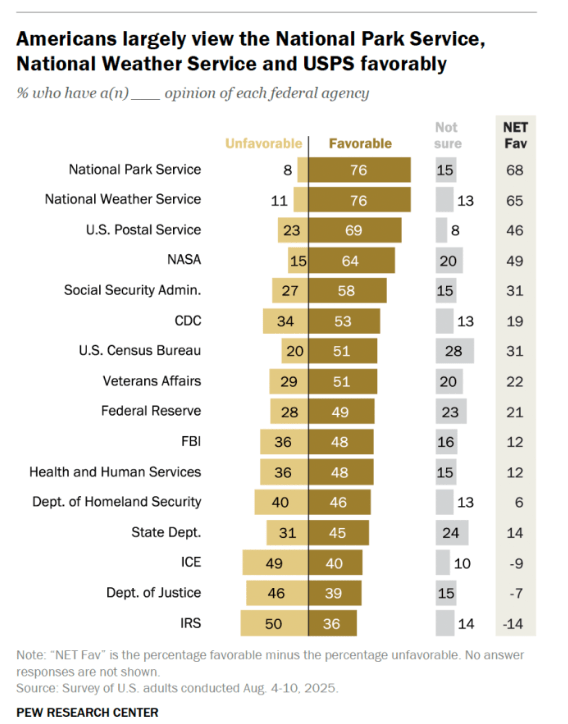
As shown in the graphic above, 64 percent of the American interviewed had a positive view of NASA, 15 percent did not, and 20 percent were not sure about what they thought about NASA. In another graphic, we learn that the 64 percent figure comes from 61 percent of Republicans and 71 percent of Democrats.
This comes at a time of planned deep cuts at the space agency. So what troubles the Republicans most about NASA?
According to Acting NASA Administrator Sean Duffy, one of the problems at NASA is the climate science focus. Mr. Duffy recently stated:
All the climate science and all of the other priorities that the last administration had at NASA we’re going to move aside, and all of the science that we do is going to be directed towards exploration, which is the mission of NASA.
Is that consistent with what the public says it wants in terms of priorities? Not at all. In fact, the public has the opposite view according to another Pew Research Center report from 2023, Americans’ Views of Space: U.S. Role, NASA Priorities and Impact of Private Companies, where monitoring the Earth’s climate was a much higher priority to Americans than sending astronauts to the Moon or Mars (see graphic below).
So the current White House is cutting a favored program and shifting the remaining resources in a direction that is inconsistent with the pubic’s stated preferences. This does not sound like a winning strategy for the White House or, more importantly, the American public paying the bills.