
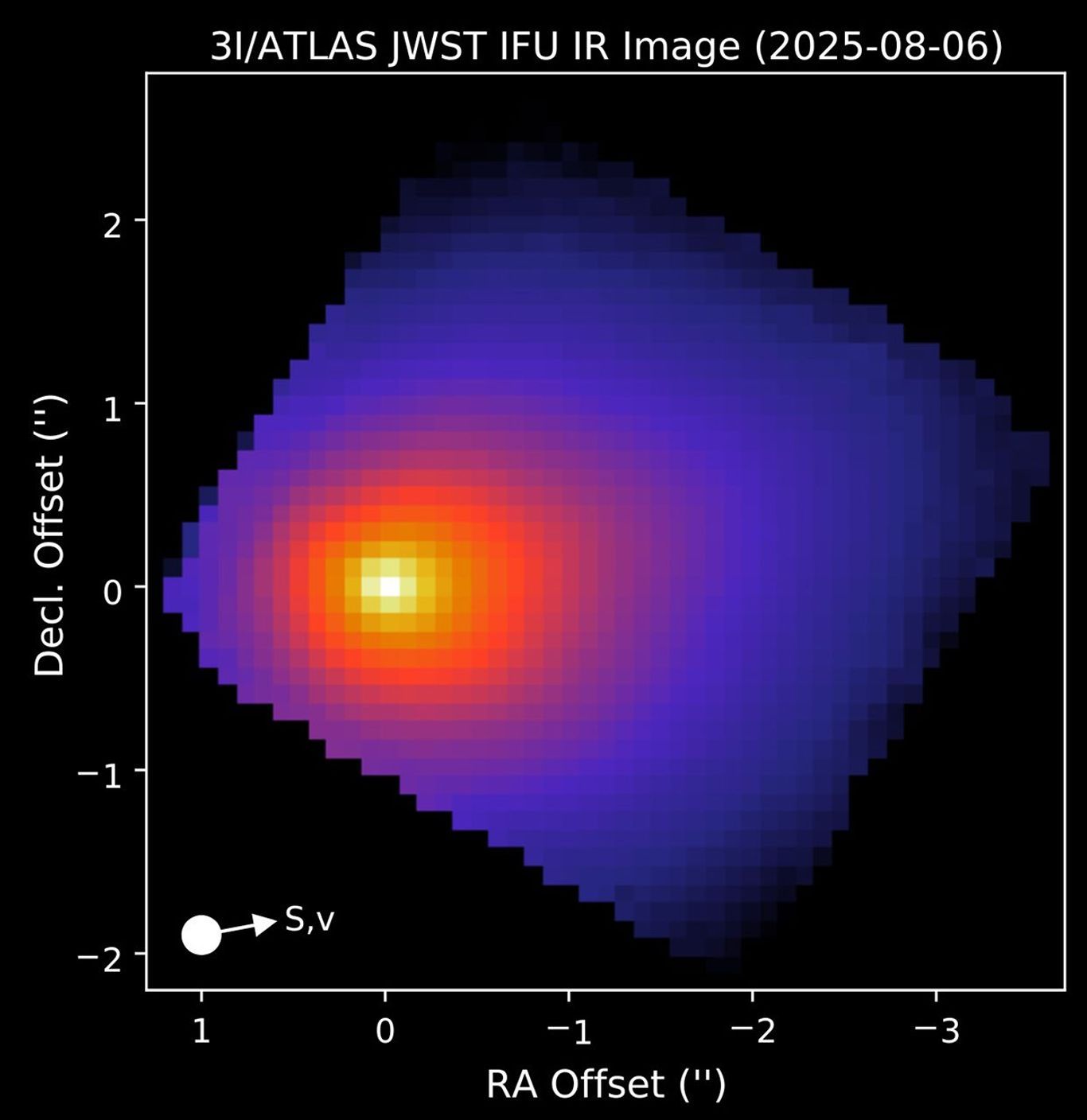
Nature abstract of study findings:
Interstellar objects provide the only directly observable samples of icy planetesimals formed around other stars, and can therefore provide insight into the diversity of physical and chemical conditions occurring during exoplanet formation. Here we report isotopic measurements of the interstellar comet 3I/ATLAS, which reveal an elemental composition unlike any Solar System body. The water in 3I/ATLAS is enriched in deuterium, at a level of D/H = (0.98 ± 0.06)%, which is more than an order of magnitude higher than in known comets, while its range of 12C/13C ratios (141–191 for CO2 and 123–172 for CO) exceeds typical values found in the Solar System, as well as nearby interstellar clouds and protoplanetary disks. Such extreme isotopic signatures indicate formation at temperatures ≲ 30 K in a relatively metal-poor environment. When interpreted with respect to models for Galactic chemical evolution, the carbon isotopic composition implies that 3I/ATLAS may have accreted as long ago as 12 billion years, following a period of intense, early star formation. 3I/ATLAS thus represents a preserved fragment of an ancient planetary system.
Citation: Cordiner, M., Roth, N.X., Micheli, M. et al. Isotopic evidence for a cold and distant origin of 3I/ATLAS. Nature (2026).
DOI: https://doi.org/10.1038/s41586-026-10771-6
Study-related stories:
Scientific American – “Interstellar Comet 3I/ATLAS is Almost as Old as the Universe Itself”
CBS News – “Interstellar Comet that Zoomed Past Earth Could Be Oldest and Coldest Object Ever Seen in Solar System, Astronomers Say”
Live Science – “’Interstellar Messenger’ 3I/ATLAS Could Be Nearly as Old as the Universe Itself, James Webb Telescope Observations Reveal”

