Arecibo Observatory Gone Forever

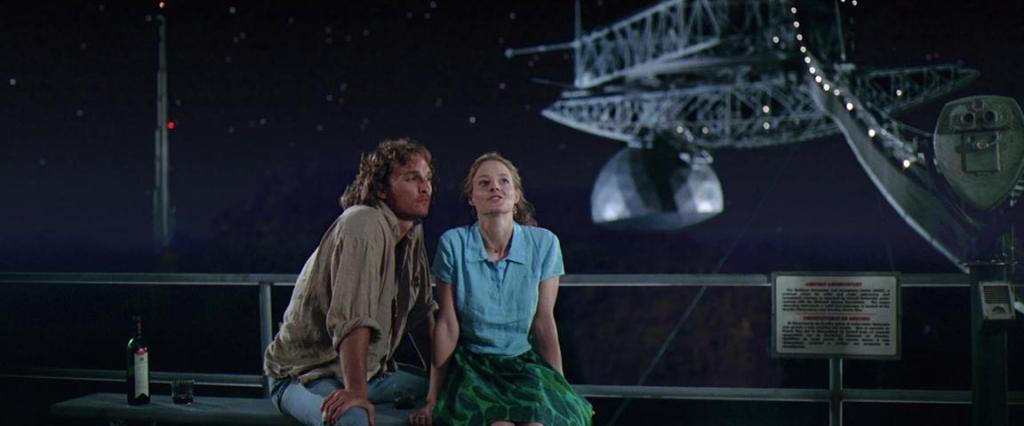
Image (Credit): Matthew McConaughey and Jodie Foster at the Arecibo Observatory in the movie Contact. (Warner Bros.)

If you were hoping that the Arecibo Observatory in Puerto Rico would have a second life, it may be time to say goodbye. Efforts to rebuild the radio telescope since it collapsed in 2020 have ended. Nature reports that the US National Science Foundation (NSF) has given up on the idea of rebuilding the telescope and instead plans to establish an educational center at the site.

You may have memories from the 1997 film Contact where Matthew McConaughey and Jodie Foster enjoyed some private time at the Observatory. Her character Dr. Ellie Arroway was working at the Observatory as part of the Search for Extraterrestrial Intelligence works (SETI) program. In fact, the SETI connection is true. You can see a SETI tribute to the telescope here.

Of course, scientists will remember almost 60 years of work with the radio telescope. While it was initially built for military purposes, it was soon transformed into a scientific site and served as the largest radio telescope on the planet for some time. As far as scientific accomplishments, here are a few of them from the NSF:

  • 1967: Arecibo discovered that the rotation rate of Mercury is 59 days, not the previously estimated 88 days.
  • 1981: Arecibo produced the first radar maps of the surface of Venus.
  • 1992: Arecibo discovered the first ever exoplanet: In subsequent observations, an entire planetary system was found around the pulsar PSR 1257+12.
  • 2008: Astronomers use Arecibo to detect for the first time, methanimine and hydrogen cyanide molecules — two organic molecules that are key ingredients in forming amino acids — in a galaxy 250 million light-years away.

So many new telescopes have come online in the past 60 years that some will say we will be fine with an educational center. This is true, but it is also worth remembering each of the telescopes along the way that helped us to understand this awesome universe of ours.

Image (Credit): The damaged Arecibo Observatory reflector dish after suffering damage from a broken cable. (University of Central Florida)

Pic of the Week: Captain Picard in California

Image (Credit): Star Trek panel at the San Diego Comic Con in July 2022. (Films that Rock)

This week’s image shows Patrick Stewart (Captain Picard) and Gates McFadden (Dr. Beverly Crusher) discussing Star Trek at the 2022 Comic Con in San Diego, CA. You can watch the full panel discussion here. You can also watch the season three (and final season) trailer for Star Trek: Picard here, indicating our favorites from The Next Generation will be returning one more time.

Movie: Mutiny in Outer Space

Image (Credit): Poster for the 1965 film Mutiny in Outer Space. (Hugo Grimaldi Film Productions)

If Hollywood is not planning to provide any summertime space movies, maybe it’s time to check the archives for something fun from the past. One such movie is Mutiny in Outer Space, a black and white film from 1965. You can find it on the Internet Archive and Youtube.

The story involves a space station infected by a lunar sample and efforts by the crew to contain the damage. It reminded me of Star Trek with deadly tribbles, though the special effects are pretty primitive compared to Star Trek, which came out the next year in color. Even so, the story hit on some themes that are recognizable today, such as space junk threatening the space station, the discovery of water on the Moon, and the establishment of lunar bases.

One humorous bit from the movie was the arrival of astronauts from the Moon at the space station. It appears the incoming rocket was unable to dock at the station, so the two astronauts had to float from the rocket to the space station. After they departed, the rocket oddly broke into two pieces and somehow landed on the space station like a suitcase on top of a station wagon. I remember hearing that Star Trek did away space transportation, and such awkward scenes, by simply creating the transporter room. It saved a lot of production money and became a key part of the series.

The film is earnest and humorous at the same time. I recommend you check out the film if you need a fun diversion some evening.

Image (Credit): Scene from the film Mutiny in Outer Space. (Hugo Grimaldi Film Productions)

Movie: Rubikon to the Rescue, Maybe

Credit: IFC Films

With the fourth of July weekend upon us, we still lack a Hollywood blockbuster space adventure film. However, an Austrian space drama arrived this weekend – Rubikon. Here is the basic plot in the year 2056:

Following a catastrophe on Earth, the planet is covered in a toxic fog. The crew in the space station, must decide whether to risk their lives to get home and search for survivors, or stay safe in the station’s “algae symbiosis system”.

It sounds a lot like another film with George Clooney from 2020. Do you remember The Midnight Sky?:

This post-apocalyptic tale follows Augustine (George Clooney), a lonely scientist in the Arctic, as he races to stop Sully (Felicity Jones) and her fellow astronauts from returning home to Earth, where a mysterious global catastrophe has taken place.

Yes, astronauts are looking down on a dying planet, again. Didn’t Interstellar also having a dying Earth? Makes you kind of miss Star Trek with its hopeful story lines.

So far, Rubikon has 30 percent on Rotten Tomatoes, so don’t get your hopes too high. Some of the reviews are shown below. Yet if you need a space adventure film this weekend, you now have one.

Image (Credit): Comments on the film Rubikon. (Rotten Tomatoes)

Supernova: One Ring to Rule Them All?

Image (Credit): Supernova Remnant J0624–6948. (NASA/CXC/A. Hobart)

Astronomers recently reported that a strange ring just outside of the Milky Way galaxy that may be an intergalactic supernova remnant. SciTechDaily had a story on the discovery first reported in the journal Monthly Notices of the Royal Astronomical Society.

Initially detected by the Australian Square Kilometre Array Pathfinder (ASKAP), the object (later named J0624–6948) is believed to be located in the Large Magellanic Cloud, which is a satellite galaxy of the Milky Way.

Professor Miroslav Filipovic from Western Sydney University stated:

The most plausible explanation is that the object is an intergalactic Supernova Remnant due to an exploded star that resided in the Large Magellanic Cloud outskirts that had undergone a single-degenerate type Ia supernova which involves the explosion of two stars orbiting each other.

If you are a fan of The Lord of the Rings films, the image may remind you of another ring and accompanying poem:

Three Rings for the Elven-kings under the sky,
Seven for the Dwarf-lords in their halls of stone,
Nine for Mortal Men doomed to die,
One for the Dark Lord on his dark throne
In the Land of Mordor where the Shadows lie.
One Ring to rule them all, One Ring to find them,
One Ring to bring them all, and in the darkness bind them,
In the Land of Mordor where the Shadows lie.

I have not sought comments from NASA on this connection just yet.

Image (Credit): Ring from the Fellowship of the Ring movie. (Warner Bros. Entertainment)