Space Stories: Nancy Roman Ahead of Schedule, ISS Leak Still a Problem, and US Grant Process Worries Space Scientists

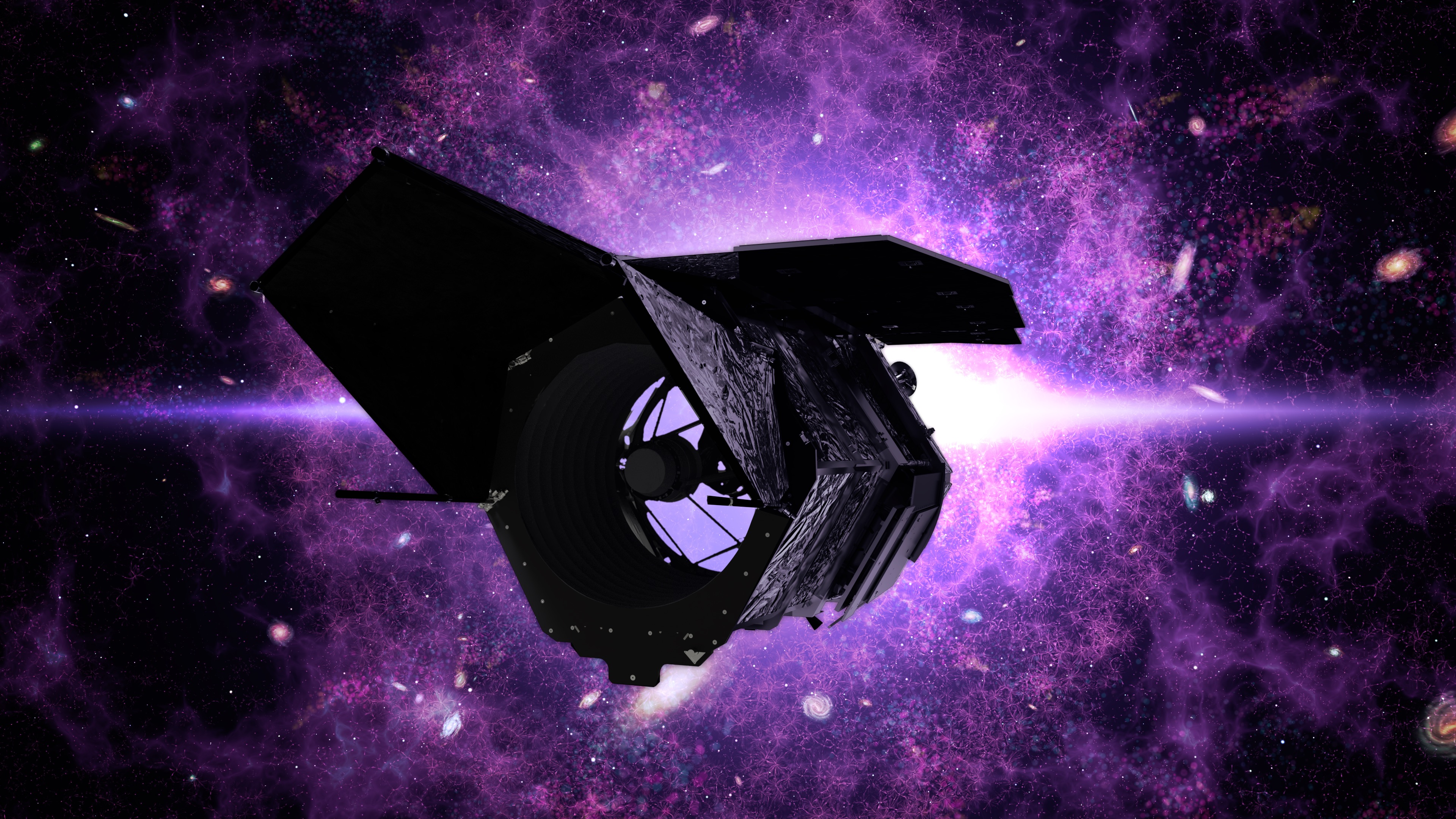
Image (Credit): Artist’s rendering of the Nancy Grace Roman Space Telescope. (NASA)

Here are some recent space-related stories.

Techspot: NASA’s Roman Space Telescope is Launching August 30, Eight Months Ahead of Schedule

NASA is planning to launch its Nancy Grace Roman Space Telescope on August 30, a full eight months ahead of schedule and even earlier than the space agency’s previous target of September. Engineers at NASA’s Goddard Space Flight Center in Greenbelt, Maryland, are in the process of packing the telescope for its journey to Kennedy Space Center in Florida later this month. Upon arrival, it’ll go to the Payload Hazardous Servicing Facility to undergo a full post-travel inspection.

Space News: “Astronauts Briefly Shelter in Dragon During ISS Leak Repair

NASA instructed astronauts on the International Space Station to briefly shelter in a Dragon spacecraft June 5 as cosmonauts attempted to repair an air leak in a Russian module. Shortly after 9 a.m. Eastern, NASA Mission Control in Houston instructed the four members of Crew-12, the Crew Dragon mission that has been at the station since February, to shelter in that spacecraft. Joining them was NASA astronaut Chris Williams, who flew to the ISS last November on a Soyuz spacecraft.The move was prompted by a decision by Roscosmos to have cosmonauts Sergey Kud-Sverchkov and Sergei Mikaev attempt to repair an air leak in a portion of the Zvezda service module known as PrK. That is a vestibule that links a docking port with the rest of the module and has had a long-running, but small, air leak.

Sky & Telescope: Proposed U.S. Grant Funding Rules Spark Worry, Backlash in Astronomy

On Friday, May 29th, the United States Office of Management and Budget (OMB) released a 412-page document rewriting how federal grants should be issued and overseen across all agencies. The changes to the procedures, which were previously altered in 2024 to make the grants process clearer, were sweeping, touching on areas from international collaboration to academic publication costs. But the through line is made explicit: to align federal grant-making with “administration policies and priorities set by the President.” Immediately, it has sparked backlash from astronomers and planetary scientists, who see grave challenges for science if the rules come to fruition.

Note: Here is the podcast version of this post.

Space Quote: One Less Sentry Watching Mars

Image (Credit): Artist’s rendering of the MAVEN spacecraft orbiting Mars. (NASA/Goddard/University of Colorado/Laboratory for Atmospheric and Space Physics)

“The MAVEN mission has truly advanced our understanding of the Martian atmosphere and evolution. This dataset has had a tremendous impact on the field…Our science team is exceptionally proud of all of these amazing discoveries.”

Comment by Shannon Curry, MAVEN’s principal investigator and a researcher at the Laboratory for Atmospheric and Space Physics at the University of Colorado Boulder, regarding the official end of the Mars Atmosphere and Volatile Evolution’s (MAVEN) 11-year mission. NASA lost contact with the spacecraft last December. You can read more about MAVEN’s accomplishments over the years at this NASA site.

A Day in Astronomy: The First U.S. Spacewalk

Image (Credit): NASA astronaut Ed White during the Gemini 4 mission on June 3, 1965. (NASA)

On this day in 1965, U.S astronaut Edward H. White became the first American to conduct a spacewalk during the Gemini 4 mission. His 23 minute mission lasted from his exit from the capsule over the Pacific to his return while over the Gulf of Mexico. He used a maneuvering gun to push himself away from the capsule as well as to push himself back.

At the end of his spacewalk, Ed White stated:

I’m coming back in… and it’s the saddest moment of my life.

Ed White later died in the launchpad explosion of Apollo 1 in 1967, along with astronauts Virgil I. “Gus” Grissom and Roger B. Chaffee.

An Apollo 1 crew memorial is located at Arlington National Cemetery (shown below) with the inscription, “Ad Astra per Aspera,” which in Latin means, “A rough road leads to the stars.”

Image (Credit): The Apollo 1 crew memorial at Arlington National Cemetery in Virginia. (Arlington National Cemetery)

Space Stories: A Massachusetts Meteor, The Red Dwarf Diet, and an Extra Ice Giant in Our Solar System

Image (Credit): A exploding meteor off the coast of Massachusetts as captured by the National Oceanic and Atmospheric Administration’s Geostationary Lightning Mapper on May 30, 2026. (National Oceanic and Atmospheric Administration)

Here are some recent space-related stories.

WCVB5 News: Meteor That Rattled Massachusetts Was Bigger Than First Thought, NASA Says

A meteor that created a sonic boom heard by thousands in Massachusetts and parts of the Northeast Saturday afternoon was larger than previously believed, NASA said Monday. Scientists now say the meteor was 5 feet in diameter, up from the initial thought of 3 feet, NASA said. “The meteor was about 5 feet (1.6 meters) in diameter with a mass of 5.6 metric tons and entered Earth’s atmosphere at roughly 42,000 mph,” NASA said Monday. Scientists believe it traveled through the atmosphere from northwest to southeast for 26 miles before breaking up at an altitude of 31 miles and producing a meteorite fall into Cape Cod Bay.

Royal Astronomical Society: “Red Dwarf Stars Detected ‘Eating’ Earth-like Planets

Astronomers have found some of the strongest evidence yet that stars can swallow their own planets. A new study, published in Monthly Notices of the Astronomical Society, supports the long-held belief that young stars are capable of ‘eating’ nearby worlds as planetary systems form. Researchers from Keele University and the University of Exeter studied thousands of stars and found evidence that six different red dwarfs – the smallest, coolest, and most common type of star in the universe – had engulfed Earth-like rocky planets.

Phys.org: One of Our Planets May Be Missing, And it Could Explain Why the Solar System Looks the Way it Does

Our solar system has two ice giants, Uranus and Neptune, but there may have been a third. According to a new study published in the journal Icarus, this extra world might have triggered a violent planetary shuffling billions of years ago that could have disrupted some of Jupiter’s and Uranus’s moons and possibly led to the formation of others.

Note: Here is the podcast version of this post.

Space Stories: ESA & China Are Smiling, Blue Origin Beats SpaceX to the Moon, and JWST Analyzes Exoplanet Atmosphere

Here are some recent space-related stories.

European Space Agency: Smile Lifts Off on Quest to Reveal Earth’s Invisible Shield Against the Solar Wind

The Smile spacecraft lifted off on a Vega-C rocket from Europe’s Spaceport in French Guiana at 04:52 BST / 05:52 CEST (00:52 local time) on 19 May 2026. The launch marks the beginning of an ambitious mission to better understand solar storms, geomagnetic storms, and the science of space weather…Smile is a collaboration between the European Space Agency (ESA) and the Chinese Academy of Sciences (CAS). It will reveal how Earth responds to the streams of particles and bursts of radiation from the Sun, using an X-ray camera to make the world’s first X-ray observations of Earth’s magnetic shield, and an ultraviolet camera to watch the resulting northern lights non-stop for 45 hours at a time.

The Guardian: “Nasa Selects Jeff Bezos’s Blue Origin for First of Three Uncrewed Lunar Missions

Nasa announced on Tuesday ambitious plans for three uncrewed lunar missions this year to kickstart construction of a $20bn moon base, and said it had chosen the Amazon founder Jeff Bezos’s Blue Origin, ahead of Elon Musk’s SpaceX, to conduct the first...[NASA’s Administrator] said the three missions planned for 2026 would be followed by “more than a dozen” more in the coming years to test systems and equipment. He said the highly successful Artemis II mission last month that sent four astronauts around the moon for the first time since 1972 had been both a catalyst and incentive to advance the moon base plan.

Astrobiology: Astronomers Observe Exoplanet Atmospheres With New Cloud-detecting Method

Every morning, clouds roll in, and by evening, they have cleared off. This sounds like a weather forecast for a coastal city here on Earth — but it’s for WASP-94A b, a well-studied gas giant orbiting a star located nearly 700 light-years away. A new study published in the journal Science documents the first detection of repeating cloud cycles on a hot Jupiter exoplanet. The first author of the study is Sagnick Mukherjee, a 51 Pegasi b postdoctoral fellow at Arizona State University’s School of Earth and Space Exploration. Mukherjee is part of a research team that analyzed data from the James Webb Space Telescope targeting WASP-94 A b, a gas giant in the constellation Microscopium. The team discovered that the planet’s morning side is blanketed in clouds of magnesium silicate, the same mineral found in common rocks, while its evening side is under clear skies.

Note: Here is the podcast version of this post.