The Nancy Grace Roman Space Telescope Is Taking Names

Image (Credit): Artist’s rending of the Nancy Grace Roman Space Telescope. (NASA)

If you want to be part of a NASA mission, you have until July 12th to get your name to NASA so it can be added to the Nancy Grace Roman Space Telescope.

All of the submitted names will be uploaded to an secure digital card that will be attached to the space telescope. These names (and maybe yours) will then be stationed about one million miles away from Earth. As of this moment, NASA already has 145,949 names.

It is not the same as having an exoplanet named after you, but your name will be attached to the observatory that will be finding and analyzing exoplanets and more.

The current schedule calls for the Nancy Grace Roman Space Telescope to be launched on August 30th.

Go to this link to provide your name and learn more about the space telescope’s upcoming mission.

Space Stories: New Lunar Lander on Display, Caltech Approves a Radio Telescope, and Missing Galactic Dark Matter

Image (Credit): Astrobotic Technology’s Griffin-1 lunar lander. (Astrobotic Technology)

Here are some recent space-related stories.

Satnews: Pittsburgh’s Moonshot: Astrobotic Unveils Griffin-1 Lander Ahead of Historic NASA ‘Moon Base II’ Mission

Emerging as a powerful symbol of regional industrial pride and the rapid privatization of deep-space logistics, Astrobotic Technology has officially unveiled its massive Griffin-1 lunar lander. The vehicle, which has been formally designated by NASA as the primary infrastructure vehicle for the Moon Base II task order under the Commercial Lunar Payload Services (CLPS) program, represents a critical stepping stone toward establishing a permanent, self-sustaining human presence on the lunar surface. Unlike smaller, first-generation commercial scouts, the Griffin platform is an “infrastructure-class” logistics vehicle engineered to transport heavy industrial cargo. Boasting a massive 625 to 650-kilogram payload capacity, the stout aluminum isogrid lander is designed to ferry bulky machinery, scientific sensor arrays, and alternative energy installations directly to the rugged, hazardous terrain of the lunar south pole.

Newser: “Giant Nevada Project Could Transform Astronomy

Caltech has approved the final design for the Deep Synoptic Array, a $200 million radio telescope project that will blanket a chunk of desert with 1,650 dishes over roughly 120 square miles—an array designed to scan the sky about 100 times faster than any existing telescope. Backed in part by Schmidt Sciences, the philanthropic effort of former Google CEO Eric Schmidt and his wife Wendy, the project is slated to be finished by 2029 and will be powered by a supercomputer that turns torrents of radio signals into sharp images on the fly.

W.M. Keck Observatory: Astronomers Discover Third Galaxy Without Dark Matter

Astronomers using W. M. Keck Observatory on Maunakea, Hawaiʻi Island, have discovered the third known galaxy apparently lacking dark matter, part of a strange linear structure that may have formed during a violent collision between galaxies. The discovery strengthens evidence for a rare and previously unseen process in which ordinary matter becomes separated from dark matter, offering astronomers a powerful new way to study one of the universe’s greatest mysteries.

Note: Here is the podcast version of this post.
Podcast: You Can Provide Comments on Proposed Grant Rules Impacting NASA

Image (Credit): Information from OMB’s “Learn About the Regulatory Process” page. (OMB)

As noted in a prior posting, the Office of Management and Budget (OMB) is politicizing the grant process for science, including space-related grants.

A recent episode of the Planetary Society’s Planetary Radio podcast covered this proposed change and suggested ways that all of us can push back on these changes.

For specific guidance on what you can do, this page from the Planetary Society provides useful instructions. As the site states:

The OMB proposal would allow political appointees to usurp agency autonomy and cancel any grant at any time if that person decides the work is no longer convenient. The proposed rules would make scientific peer review only advisory while political appointees decide what (and who) gets funded.

The site provides clear instructions to help you write at least two paragraphs that can then be used to challenge this proposed policy. In this case, form letters are not helpful because they would be grouped together as one comment.

The American Astronomical Society has its own page explaining how you can respond to this particular OMB proposal.

And remember, if you want to submit comments but remain anonymous rather that providing all of your personal details to OMB or even the Planetary Society, you are allowed to do that as well per these OMB instructions. So don’t let that be a factor that holds you back.

Space Quote: Some Question Lack of Female Astronaut on Artemis III Crew

“The office gets what it needs when it needs it, and we’ll certainly have all these other people that you mentioned, you know, female military test pilots or just other female astronauts, that’ll be picking up on the follow-on Artemis missions.”

-Statement by Artemis III mission commander Randy Bresnik, as quoted by CBS News. He was noting NASA’s diversity of personnel that is ready for the various missions after some criticized NASA for not having a female astronaut among the Artemis III crew. NASA Administrator Jared Isaacman also noted his work with women throughout his career, adding in the same news story that:

The last astronaut candidate class selected under this administration was majority female [six women and four men] because they were the best of the best, including one astronaut [Anna Menon] I previously went to space with.

Note: It is worth mentioning that in March 2025 NASA eliminated from its webpage its earlier pledge to land the “the first woman, first person of color” on the lunar service as part of Artemis III mission. The removal was said to be related to an anti-DEI Executive Order. Of course, we are now dealing with a different Artemis III, with the Artemis IV mission now scheduled to be the first to land a crew on the Moon.

Artemis III Has a Crew

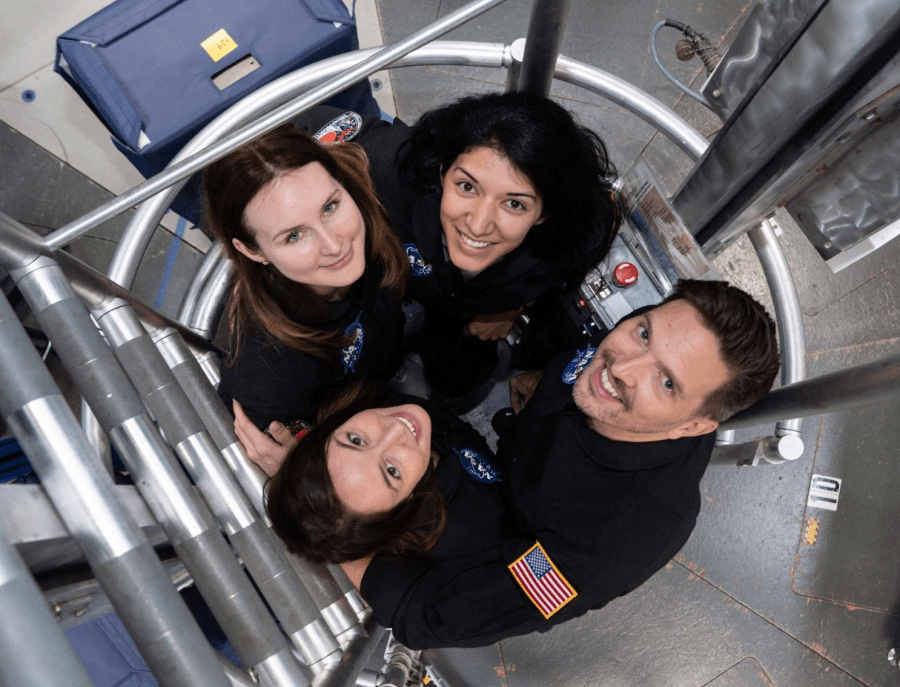
Image (Credit): The Artemis III crew members (from left: Andre Douglas, Luca Parmitano, Randy Bresnik, Frank Rubio). (NASA/Bill Stafford)

Earlier today NASA announced its new four-member crew for the next set of Artemis tests. The two week long Artemis III mission will test spacecraft in low Earth orbit in preparation for Artemis IV, which will entail an actual crewed mission to the surface of the Moon.

The new crew are three NASA astronauts and one European Space Agency (ESA) astronaut from Italy. NASA has a full profile of each crew member, but here are the basics:

NASA may have a crew, but does it have any partners that are really ready for a lunar landing?

To date, the only fully operational spacecraft is the Orion capsule, which will be sent aloft via the Space Launch System. Both SpaceX and Blue Origin plan to send up demonstration lunar landers that will not contain all of the necessary components for humans preparing for a Moon landing. This sounds a little dangerous given that the real reason for Artemis III is a dry-run in space. It sounds more like a dry-run for a dry-run, but NASA may not have time to complete a true test.

In additon to lunar lander delays, SpaceX is busy trying to make a fortune with its IPO, while Blue Origin is still licking its wounds after the recent explosion at Cape Canaveral.

These four astronauts may be the best news out of NASA for some time to come, so it may be best to raise a toast to the four of them and then simply hope for the best.