
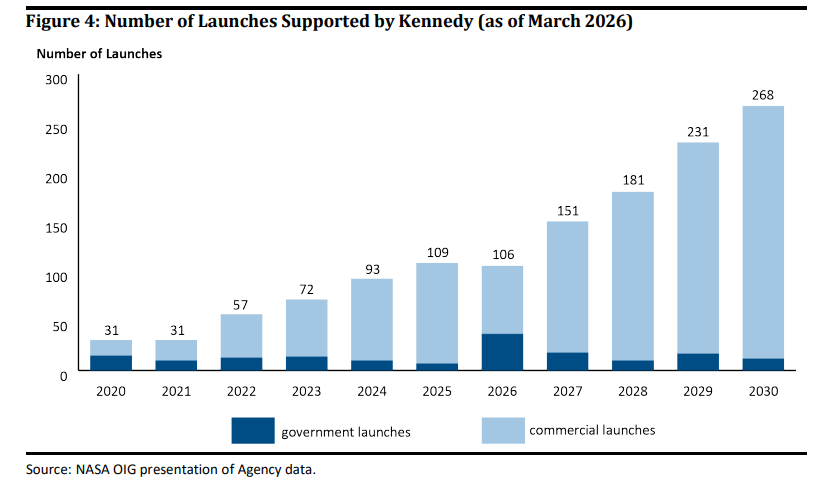
First, let’s note the good news. NASA has more and more launches on its current launch pads (see figure above). Now, the bad news. NASA is running out of functioning launch pads.
That’s the story from NASA’s Office of Inspector General in its latest audit report, NASA’s Launch Infrastructure. The June 22nd audit report concludes that:
NASA’s launch infrastructure is dated and lacks the capacity to meet the growing demands of the Agency and government and commercial partners. The number of launches supported by Kennedy and Wallops has increased dramatically since 2020 and is projected to grow even further by 2030 due to a surge in commercial launches. The growing number of projected launches from Kennedy and Wallops could eventually outpace each site’s capacity to support the launches. Based on current launch projections, Kennedy and Wallops are expected to operate near capacity in the 2028 to 2029 time frame.
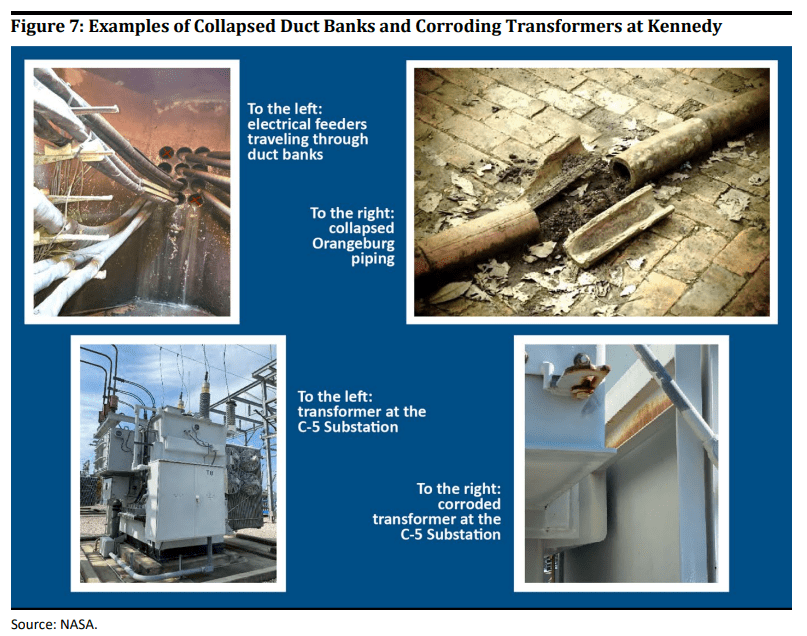
The report also notes that the Kennedy Space Center is in tough shape (see figure below). For example, the auditors stated:
Kennedy’s roadway and bridge infrastructure was largely constructed in the 1960s and was not designed to accommodate the volume, frequency, and weight of modern heavy transport operations. Roadways and bridges are in marginal to poor condition and are expected to receive further strain as launch rates increase and generate approximately 19,000 additional truck trips annually to transport flight hardware, propellants, and related materials.
Why is this the situation in a nation that seems to want a strong space program? The report highlights a number of causes, including budget cuts and NASA’s inability to seek sufficient reimbursement from commercial users. It seems we want the private sector to be involved, but we are subsidizing all of the infrastructure, thereby not showing the true cost of these missions. The auditors noted that Congress is aware of this problem, but still unable to pass legislation to correct this reimbursement issue.
The report has a number of recommendations addressed to NASA, which is the auditee. Yet a few recommendations are also needed for Congress. My first recommendation would be for Congress to get off its butt and put legislation in place to ensure the commercial sector is reimbursing the government for the services it is using. That seems easy enough with a serious Congress, and NASA certainly has enough bipartisan support to make this happen.
Note: Figure 4 shows that the vast majority of the launches from Florida are for commercial purposes and not government launches. For instance, 101 of the 109 launches in 2025 related to SpaceX, and most of those launches pertained to Starlink, a commercial enterprise. Maybe it is time to ask the world’s only trillionaire to kick in a litte more for space infrastructure.
 Our Awesome Universe