
This image is just one of many highlighted by CNN from this week’s solar eclipse. Go to this link for more.

This image is just one of many highlighted by CNN from this week’s solar eclipse. Go to this link for more.

This week’s image is from the U.S. National Science Foundation’s (NSF) National Solar Observatory (NSO). It shows the highest resolution image ever captured of the Sun’s surface. The image was captured by the Inouye Solar Telescope located in Maui, Hawaii.
Here is more from the NSF about this image:
Using the world’s most powerful solar telescope, the NSF Daniel K. Inouye Solar Telescope near the summit of Maui’s Haleakalā, combined with computer simulations, an international team of scientists from the NSO, NSF NCAR High Altitude Observatory (HAO), and the Max Planck Institute for Solar System Research (MPS) found the signature of Kelvin-Helmholtz instability (KHI), tiny swirling patterns like small whirlpools, on the Sun’s surface. Researchers suggest that KHI might be a key reason why the Sun’s outer atmosphere gets so hot, and why magnetic energy builds up and moves around on the Sun. Magnetic energy fuels solar flares and eruptions—the kind of solar activity that can send bursts of energy toward Earth and affect satellites, power grids, and other technology. The discovery opens a new window into the fundamental physics of the Sun and other stars while underscoring the unmatched capabilities of the Inouye Solar Telescope.

The image above, taken on July 20th, shows one of the many teams working on the Nancy Grace Roman Space Telescope as it gets ready for its launch on August 30th. The pictured individuals are part of the propellant, safety, and quality assurance team.
NASA’s latest update on the mission stated:
Technicians completed fueling NASA’s Nancy Grace Roman Space Telescope, bringing it an important step closer to launch. On July 25, the team completed operations that carefully loaded 290 gallons of hydrazine fuel into the observatory at the Payload Hazardous Servicing Facility at NASA’s Kennedy Space Center in Florida.
After launch and separation from the rocket, Roman will use this onboard propellant to perform maneuvers as it travels to Sun-Earth Lagrange point 2, or L2, located about one million miles from Earth. There, about four times the distance to the Moon, it will have an ideal home for astronomy.
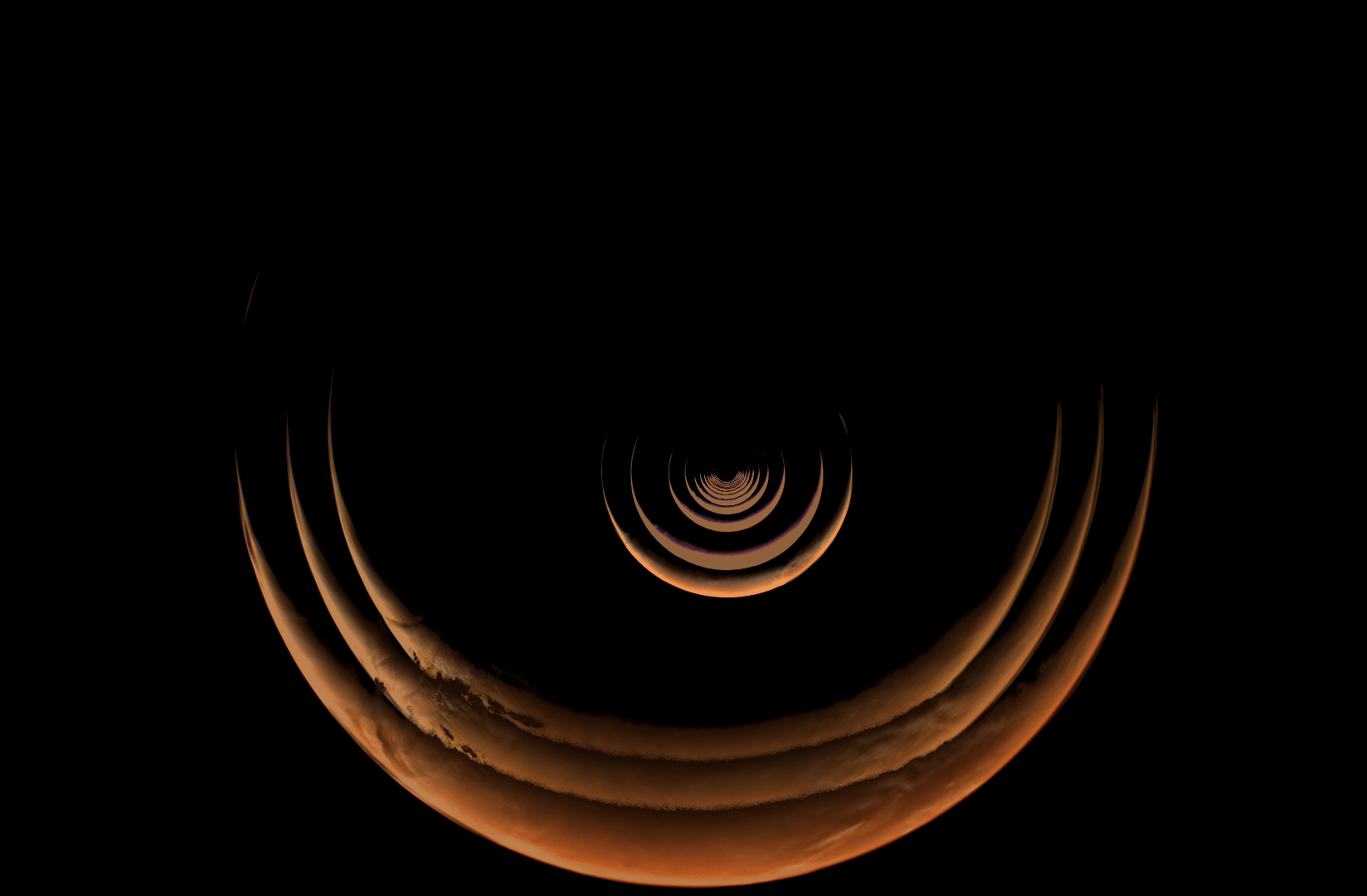
This week’s image is from NASA’s Psyche spacecraft, which was doing a flyby of Mars last month for a gravity assist on it way to asteroid Psyche in 2029. What you are seeing is a composite photo of the crescent of the planet as the Psyche spacecraft approached it. NASA shared the photo on July 17, 2026.
You can see much more related to this flyby at this NASA link.

This week’s image comes from a Chinese probe called Tianwen-2. It shows the spinning asteroid 2016 HO3, or Kamo‘oalewa, which is labeled by some of a “quasi-moon” of Earth until it decides to move on. Unlike the actual Moon, this asteroid is simply joining the Earth as it circles the Sun. The asteroid is about the size of a school bus.
The Chinese probe, launched from China in May 2025, is believed to have started its orbit of asteroid Kamo‘oalewa on June 6th of this year. It is now believed to be a rubble-pile asteroid, meaning it is basically loose material rather than a solid object. Even so, the Chinese probe may try to grab a sample to be returned to Earth in November 2027.
The source of the asteroid is still being debated, with some believing it is a piece of the Moon dislodged by an incoming asteroid while others believe it comes from the main asteroid belt.
In a paper released last year, scientists were leaning towards its origin being the main asteroid belt, noting:
Quantitative estimates show that population models of [Near Earth Asteroids] based on the migration of objects from the main belt are capable of accounting for Kamo‘oalewa-like objects. This relative contribution supports the hypothesis that (469219) Kamo‘oalewa originated from the main belt, which will be further investigated by future observations and in situ exploration of the Tianwen-2 spacecraft.
How long will it remain Earth’s partner? Back in 2021, Renu Malhotra, a UArizona planetary sciences professor, stated:
It will not remain in this particular orbit for very long, only about 300 years in the future, and we estimate that it arrived in this orbit about 500 years ago.

