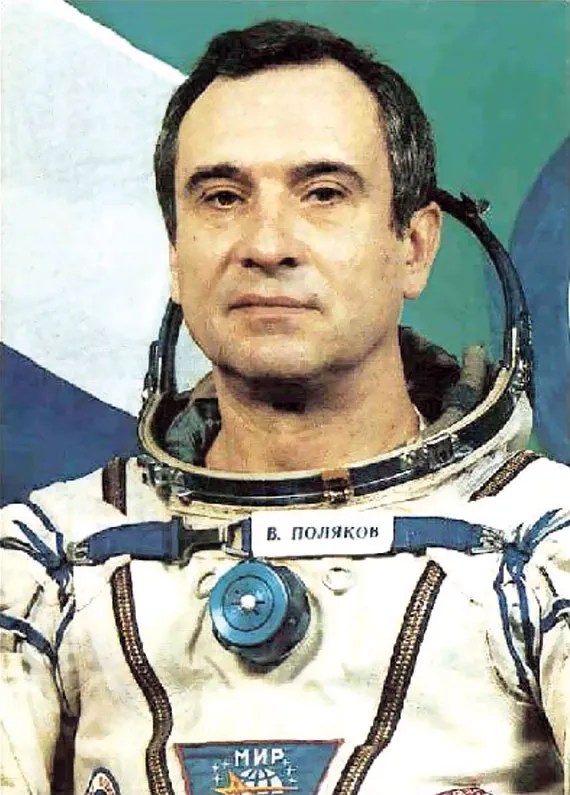
Last week cosmonaut Valery Polyakov passed away at the age of 80 (1942 to 2022). He still holds the record for the longest single spaceflight in history when he was aboard the Mir space station for 437 days and 18 hours during one stay between 1994 and 1995. By the time he retired later in 1995, he had spent 678 days in space.
Russians have a history of long tours in space, including four cosmonauts from the last century who spent at least one year in a single tour:
Valery Polyakov – 437 days aboard Mir (1994-95)
Sergei Avdeyev – 379 days aboard Mir (1998-99)
Vladimir Titov – 365 days aboard Mir (1987-88)
Musa Manaro – 365 days aboard Mir (1987-88)
When U.S. astronaut Astronaut Scott Kelly returned to Earth with cosmonaut Mikhail Kornienko from the International Space Station in 2016 after 340 days in space, the Russians were not so impressed according to a story in arsTECHNICA. The story notes cosmonaut Talgat Musabayev, serving as the head of the Kazakh space agency, stated, “Congratulations on your record. Of course it was already done 28 years ago.”
Image (Credit): The Soviet Mir space station. (Encyclopaedia Britannica)
Image (Credit): The Soyuz MS-22 rocket launch from earlier today. (NASA/Bill Ingalls)
Earlier today, the Russian Soyuz MS-22 rocket launched from Kazakhstan and successfully placed three new inhabitants on the International Space Station (ISS): NASA astronaut Frank Rubio and Russian cosmonauts Sergey Prokopyev and Dmitri Petelin. The three will stay on the ISS for the next six month, while three cosmonauts will be returning to Earth next week after completing their own six month tours.
Even with all of the Russian posturing back on the surface, it is great to see the ISS team is remaining above the fray. That is, if you ignore the flag-waving antics of the three returning cosmonauts. Sorry, I could not leave it alone.
Image (Credit): Artist’s impression of the Chinese Space Station. (China Manned Space Program)
The China Global Television Network recently reported that China is looking into offering space rides to commercial passengers by 2025, including suborbital flights, cargo flights, and trips to Chinese Space Station. For instance, suborbital flights are expected to be priced at 2 and 3 million yuan (or $287,200 to $430,800).
Given the growing U.S. space industry with its own range of space flight options, it was only a matter of time that China would enter this commercial space race. Russia has been in the game the longest, having sold seats to U.S. astronauts hoping to reach the International Space Station (ISS) following the demise of the space shuttle.
Not to be outdone, NASA has also announced plans to take commercial passengers to the ISS at $55 million per seat. According to Tech Times, NASA is seeking commercial partners for two such flights per year starting as early as 2023. We have already discussed the Axiom Mission 1 (or AX-1 mission) to the ISS earlier this year at about the same price, so this is not a new idea. I guess the Axiom Mission 1 went well enough for NASA to see this as a regular operation.
A variety of space travel options from a variety of countries and commercial suppliers shows that playing in space can be both fun and profitable. Just ask Captain Kirk.
That is fine, as long as the tourists do not get in the way of the real work that is being conducted. With the taxpayers still footing most of the space-faring bill, we do not want space travel to be seen as only a luxury for the wealthy (similar to electric vehicles in the U.S., up to now). Space and related space travel should be seen as something belonging to everyone.
Image (Credit): Image from the earlier Space Race between the US and Soviet Union. (The Independent)
“Space will be the next great commons, a shared global resource like the oceans or cyberspace. History shows that these great commons are inevitably a source of competition and conflict, not voluntary cooperation. Whoever dominates space will determine the future of nations. We have to abandon the globalist fantasy that the U.S., China, and Russia will work together to keep space rules-based, free and open.”
Image (Credit): USAF’s X-37B Orbital Test Vehicle at Vandenberg AFB, California in June 2009. (USAF)
You may have heard of the U.S. Air Force’s (USAF) X-37B unmanned mini-space shuttle that has been sent into orbit many times in the past. It performed secretive missions for the USAF, yet it now falls under the U.S. Space Force. The X-37B is currently orbiting the Earth and has been doing so since May 2020. While it has been said to carry various NASA experiments, this is probably cover for its other work (given that the International Space Station is more than able to carry out these experiments).
So while we are still trying to figure out the real mission of the X-37B, China is experimenting with its own secret space plane and saying even less. On August 4th, China launched its space plane aboard a Long March 2F rocket for a spin around the globe. This is part of continuing experimental flights.
And just in case you might think Russia is falling behind, it already has spacecraft in orbit that seem to be tracking some U.S. satellites.
What are these nations up to? The role of the U.S. Space Force relates to:
…organizing, training, and equipping Guardians to conduct global space operations that enhance the way our joint and coalition forces fight, while also offering decision makers military options to achieve national objectives.
That does not sound like a scientific mission, which is why the USAF and not NASA owned the spacecraft years back.
More likely than not, while these spacecraft will be able to repair and protect the parent nation’s satellites, they will also be able to block, disable, and destroy the satellites of other nations. Yes, this is the militarization of space and all that means in a time or war – potentially endless debris threatening the missions of the other satellites orbiting the planet.
Like it or not, the space race continues on in many forms.
Note: The U.S. Air Force still has a page on the X-37B that highlights its mission. The page states:
The X-37B Orbital Test Vehicle, or OTV, is an experimental test program to demonstrate technologies for a reliable, reusable, unmanned space test platform for the U.S. Air Force. The primary objectives of the X-37B are twofold; reusable spacecraft technologies for America’s future in space and operating experiments which can be returned to, and examined, on Earth.
Here are the specs for the X-37B:
Primary Mission: Experimental test vehicle
Prime Contractor: Boeing
Height: 9 feet, 6 inches (2.9 meters)
Length: 29 feet, 3 inches (8.9 meters)
Wingspan: 14 feet, 11 inches (4.5 meters)
Launch Weight: 11,000 pounds (4,990 kilograms)
Power: Gallium Arsenide Solar Cells with lithium-Ion batteries
Launch Vehicles: United Launch Alliance Atlas V (501) and SpaceX Falcon 9