Space Stories: Blue Origin Brings Satellite to Wrong Orbit, Space Force Preparing for Moon Base, and Japan Refocuses After Deletion of Lunar Gateway

Image (Credit): NG-3 mission patch. (Blue Origin)

Here are some recent space-related stories.

—Associated Press: “Blue Origin’s New Glenn Rocket is Grounded After Launching Satellite into the Wrong Orbit“

Jeff Bezos’ rocket company, Blue Origin, blamed a bad engine Monday for a failed weekend launch that left a satellite in the wrong orbit, dooming it. Launches of the huge New Glenn rocket are grounded until Blue Origin and the Federal Aviation Administration complete their investigation.The rocket blasted off from Cape Canaveral Space Force Station on Sunday. The recycled first-stage booster performed well, landing on an ocean barge several minutes into the flight. But the upper stage was unable to put the satellite into a high enough orbit to begin operations.

—Breaking Defense: “With Eyes on Future NASA Moon Base, Space Force Launches Cislunar Acquisition Task Force“

The Space Force is launching a new acquisition task force to study how the Defense Department should move into cislunar space as it looks to support a planned NASA moon base, according to Maj. Gen. Stephen Purdy, senior advisor to Air Force Secretary Troy Mink for space acquisition. “We’re going to stand up a Cislunar Coordination Office on the Space Force acquisition side,” he told the annual Space Symposium here on April 15, who said the new office will bring together program managers and engineers to “build road maps” for “acquiring the necessary technology and a schedule for action.”

—South China Morning Post: “Japan to Focus on Lunar Rover After US Halts Moon Space Station“

A US move to freeze the Lunar Gateway orbiting space station could render Japan’s new technologies redundant – but its space agency is expected to be diplomatic in its response. The Lunar Gateway project was initially planned as an installation that would orbit the moon as part of the United States’ Artemis programme, which recently made headlines for a record-breaking journey that went deeper into space than anyone had ever flown before…On March 24, however, Nasa announced it was freezing the project to focus on the construction of a base on the lunar surface, with future crewed missions to Mars in mind…The agency is now expected to focus all its attention on the third element of its collaboration with Nasa, the pressurised lunar rover that is being developed with Toyota to allow astronauts to drive on the moon.
Space Stories: The Fate of Juno, the End of a NASA Probe, and “Extragalactic Archeology”

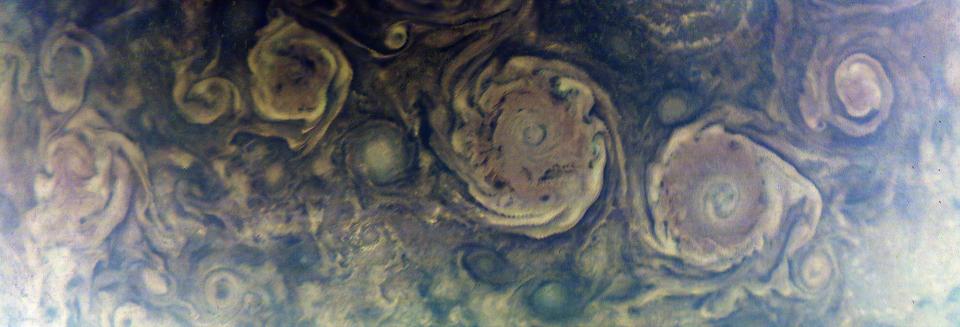
Image (Credit): Jupiter’s North Pole at minimum emission angle as captured by the Juno spacecraft. (NASA/JPL-Caltech/SwRI/MSSS/Thomas Thomopoulos)

Here are some recent space-related stories of interest.

—Ars Technica: “A Mission NASA Might Kill is Still Returning Fascinating Science from Jupiter“

Jupiter’s colossal storms generate lightning flashes at least 100 times more powerful than those on Earth, according to scientists analyzing data from NASA’s Juno spacecraft. The findings were published March 20 in the journal AGU Advances. Researchers used data recorded by Juno in 2021 and 2022, after NASA granted an extension to the spacecraft’s operations upon completing a five-year science campaign at Jupiter. Juno remains in good health, but NASA officials have not said if they will approve another extension for the mission. The issue is money.

—Astronomy.com: “NASA’s Van Allen Probe A Burns Up Over the Pacific after 14 Years in Space“

NASA’s Van Allen Probe A re-entered Earth’s atmosphere on Wednesday, March 11, at 6:37 a.m. EDT, marking the final chapter for a spacecraft that reshaped scientists’ understanding of the radiation environment around our planet. The U.S. Space Force confirmed the spacecraft came down over the eastern Pacific Ocean. NASA said most of the 1,300-pound (600 kilograms) probe burned up during reentry, though some pieces may have reached the surface. Its twin, Probe B, remains in orbit and is not expected to re-enter before 2030. The twin probes launched together on Aug. 30, 2012, on what was supposed to be a two-year mission. They operated for nearly seven years instead, circling Earth inside the Van Allen radiation belts — zones of high-energy charged particles held in place by the planet’s magnetic field. 

—Carnegie Science: ““Extragalactic Archeology” Reveals Nearby Galaxy’s Evolution“

A team of astronomers, including Carnegie Science’s Jeff Rich and other former Carnegie Observatories astronomers, have for the first time traced the history of a galaxy outside our own Milky way by studying chemical fingerprints in deep space, a new approach they are calling “extragalactic archeology.” Their findings are published in Nature Astronomy. “This is the first time that a chemical archaeology method has been used with such fine detail outside our own galaxy,” said lead author Lisa Kewley of the Center for Astrophysics | Harvard and Smithsonian.

Space Stories: Meteor Shakes Ohio, Executive Order Could Impact Pluto, and Musk May Muck Up Space Again

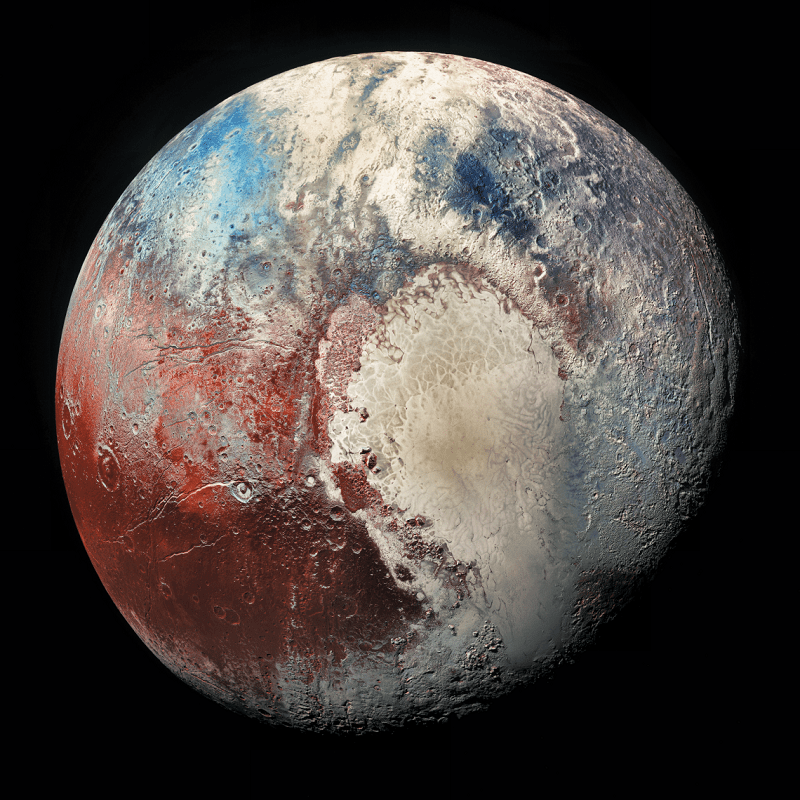
Image (Credit): Dwarf planet Pluto. (NASA/Johns Hopkins University Applied Physics Laboratory/Southwest Research Institute)

Here are some recent space-related stories of interest.

—Fox 8 News: “NASA Confirms Boom was 17,000-pound Meteor“

A loud “boom” was reported across Northeast Ohio just before 9 a.m. on Tuesday. People around Northeast Ohio flooded the FOX 8 newsroom with reports of what heard like a “large explosion” lasting several seconds and causing homes and businesses to “shake.” NASA has confirmed a 6-foot, 17,000-pound meteor traveled 44,000 miles per hour over northeast Ohio. It was 50 miles above Lake Erie when the first flash was detected.

—USA Today: “NASA’s Isaacman Latest to Endorse Trump Reclassifying Pluto as a Planet“

President Donald Trump campaigned on “America first,” but some of his supporters and appointees apparently want Pluto to once again be … ninth. The ninth planet in our solar system, that is. Ever since Pluto was infamously stripped of its planetary status two decades ago, debate has raged for years over the distant icy world – half the size of the United States – and just what sort of cosmic body it should be classified as. Now, Jared Isaacman, NASA’s new chief, has appeared to signal his support for Trump to designate Pluto as a planet once again through executive order.

—Newsweek: “New 1M‑Satellite Plans Could ‘Permanently Scar’ Night Sky, Astronomers Warn“

The Royal Astronomical Society (RAS) has issued a stark warning over proposals by Elon Musk’s SpaceX and the California-based startup Reflect Orbital, saying the plans could cause lasting damage to ground‑based astronomy and dramatically alter the night sky for skywatchers. In comments submitted to U.S. regulators, the RAS said the scale and brightness of the proposed satellite constellations risk overwhelming astronomical observations from Earth. The society, alongside the European Southern Observatory (ESO), has formally opposed both projects in filings to the Federal Communications Commission (FCC), where the companies have sought approval.

More Satellites Planned by Iran

Credit: Image by 政徳 吉田 from Pixabay

Just as we deal with more and more satellites from SpaceX, Amazon, Europe, and the Chinese, creating an increasing amount of orbital pollution, we now have to contemplate Iran adding thousands more satellites to this number.

According to the Tehran Times, Iran is looking to create its own internet satellite system similar to Starlink. Hassan Salarieh, the head of the Iranian Space Agency, stated:

To develop satellite constellations to offer ‘wideband’ services in low Earth orbit (LEO) requires a large number of satellites. Based on the altitude of the orbit and the type of design, sometimes it would be necessary to inject several thousand satellites into the orbit to achieve full coverage.

This is the same country that shut down its entire internet system recently to thwart protesters, only to find that the US was smuggling Starlink terminals into Iran. So one can only assume the government will be keeping close tabs on any internet service, be it ground-based or satellite-based.

Whatever the case, the continued proliferation of such systems will only put greater strains on Earth-based astronomy.

Pandora and Friends Start New Missions

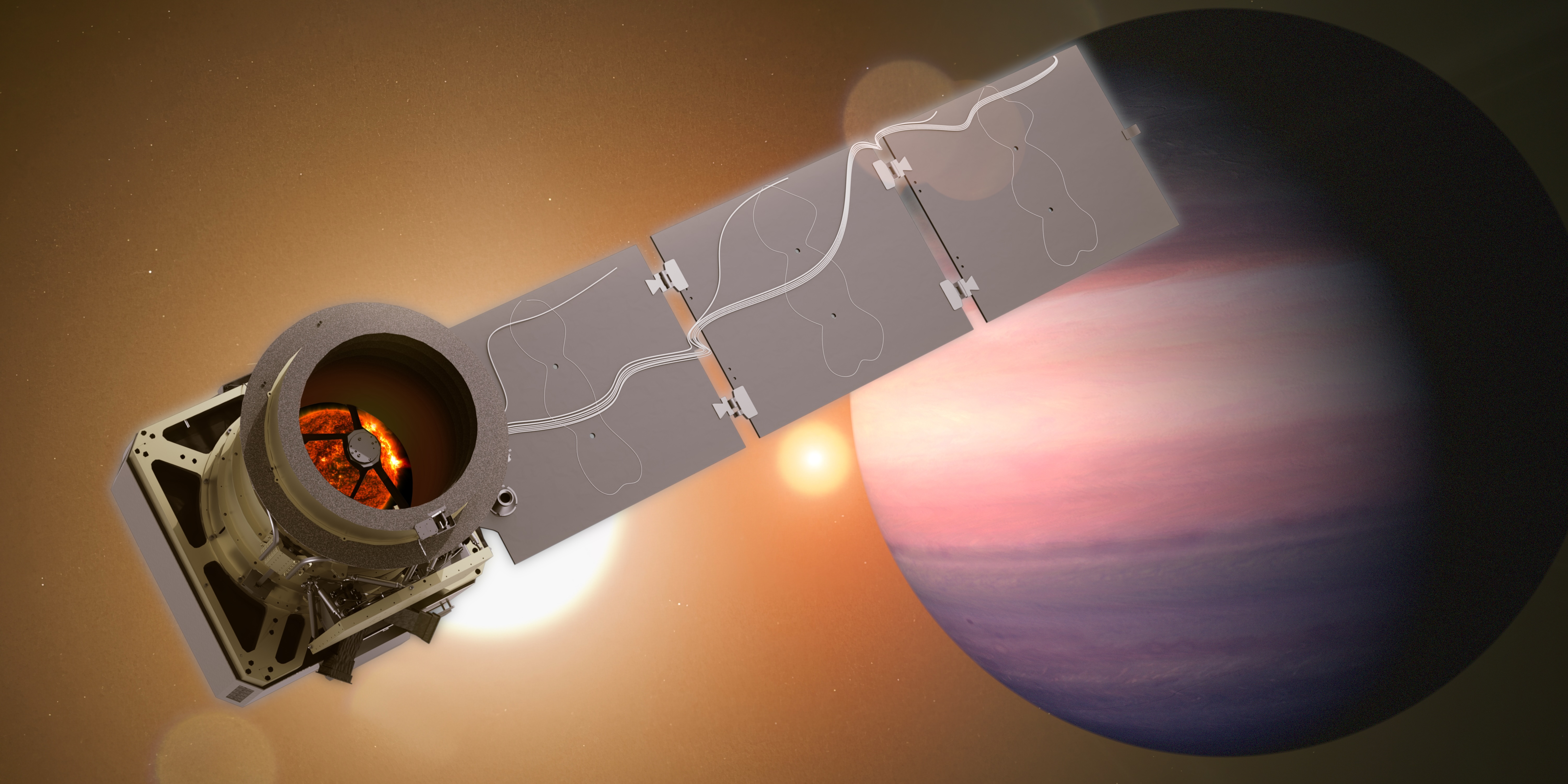
Image (Credit): An artist’s rendering of NASA’s Pandora mission. (NASA)

Earlier today, NASA’s Pandora mission got its start aboard a SpaceX rocket launched from California’s Vandenberg Space Force Base.

The Pandora satellite, once fully operational, will view exoplanet atmospheres and their host stars to learn more about these exotic worlds. In its first year, the satellite will focus on approximately 20 known exoplanets. This NASA video describes the process.

The 716-pound Pandora satellite is much smaller than the 14,300-pound James Webb Space Telescope (JWST). Of course, the JWST has a much larger mission that expands over a much longer time period.

If you are looking for something small, you might be interested in the two CubeSats launched with Pandora. One is called the Star-Planet Activity Research CubeSat (SPARCS), which will study coronal mass ejections on small stars, while the second is named the Black Hole Coded Aperture Telescope (BlackCAT) with the mission of observing X-ray flares from active galaxies with supermassive black holes as well as gamma-ray bursts.

It was a successful Sunday for NASA and space enthusiasts everywhere.