Space Stories: Dinosaur Dust, Missing Stars, and SETI Signals

Image (Credit): The end of the dinosaurs. (NYT, Roger Harris/Science Source)

Here are some recent stories of interest.

Royal Observatory of Belgium: “Dust Played a Major Role in Dinosaur Demise

Fine dust from pulverized rock generated by the Chicxulub impact likely played a dominant role in global climate cooling and the disruption of photosynthesis following the event. This is suggested by a new study published in Nature Geoscience, in which researchers Cem Berk Cenel, Özgür Karatekin and Orkun Temel of the Royal Observatory of Belgium contributed.

Express: “Astronomers Trying to Unravel Mystery of Three Stars that Suddenly Disappeared from Sky

A team of Spanish astronomers is leading the investigation into one of stargazing’s most perplexing mysteries. Three bright stars photographed in the night sky above southern California in 1952 vanished just an hour later. Generations of scientists have sought to explain the rare phenomenon over the past half-century, but nothing has yet convinced the community. Researchers at the Centre for Astrobiology (CAB) in Madrid tried to solve the riddle of the “triple transient” that has “remained absent from telescope exposures for 71 years” in a new paper published online.

Sci.News: “New Study Sets Clearer Bounds on Search for Technosignatures from Extraterrestrial Intelligences

A stable-frequency transmitter with relative radial acceleration to a receiver will show a change in received frequency over time, known as a ‘drift rate.’ For a transmission from an exoplanet, astronomers must account for multiple components of drift rate: the exoplanet’s orbit and rotation, the Earth’s orbit and rotation, and other contributions. Understanding the drift rate distribution produced by exoplanets relative to Earth, can help scientists constrain the range of drift rates to check in a Search for Extraterrestrial Intelligence (SETI) project to detect radio technosignatures, and help them decide validity of signals-of-interest, as they can compare drifting signals with expected drift rates from the target star. In a new study, University of California, Los Angeles astronomer Megan Grace Li and colleagues modeled the drift rate distribution for over 5,300 confirmed exoplanets, using parameters from the NASA Exoplanet Archive.

Space Stories: Distant Spacecraft Updates, Lucy Gets Ready for a Flyby, and Lunar Near-Earth Asteroids

Image (Credit): Voyager II spacecraft instruments. (NASA)

Here are some recent stories of interest.

Space.com: “NASA’s interstellar Voyager Probes Get Software Updates Beamed from 12 Billion Miles Away

About 46 years after NASA’s Voyager 1 and Voyager 2 launched on an epic journey to explore space, the probes’ antique hardware continues to receive tweaks from afar. One update, a software fix, ought to tend to the corrupted data that Voyager 1 began transmitting last year, and another set aims to prevent gunk from building up in both spacecraft’s thrusters. Together, these updates intend to keep the spacecraft in contact with Earth for as long as possible.

NASA: “NASA’s Lucy Spacecraft Preparing for its First Asteroid Flyby

NASA’s Lucy spacecraft is preparing for its first close-up look at an asteroid. On Nov. 1, it will fly by asteroid Dinkinesh and test its instruments in preparation for visits in the next decade to multiple Trojan asteroids that circle the Sun in the same orbit as Jupiter. Dinkinesh, less than half a mile, or 1 kilometer, wide, circles the Sun in the main belt of asteroids located between the orbits of Mars and Jupiter. Lucy has been visually tracking Dinkinesh since Sept. 3; it will be the first of 10 asteroids Lucy will visit on its 12-year voyage. To observe so many, Lucy will not stop or orbit the asteroids, instead it will collect data as it speeds past them in what is called a “flyby.”

UC San Diego: “How Could a Piece of the Moon Become a Near-Earth Asteroid? Researchers Have an Answer

A team of astronomers has found a new clue that a recently discovered near-Earth asteroid, Kamooalewa, might be a chunk of the moon. They hypothesized that the asteroid was ejected from the lunar surface during a meteorite strike–and they found that a rare pathway could have allowed Kamooalewa to get into orbit around the sun while remaining close to the orbits of the Earth and the Moon. The research team details their findings in the Oct. 23 issue of the journal Nature Communications Earth & Environment. Kamo`oalewa has been the object of several astronomy studies in recent years. As a result, a Chinese mission launching in 2025 is set to land on the asteroid and return samples to Earth.

Space Stories: Roving Students, Preparing for Roman Times, and a New Space Center

Image (Credit): Students at this year’s obstacle course at the U.S. Space & Rocket Center during NASA’s Human Exploration Rover Challenge event. (NASA)

Here are some recent stories of interest.

NASA: “Dozens of Student Teams Worldwide to Compete in NASA Rover Challenge

NASA has selected 72 student teams to begin an engineering design challenge to build human-powered rovers that will compete next April at the U.S. Space & Rocket Center in Huntsville, Alabama, near the agency’s Marshall Space Flight Center. Celebrating its 30th anniversary in 2024, the Human Exploration Rover Challenge tasks high school, college, and university students to design, build, and test lightweight, human-powered rovers on an obstacle course simulating lunar and Martian terrain, all while completing mission-focused science tasks.

Space.com: “NASA’s Roman Space Telescope will Launch in 2027. Here’s How Scientists are Getting Ready

NASA is mobilizing the scientific community to ensure the agency’s next big space telescope will be ready to deliver a “big picture” view of the universe almost immediately after launching. The Nancy Grace Roman Telescope — also known as the Roman Space Telescope, or just Roman — is set to launch in 2027 and will view the cosmos with a staggeringly wide field of view. Its big-picture observations of distant and early galaxies could help scientists solve the mysteries of dark matter and dark energy. Collectively, this so-called dark universe accounts for 95% of the energy and matter in the cosmos, yet the true nature of dark matter and dark energy eludes scientists.

SF YIMBY: “UC Berkeley Announces $2 Billion Space Center At NASA Ames Research Center

New plans have been revealed for a $2 billion research center run by UC Berkeley at the NASA Ames Center in Mountain View, Santa Clara County. The Berkeley Space Center, as it will be called, will reshape 36 acres on the sprawling Ames Research Center, providing a hub for future companies to collaborate with the school and NASA scientists & engineers to improve technology for aviation, space exploration, and how people live and work in space.

Space Stories: Fancy Space Suits, Giant Blinding Satellites, and More Russian Space Station Leaks

Credit: Dezeen

Here are some recent stories of interest.

Dezeen: “Prada Designing Lunar Spacesuits for NASA Moon Mission

Fashion house Prada has teamed up with commercial space company Axiom Space to create lunar spacesuits for NASA’s Artemis III mission, which will be the first crewed moon landing since 1972. Called Axiom Extravehicular Mobility Unit (AxEMU), the suits will be designed to give astronauts “advanced capabilities for space exploration,” Prada said. They are an evolution of NASA’s Exploration Extravehicular Mobility Unit (xEMU) spacesuit design and will use “innovative technologies and design” to be more flexible and provide more protection against the harsh lunar environment, according to the brand.

Scientific American: “Giant Satellite Outshines Most Stars in the Sky

On some nights, one of the brightest objects in the sky is neither a planet nor a star. It is a telecommunications satellite called BlueWalker 3, and at times it outshines 99% of the stars visible from a dark location on Earth, according to observations reported today in Nature. BlueWalker 3 is the most brilliant recent addition to a sky that is already swarming with satellites. The spaceflight company SpaceX alone has launched more than 5,000 satellites into orbit, and companies around the globe have collectively proposed launching more than half a million satellites in the coming years — a scenario that astronomers fear could hamper scientific observations of the Universe.

The Guardian: “Third Space Station Leak in a Year Prompts Doubts About Russia’s Programme

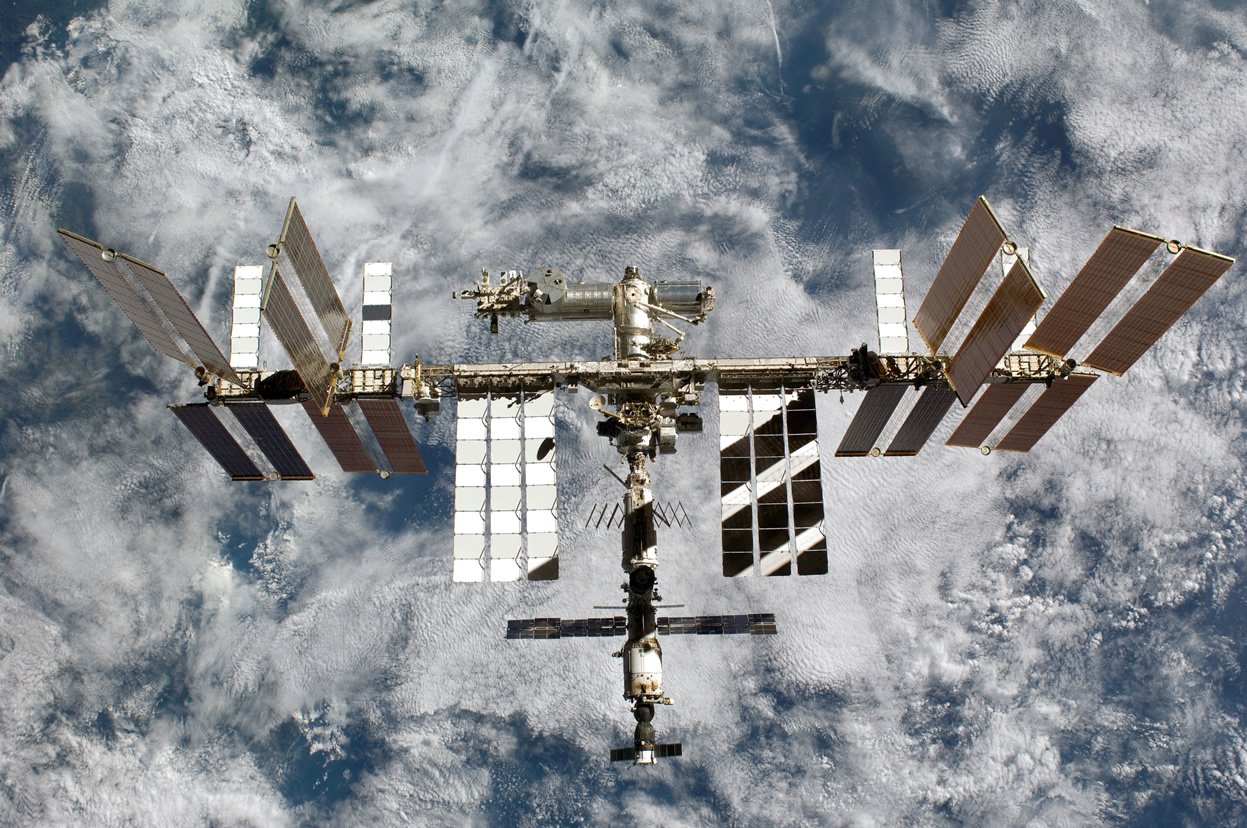
The Russian segment of the International Space Station (ISS) has sprung its third coolant leak in under a year, raising new questions about the reliability of the country’s space programme even as officials said crew members were not in danger. Flakes of frozen coolant spraying into space were seen in an official live feed of the orbital lab provided by Nasa on Monday, and confirmed in radio chatter between US mission control and astronauts. “The Nauka module of the Russian segment of the ISS has suffered a coolant leak from the external (backup) radiator circuit, which was delivered to the station in 2012,” Russian space agency Roscosmos said on Telegram, adding temperatures remained normal in the affected unit.

Space Stories: Psyche Ready to Go, Interesting Exoplanets, and Protecting Astronaut Health

Image (Credit): Artist’s rendering of NASA’s Psyche mission approaching the asteroid Psyche. (NASA)

Here are some recent stories of interest.

Universe.com: “NASA’s Psyche Now Set to Launch October 12

With just under two weeks until its planned launch, NASA’s Psyche mission has been rescheduled. As per a NASA blog post, the agency along with SpaceX are now aiming for liftoff on October 12 at 10:16 A.M. EDT from the Kennedy Space Center in Florida — the first of several NASA science missions that will ride to space on a Falcon Heavy Rocket. The mission was originally set to launch October 5.

Trottier Institute for Research on Exoplanets: “UdeM-Led Study of Exoplanet TRAPPIST-1 b Reveals New Insights into its Atmosphere and Star

A team of astronomers has made an important leap forward in our understanding of the intriguing TRAPPIST-1 exoplanetary system. Not only has their research shed light on the nature of TRAPPIST-1 b, the exoplanet orbiting closest to the system’s star, but it has also shown the importance of parent stars when studying exoplanets. The findings, published today in Astrophysical Journal Letters, shed light on the complex interplay between stellar activity and exoplanet characteristics.

NASA: “NASA Funds Eight Studies to Protect Astronaut Health on Long Missions

NASA is funding eight new studies aimed at better understanding how the human body reacts to spaceflight. These studies will be done on Earth without the need for samples and data from astronauts. Collectively, these studies will help measure physiological and psychological responses to physical and mental challenges that astronauts may encounter during spaceflight. With this information, NASA may be better able to mitigate risks and protect astronaut health and performance during future long-duration missions to the International Space Station, the Moon, Mars, and beyond.