In Case You Missed It: Moons of Exomoons

Image (Credit): Example of an Earth-sized moon around a Neptune-sized moon around Jupiter. (Cool World Labs)

Hearing about the moonlet targeted by the DART spacecraft reminded me of a recent video discussing whether exomoons could have their own moons. It was a piece by Cool World Labs titled “Can Moons Have Moons?” It gets into the “Hill Sphere,” which is an astronomical body’s region in which it dominates the attraction of satellites. It can get pretty complex, as the drawing above demonstrates, but its an interesting concept that has yet to be proven in our own solar system or elsewhere. Given that Cool World Labs is already finding exomoons, it may be only a matter of time before we experience these submoons.

Video/Radio: Martian Life is “Not Bonkers”

Image (Credit): Professor Brian Cox on The Chris Moyles Show. (Radio X)

Last week on the The Chris Moyles Show on Radio X, Dr. Brian Cox responded to a call in question about life on Mars. He noted that NASA’s Perseverance rover may find signs of life in an ancient river delta where it is now drilling. He said he would not be surprised if Martian microbes were located.

He also discussed plans to visit Jupiter’s moon Europa to explore its seas and look for life. Interestingly, he highlighted how Europa may contain three times as much water as can be found on the Earth. That would make it quite a rest stop for future solar system voyages.

In the end, he made it clear that finding life in our solar system is “not bonkers.” That said, he also explored the idea that we may be alone in this universe in terms of intelligent civilizations.

Profile: Asteroid Bennu

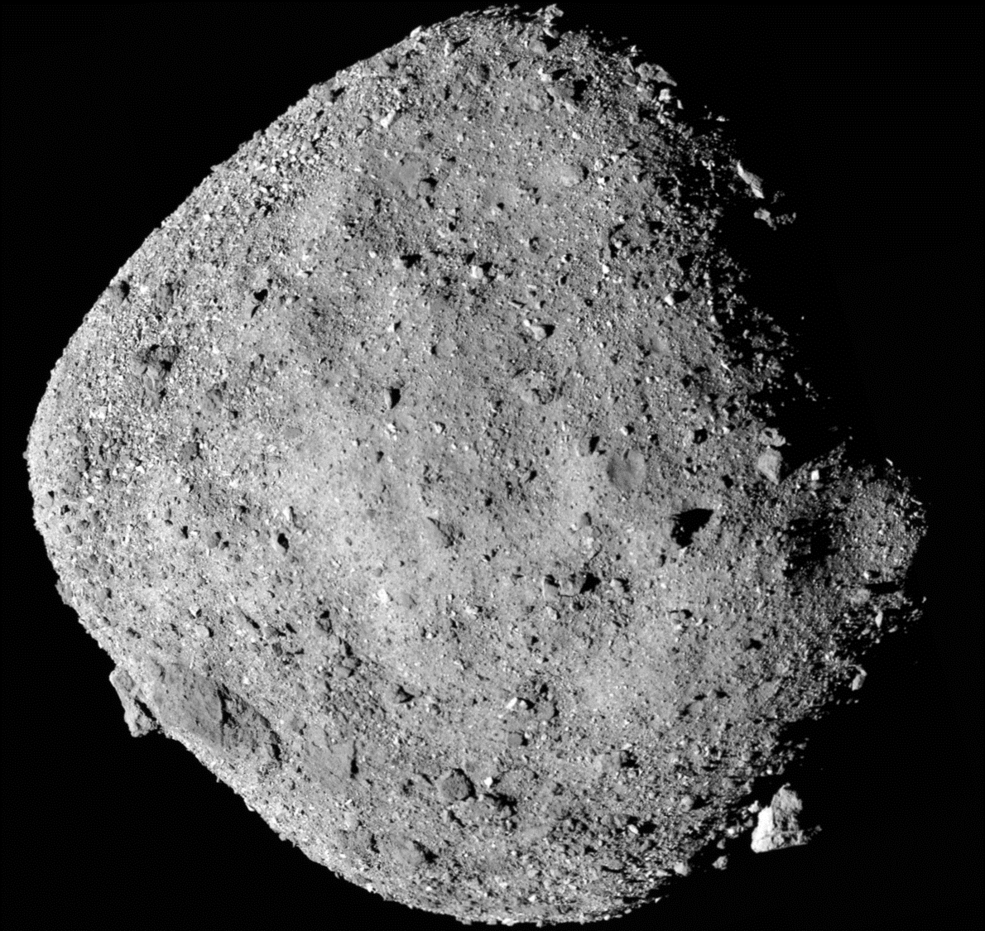
Image (Credit): Mosaic image of asteroid Bennu composed of 12 PolyCam images collected on Dec. 2, 2018 by the OSIRIS-REx spacecraft from a range of 15 miles. (NASA/Goddard/University of Arizona)

Back in 2020, NASA’s OSIRIS-REx spacecraft collected samples from asteroid Bennu, named after the ancient Egyptian mythological bird associated with the Sun, creation, and rebirth. These samples are scheduled to return to Earth until next year, but in the meantime there is already a lot that NASA knows about this asteroid. Some of the key points are listed below:

  • Bennu is over 4.5 billion years old.
  • Bennu is a “rubble-pile” asteroid, meaning it is rocky debris compressed by gravity.
  • Bennu is likely to be rich in platinum and gold compared to the average crust on Earth.
  • Between the years 2175 and 2199, the chance that Bennu will impact Earth is only 1-in-2,700.

You can tour the surface of Bennu by viewing a video produced by NASA’s Goddard Space Flight Center in Greenbelt, Maryland. Titled “Tour of Asteroid Bennu,” the film was featured in the SIGGRAPH Computer Animation Festival Electronic Theater. While it did not win any awards, it was still a great opportunity to share the mission with a wider audience.

Missions to planets and moons tend to get most of the attention, but asteroids can reveal plenty about the origins of our solar system. You can learn more about the OSIRIS-REx mission to Bennu here.

Video: The Problem With “The Rare Earth Hypothesis”

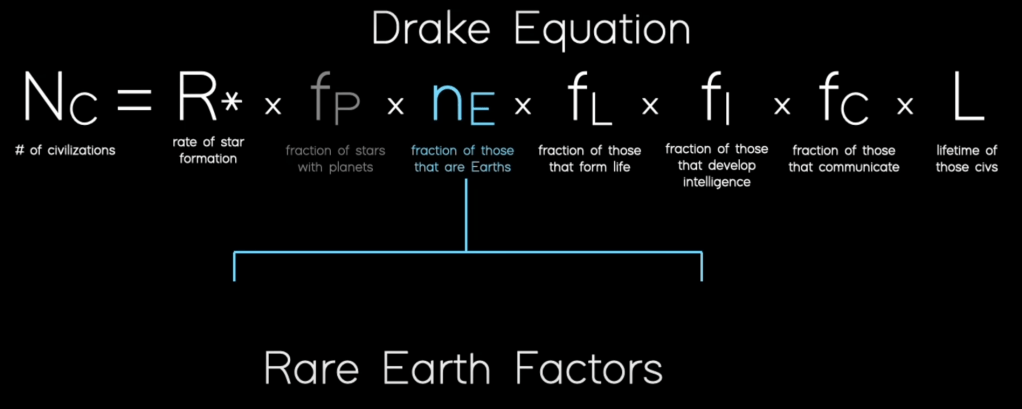
Image (Credit): Upgraded Drake Equation to account for the Rare Earth factors. (Cool Worlds Lab)

Cool Worlds Lab has another great video out, this time discussing the Rare Earth Hypothesis. This hypothesis assumes that a multitude of factors are necessary for life to develop in the universe, and the program goes deeper into a few of these factors, including the need for:

  1. A magnetosphere;
  2. Plate tectonics;
  3. A large moon;
  4. Impacts from asteroids and comets; and
  5. A Jupiter-sized planet.

The program challenges some of these factors and also highlights the need for a more open understanding of the origins of life beyond our current understanding. Basically, the conditional probably of the Drake Equation or even the modified Drake Equation unnecessarily leads one down a very narrow path.

It’s an eye-opening review of the evidence and worth watching. Check it out.

In Case You Missed It: The Vatican’s Space Observatory

Source/Credit: The telescope domes on the roof of the Vatican Observatory, at the Apostolic Palace in Castel Gandolfo from Andreas Solaro/AFP via Getty Images.

Just in case you missed it, I recommend you read NPR’s June 2021 article, “The Vatican’s Space Observatory Wants To See Stars And Faith Align.” You can read about the interplay of astronomy and the Catholic Church. For instance, did you know the idea of the Big Bang originated with a Belgian priest? Or that the Vatican Observatory coordinates with NASA on space issues?

You can learn more from the article. You might also want to visit the Vatican Observatory’s website or listen to one of the podcasts from the Observatory.

Click the image of Brother Guy Consolmagno for a video.