SpaceX Agrees to Work with Scientists to Reduce Impact of its Satellites

Image (Credit): Artist’s rendering of a Starlink satellite in orbit. (SpaceX)

Earlier this month, the National Science Foundation (NSF) and SpaceX came to an agreement to “mitigate potential interference” from its Starlink satellites. These satellites have been impacting ground-based radio, optical, and infrared astronomy facilities.

Basically, SpaceX agreed to continue working on recommendations and best practices from the scientific community, ensure the second generation of Starlink satellites are darker and less intrusive in the night sky, continue to assist with studies on the satellites impact on astronomy facilities, and improve overall coordination with these scientific facilities.

It is a tall order, but any company pumping thousands of satellites into the night sky should have some responsibilities to others using that same sky. SpaceX is just the first of many companies with big plans for the night sky, so maybe this will set a precedent for the satellites that follow, or at least the U.S. satellites. I am note sure we can do anything about the Chinese and others, but the United Nations cans certainly create similar standards at the international level.

In the agreement, the NSF stated:

NSF and SpaceX have collaborated from the beginning on how best to meet the goals of protecting astronomy while also providing maximum internet access for communities across the United States. The mitigation steps taken can and should serve as a model for coordination among satellite operators and the astronomy community within the United States and beyond.

Let’s hope the NSF is right.

Fortified Rockets? Ask the Pentagon

Image (Credit): China’s KZ-11 transport launch system, which may be a model for an anti-satellite system. (Chinaspaceflight.com)

Earlier this month, The Wall Street Journal published an article, “Space Launches Should Withstand Chinese Challenge, Pentagon Mandate Says,” regarding new rocket requirements being developed by the US Department of Defense (DOD). It appears the Pentagon is worried about both the Russians and Chinese interfering with the launches of spy satellites. It doesn’t help to have an ongoing war in Ukraine where the Russians have already threatened US satellites. As a result, commercial rocket companies will need to meet some new specs on future missions.

DOD has already started the move to smaller satellites with dispersed missions to eliminate big space targets, which also allows for smaller companies to get into the game. More satellites launched from more locations (if not mobile locations) can assist the military with its missions whether it is facing errors or attacks. Even with some recent rocket mishaps, the story on the ground is positive as more companies join the industry while satellites get smaller and smaller.

This is not the space race the astronomy community wants to have, but the militarization of space is nothing new and is the primary reason we even started the space program. If the Blue Marble is not enough for us to understand the cost of war on the ground and in space, I am not sure what will work.

Update on Artemis III

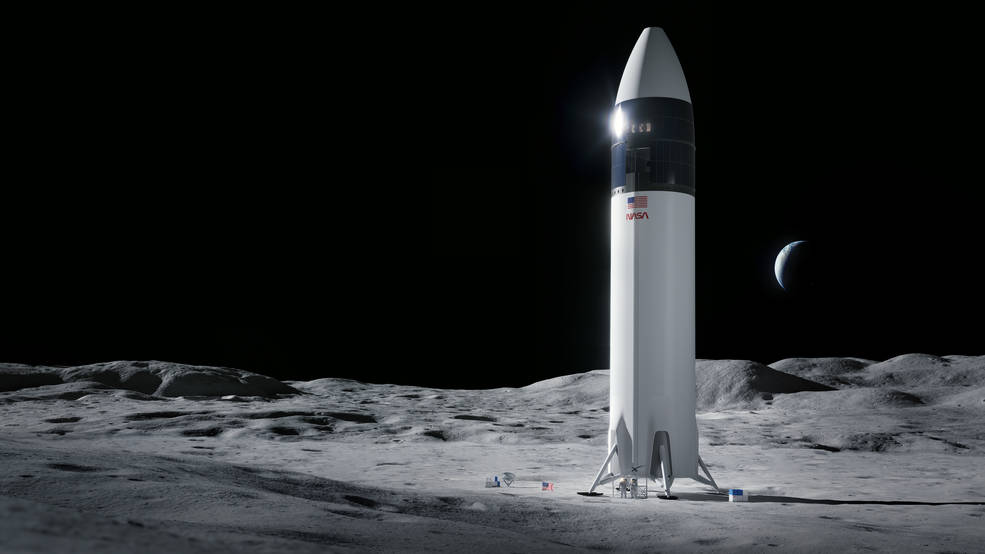
Image (Credit): Arstist’s rendering of SpaceX Starship human landing system design. (SpaceX)

The other week, NASA revealed an update on the Artemis III mission to the Moon in 2025. Now that Artemis I was a success and Artemis II is being readied, Artemis III is becoming much clearer on the horizon. The plan focuses on the first crew to land on the surface, noting that future missions will be involved in building the Gateway lunar space station.

While the Space Launch System (SLS) will get the crew into orbit on Orion, SpaceX has been chosen to bring this first crew to the moon. However, SpaceX will first need to test this human landing system on the Moon without a crew.

The landing site is likely to be on the Moon’s South Pole involving two astronauts who will take the SpaceX human landing system to the surface. They will conduct their research work in Axiom space suits.

It all may have become routine back in the 1970s, but NASA is demoing everything all over again to ensure new systems and new parties are up to par for this return to the Moon. The world is watching again, particularly China. We need to be perfect in this overdue first step back into human space travel.

You can view all of the parts of the mission in the graphic below.

Image (Credit): Artemis III mission map. (NASA)

Space Stories: The End of Geotail, a Galactic Map, and Sweden Gets a Spaceport

Image (Credit): An artist’s rendering of the Geotail spacecraft. (NASA)

Here are some recent stories of interest.

—NASA: “NASA’s Geotail Mission Operations Come to an End After 30 Years“

After 30 years in orbit, mission operations for the joint NASA-JAXA Geotail spacecraft have ended, after the failure of the spacecraft’s remaining data recorder. Since its launch on July 24, 1992, Geotail orbited Earth, gathering an immense dataset on the structure and dynamics of the magnetosphere, Earth’s protective magnetic bubble. Geotail was originally slated for a four-year run, but the mission was extended several times due to its high-quality data return, which contributed to over a thousand scientific publications. While one of Geotail’s two data recorders failed in 2012, the second continued to work until experiencing an anomaly on June 28, 2022. After attempts to remotely repair the recorder failed, the mission operations were ended on November 28, 2022.

—Phys.org: “Billions of Celestial Objects Revealed in Gargantuan Survey of the Milky Way“

Astronomers have released a gargantuan survey of the galactic plane of the Milky Way. The new dataset contains a staggering 3.32 billion celestial objects—arguably the largest such catalog so far. The data for this unprecedented survey were taken with the Dark Energy Camera, built by the US Department of Energy, at the NSF’s Cerro Tololo Inter-American Observatory in Chile, a Program of NOIRLab.

—Advanced Television: “Sweden Inaugurates Rocket Launch Site“

While much of the world’s press recently focused on Virgin Orbit’s failed ‘horizontal’ aircraft launch of a batch of 9 small satellites from Spaceport Cornwall, other rivals are gearing up to tap into the growing demand for satellite launches. Sweden has claimed the crown as “mainland Europe’s first orbital launch site”. Ursula von der Leyen, President of the European Commission, helped cut the ribbon at Kiruna, Sweden, saying: “This spaceport offers an independent European gateway to space. It is exactly the infrastructure we need, not only to continue to innovate but also to further explore the final frontier.”

Another Rocket Setback, This Time in Alaska

Credit: ABL Space Systems

Virgin orbit is not the only rocket company having a bad week. CNN reports that on Tuesday U.S. rocket company ABL Space Systems ran problems off the Alaska coast when its RS1 rocket shut down prematurely during its maiden launch. The rocket and the two satellites it was carrying were lost.

It was a bad week, but the space industry is growing and persistence will pay off. It is also important to have deep pockets to cover early failures. SpaceX and Blue Origin benefited from billionaire backers, and ABL is lucky to have Lockheed Martin in its corner. With an initial order of 58 rocket launches, Lockheed Martin has every reason to encourage continued progress.

Update: As of earlier today, ABL Space Systems has not issued a press release on the Alaska incident, but in a Tweet the company stated:

As expected in this scenario, there is damage to the launch facility. All personnel are safe, and fires have subsided. We’ll plan our return to flight after investigations are complete. Thanks to our stakeholders and the space community for the expressions of support.

The Pacific Spaceport Complex – Alaska, earlier called the Kodiak Launch Complex, is a dual-use (commercial/government) facility owned and operated by the Alaska Aerospace Corporation, which is a public corporation of the State of Alaska. Opened in 1998, the spaceport complex is located on Kodiak Island in Alaska.