Virgin Orbit Experiences a Setback

Image (Credit): Virgin Orbit 747 carrying a LauncherOne rocket. (Virgin Orbit)

It was supposed to be the beginning of rocket launches from the England, but we will have to wait a little longer. While Virgin Orbit’s Cosmic Girl, the 747 carrying the LauncherOne rocket, successfully left Spaceport Cornwall, the launch itself from the belly of the plane did not go as planned. Both the rocket and payload were lost.

Virgin Orbit’s CEO, Dan Hart, made this statement:

While we are very proud of the many things that we successfully achieved as part of this mission, we are mindful that we failed to provide our customers with the launch service they deserve. The first-time nature of this mission added layers of complexity that our team professionally managed through; however, in the end a technical failure appears to have prevented us from delivering the final orbit. We will work tirelessly to understand the nature of the failure, make corrective actions, and return to orbit as soon as we have completed a full investigation and mission assurance process.

Here is the list of items lost in yesterday’s “Start Me Up” mission:

  • IOD-3 AMBER (aka IOD-3) – Developed by Satellite Applications Catapult (“SA Catapult”) and Horizon Technologies and built by AAC Clyde Space, all based in the U.K. IOD-3 Amber is expected to be the first of more than 20 Amber satellites to provide space-based Maritime Domain Awareness (MDA) data to users. 
  • Prometheus-2 – Two cubesats owned by the U.K. Ministry of Defense’s (MOD) Defense Science & Technology Laboratory Dstl. These satellites, co-funded with Airbus Defence and Space who are designing them jointly with In-Space Missions, will support MOD science and technology (S&T) activities both in orbit and on the ground through the development of ground systems focused at Dstl’s site near Portsmouth. 
  • CIRCE (Coordinated Ionospheric Reconstruction CubeSat Experiment) – CIRCE is part of a joint mission between the U.K.’s Defense Science and Technology Laboratory and the U.S. Naval Research Laboratory (NRL).   
  • DOVER – Developed by RHEA Group in the UK, it is the company’s first satellite in its 30-year history. The satellite is being co-funded through the European Space Agency’s (ESA) Navigation Program (NAVISP) and built by Open Cosmos of the United Kingdom. DOVER is a SmallSat that was created as a pathfinder for resilient global navigation satellite systems.   
  • ForgeStar-0 – Developed by Space Forge of Wales, the satellite is a fully returnable and reusable platform to enable in-space manufacturing. This launch will be the first for the company’s ForgeStar platform and will test future returns from space technology.     
  • AMAN – Oman’s first orbital mission, it is a single earth observation satellite meant to demonstrate the future feasibility of a larger constellation and was developed after a memorandum of understanding among the Sultanate of Oman, Polish Small Satellite manufacturer and operator SatRev, Poland-originated AI data analytics specialists TUATARA, and Omani-based merging technology innovator ETCO. The agreement includes additional planned small satellites, including this, the first in Oman’s history.
  • STORK-6 – Stork-6 is the next installment of Polish Small Satellite manufacturer and operator SatRev’s STORK constellation. Virgin Orbit previously launched two spacecraft in this constellation on a previous launch and looks forward to continuing to launch SatRev’s STORK spacecraft in the future.

Virgin Orbit had four consecutive launch successes until this latest mishap. An investigation will be necessary to review what happened.
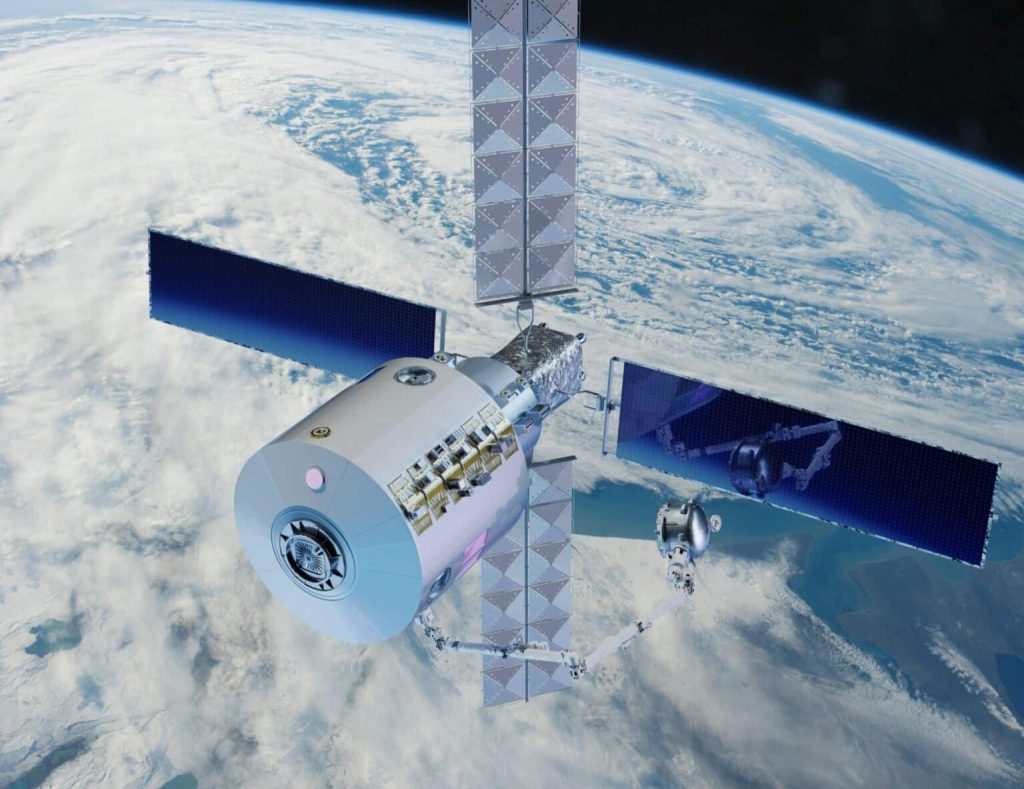
Space Quote: Starlab to Replace the ISS

Image (Credit): Image of Starlab from the Voyager Space website. (Voyager Space)

“This partnership with Voyager Space is the first step toward fielding the next generation of space stations to serve international astronauts. We are excited to support a project aimed at changing history…This collaboration is an important step in making Starlab a reality, providing a foundation for long-lasting European and American leadership in space. Our team is looking forward to diving in on the technology and putting our best engineers to work.”

-Statement by Jean-Marc Nasr, Executive Vice President of Space Systems at Airbus Defence and Space, in a press release regarding Voyager Space and Airbus Defence and Space partnering to develop and operate Starlab in 2028. The Low-Earth Orbit space station will serve NASA, ESA, and others in the scientific community following the retirement of the International Space Station. NASA has already awarded $160 million to Voyager and Nanoracks, its operating company, to create the new space station.

Top Astronomy Stories in 2022

Image (Credit): The stellar nursery 30 Doradus, nickname of the Tarantula Nebula, captured by the James Webb Space Telescope. (webb.nasa.gov)

Given that 2022 was a busy year, I thought I would highlight the top astronomy stories on the site – the good and the bad covering space missions to TV shows. Unlike other websites, I waited until the new year to create the list just in case we were visited by extraterrestrials. In this way, we now have a full catalog of the 2022 happenings.

Here is the list in no particular order other than science first, politics and commercial space second, and entertainment third.

  1. James Webb Space Telescope begins operation – see site link here;
  2. Double Asteroid Redirection Test (DART) successfully shifts the course of an asteroid pair – see site link here;
  3. Artemis I Orion capsule successfully orbits the Moon – see site link here;
  4. Commercial satellites become an increasing threat to Earth-based telescopes – see site link here;
  5. China completes its first space station – see site link here;
  6. Boeing is closer to being the second U.S. company to send astronauts to the International Space Station – see site link here;
  7. Ukraine invasion derails the Russian space program – see site link here;
  8. Russia reconfirms support for International Space Station – see site link here;
  9. Star Trek gets it right by returning to the past with Strange New Worlds – see site link here; and
  10. Star Wars gets it right with its new Andor series. – see site link here.

I cannot wait to see what 2023 will bring.

Space Quote: Is Opaque SpaceX the Only Game in Town?

Image (Credit): SpaceX’s mission control room located in Hawthorne, California. (SpaceX)

“Nobody really knows anything about the financials of SpaceX…No balance sheet or financial report is available. We have a very large company of 10,000 people — a main contractor to NASA and the Defense Department — and there is absolutely no information available on its financial health.”

-Statement by Pierre Lionnet, the research and managing director of Eurospace, regarding the situation at SpaceX in a December 29, 2022 New York Times article, “31 Hours Inside SpaceX Mission Control.” Overall, it was a very positive article about the situation on the ground at SpaceX, but maybe it is time to push even harder for greater redundancy in the U.S. space program. Mr. Musk’s troubles at Twitter have already spilled over into Tesla. Will SpaceX be next? One of the people interviewed for the article noted that SpaceX is the “only game in town.” We already had this rocket dependency with the Russians, and look where we would have been if we did not expanded into the commercial sector. I think even greater expansion would be advantageous as Mr. Musk continues to spin out of control.

Rocket Lab’s Electron Launches from MARS

Image (Credit): The Electron rocket on the launchpad. (Rocket Lab)

Rocket Lab has big plans for the Mid-Atlantic Regional Spaceport (MARS) where tomorrow it will launch the first of its U.S. based Electron rockets. The December 18th mission from the Virginia spaceport will depart from NASA’s Wallops Flight Facility. While Rocket Lab has been launching the Electron from New Zealand, it is starting up operations in Virginia and may become a big presence on the mid-atlantic coast.

The Electron, a 60-foot rocket, is intended for short turnaround of smaller loads. This sounds ideal to the customer base for satellites in Washington, DC just up the road. If all goes well, the larger Neutron rocket will also be launched from MARS in the near future. Ultimately, the VA facility may host monthly Rocket Lab launches.

In an earlier press release, Rocket Lab noted its going potential with both Launch Complex 1 in New Zealand and the new Launch Complex 2 in Virginia:

While “Virginia Is For Launch Lovers” will be Electron’s first launch from the U.S., Rocket Lab has already conducted 32 Electron missions from Launch Complex 1 in New Zealand, delivering 152 satellites to orbit for customers including NASA, the National Reconnaissance Office, DARPA, the U.S. Space Force and a range of commercial constellation operators. Electron is already the most frequently launched small orbital rocket globally and now with the capacity of the pads at Launch Complex 1 and 2 combined, Rocket Lab has more than 130 Electron launch opportunities every year. 

Tomorrow’s launch will be an important test of the company’s new approach. If all goes well, it is good news for the Virginia economy as well as the U.S. commercial space industry.

Update: The launch has been delayed due to weather until Monday, December 19th.

Second Update: The Monday launch was delayed again due to weather. Stay tuned for a new launch date.