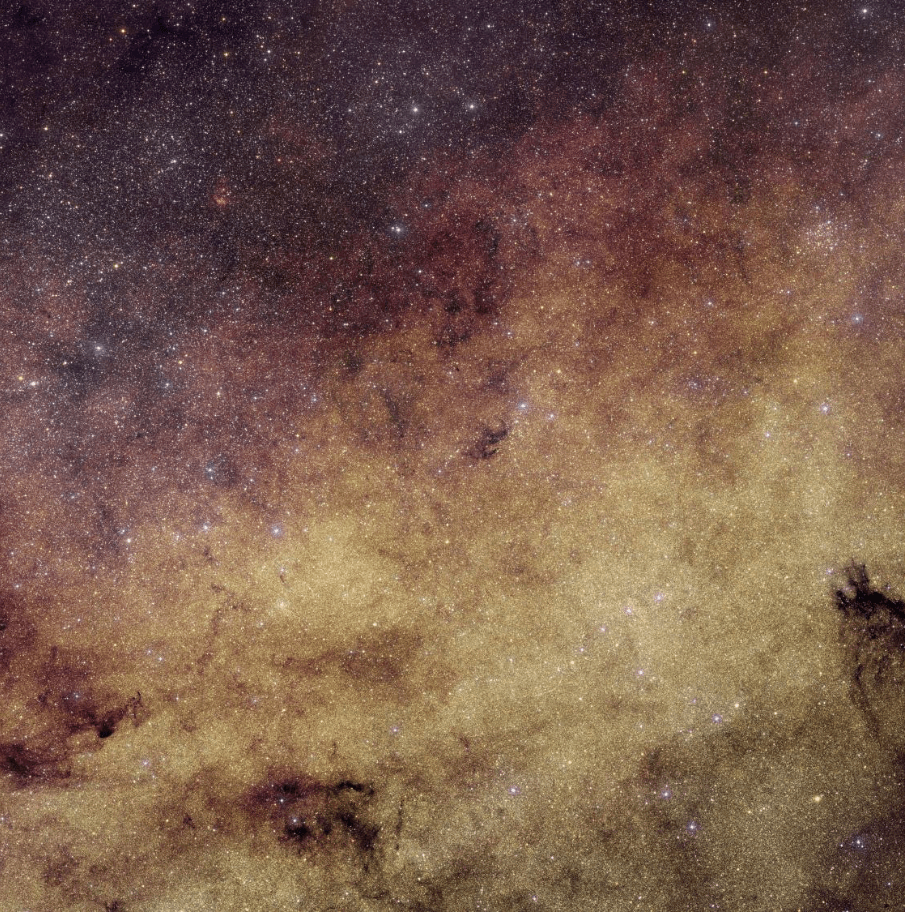
This week’s image is from the European Space Agency’s (ESA) Euclid space telescope. It shows the center of the Milky Way Galaxy with its more than 60 million stars.
Here is more from ESA pertaining to what you are seeing above:
The galactic bulge – the central region of our galaxy – is a vast, tightly packed structure filled mainly with old, cooler stars, giving it its characteristic yellow colour. Seen from some 26 000 light-years away, Euclid observes the galaxy’s centre through a complex foreground of material along its line of sight.
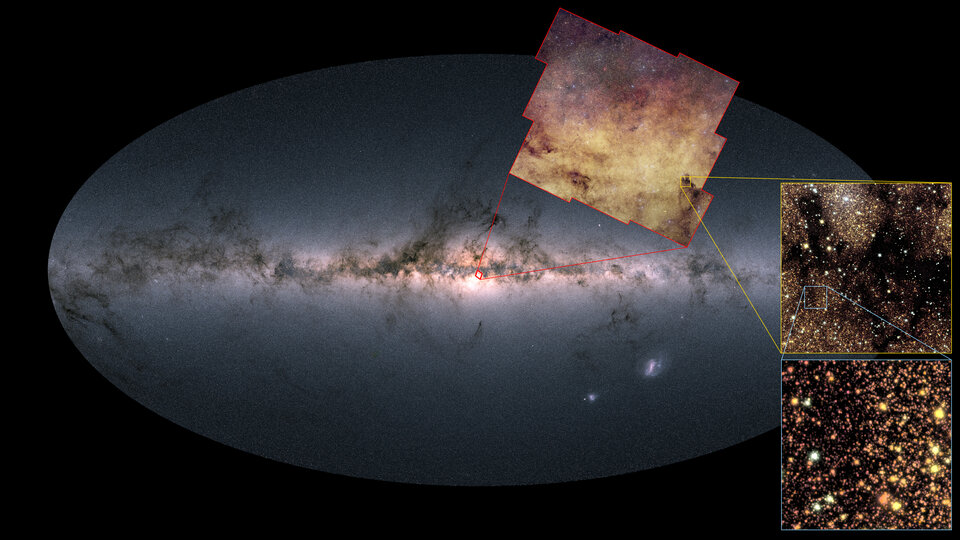
This ultra-wide view towards the bulge reveals not only stars, but also seemingly empty dark regions. The dark patches are not devoid of stars: they mark dense, dust-rich molecular clouds that absorb and scatter light from the bulge behind them. As Euclid looks through two of the Milky Way’s spiral arms, it also encounters regions of active star formation, traced by newly formed, massive blue stars. Their intense ultraviolet radiation ionises surrounding hydrogen gas, producing the faint red glow clearly visible in one of the cutouts.
The image below provides more context about the location of the image shown above. Go to this link for more information on the Euclid’s survey.